
The Air Force wants a cannon to shoot down drones

Source: Task & Purpose
Loading...Strong SignalCredibility: 81%
Report Content
The Air Force is looking for a “ground-based, medium-caliber gun weapon system” to defend air bases from small drones, big drones, and subsonic cruise missiles.
This Ground-Based Air Defense, or GBAD, mission is typically handled by the Army. That setup works well when sprawling bases are the standard, and the threats from the air are more predictable and not coming in swarms.
But the proliferation of cheap, capable, and accurate drones, combined with traditional munitions like ballistic missiles, is forcing every military branch to rethink air defense. Just look at the war in Iran, where costly U.S. aircraft are being hit on the ground by Iranian drone and missile strikes, and the military is quickly running out of high-end Patriot interceptors to fend them off.
On Sept. 3, the Air Force posted a Request for Information, or RFI, seeking a new ground-based, medium-caliber gun weapon system. An RFI is more about conducting market research than putting real weapons in operators’ hands, but it shows what kind of weapons the Air Force is looking for.
Three of the requirements are magazine depth, cost per engagement, and raid handling. In plain English, that means the Air Force wants something that can fire more than a handful of interceptors before needing a complicated reload, and they don’t want to spend several times what the target costs with each shot. It also must be able to defeat a swarm of threats, but exactly how big of a swarm the Air Force wants GBAD to defeat is not public.
Another requirement is salvo probability of kill versus cruise missiles and Group 1 to 5 drones, which means the system has to have a high chance of shooting down small drones, big drones, and cruise missiles in a single salvo. A “salvo” in this case could mean the weapon is multi-barreled, or it’s a single-barrel system designed to fire multiple rounds at each target.
The last big requirement is “rapidly deployable,” which means the Air Force wants to be able to pack up GBAD and move quickly. The backdrop here is that the Air Force has been training to use distributed airfields on highways and other austere locations. It is a great strategy to make targeting harder and not be completely reliant on permanent and obvious airfields. Because airmen here would have to move quickly, their defenses have to move with them.
There are always trade-offs. For example, if the GBAD has higher-end munitions or advanced sensors, it may be more expensive and difficult to move around. This means multiple systems will likely be needed to defend an area and cover those blind spots.
The Air Force seems to hint at this in the RFI, where it calls for a “lightweight, modular, and transportable footprint that can be swiftly projected into austere theater environments.” Modularity could let airmen swap out parts of the system so it can handle different threats.
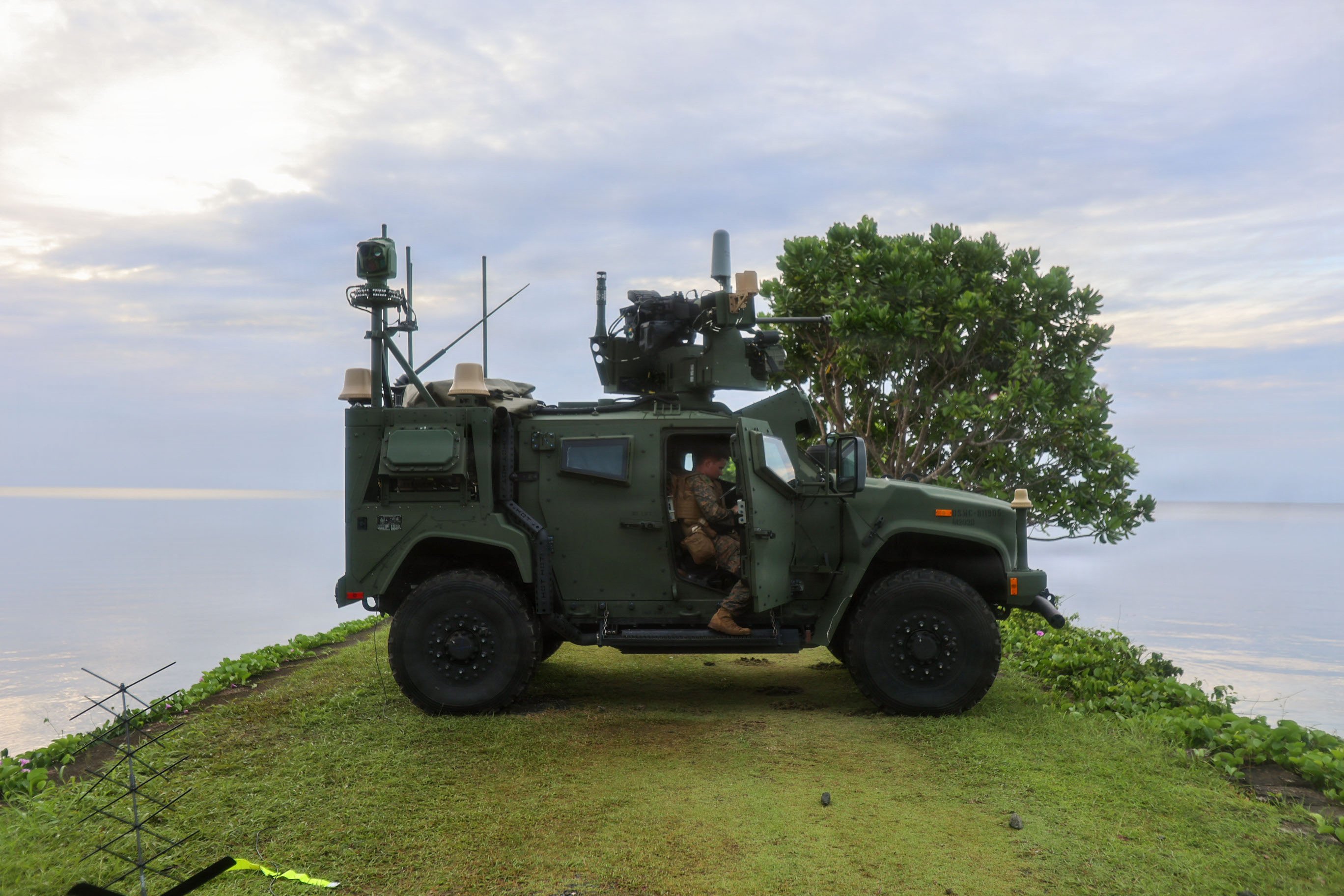 Marines prepare a Marine Air Defense Integrated System for live-fire in Koror, Palau, July 29, 2026. Marine Corps photo by Cpl. Ryan Sotodavila.
We can only guess what this might look like. Maybe it will be a 30mm cannon fixed to a joint light tactical vehicle like the Marine Corps’ Marine Air Defense Integrated System. Or maybe it will be a shipping container that pops out a cannon and some sensors, similar to how the GRIZZLY system works with air-to-ground missiles. Rheinmetall has a rendering of its Skyranger 35 turret on a pallet, which also makes sense.
The reason all these other systems exist is that the other services are in a similar boat. Marines are getting anti-drone 5.56 rifle rounds, the Army is testing small soldier-worn jammers, and the Navy is firing Hellfires at drones. Everyone is trying to operate with a smaller footprint, but they still need to defend themselves.
No matter what, this will exist in a layered defense. This isn’t the Air Force’s first foray into GBAD. They are also buying or developing several other counter-drone systems like the THOR and Mjolnir microwave weapons, and the X-MADIS, which uses electronic warfare, and several other systems. But this would add a dedicated medium-caliber cannon missing from the layers.
The Air Force has not selected a gun, a caliber, or even committed to buying one. But the RFI shows how much the air-base problem has changed: the service now wants an affordable, deep-magazine defense that can move with dispersed aircraft instead of waiting for scarce Army systems to arrive. If a request-for-proposal follows, the caliber and form factor will tell us exactly how they envision carrying out this mission.
We go into what the Air Force wants from the defense industry, why sprawling and increasingly dispersed air bases need new defenses, and how this cannon could fit alongside other systems in our most recent YouTube video, which you can check out here.
The post The Air Force wants a cannon to shoot down drones appeared first on Task & Purpose.
Classification
Region
North America
Analytical Domain
Operational
Primary Category / Secondary Categories
Weapons & Equipment / Military Operations
Subcategory
New Weapon System
SALUTE Report
Size
Not specified
Activity
The Air Force is seeking a ground-based, medium-caliber gun weapon system to defend against drones and cruise missiles.
Location
United States
Unit
United States Air Force
Time
September 3
Equipment
ground-based medium-caliber gun weapon systemdronescruise missiles
Summary
The U.S. Air Force is seeking a ground-based, medium-caliber gun weapon system to defend against drones and cruise missiles as of September 3. This initiative aims to enhance air base defenses in response to the increasing threat from inexpensive and effective drone technology. The system must be rapidly deployable and capable of engaging multiple threats simultaneously, reflecting a significant shift in air defense strategy.
Key Facts
- The Air Force is looking for a medium-caliber gun system to defend against drones and missiles.
- The system must have a high salvo probability of kill against various drone sizes and cruise missiles.
- Requirements include magazine depth, cost per engagement, and rapid deployability.
- The Air Force is adapting to threats from cheap and accurate drones and missile strikes.
- This initiative reflects a shift in air defense strategy to protect dispersed air bases.