
The Navy's New Type of Terminal Air Defense Missile System Appears, Command Screen Fully Mosaic Interpretation Has Arrived!
The naval training unit recently successfully completed the final testing task of a new type of terminal air defense missile system in a certain area of the Bohai Sea, providing solid data support for the enhancement of the weapon system's combat capabilities.
What is a terminal air defense missile system? How far is it from being deployed to the troops?
The final testing is a key link in the development process of weaponry and equipment. A slight error in the final testing could lead to significant failures on the future battlefield. The completion of the final testing means that the development work of this type of weaponry is basically finished. Military commentator Song Xiaojun stated that the completion of the final testing indicates that deployment is not far off.
Song Xiaojun: After this weapon completes testing, it can basically be deployed on our country's relevant weapon platforms, such as frigates, destroyers, and even aircraft carriers may potentially be equipped with it.
Why is the command screen completely pixelated?
In the television report, the command screens in front of the naval officers and soldiers were all pixelated, attracting widespread attention online. Military commentator Li Yaqiang explained that this is to prevent the leakage of military secrets, as malicious individuals could deduce the entire combat method of the weapon system from just a few values.
Li Yaqiang: Because various technical data will be displayed on it, and it can be seen through the screen, understanding the specific technical performance of this weaponry. This equipment is a large system with various auxiliary equipment or various related devices. By glancing at the screen, one can roughly know how many systems are related and to what extent.
What does terminal air defense missile mean? What kind of tasks does it undertake in combat?
Song Xiaojun: The air defense missile systems of the navy's surface vessels are divided into area air defense and point defense, with the latter further divided into forward and terminal defense. Terminal defense is about intercepting incoming targets when they are close to the vessel. If one tries to evade or use other methods to avoid, it may cause a lot of unnecessary losses.
What kind of equipment is a terminal air defense missile? Military commentator Li Yaqiang said that such a weapon system includes multiple pieces of equipment, each with its own division of labor, but they must also work together.
Li Yaqiang: First, there must be detection equipment, and there should also be corresponding guidance radars. Short-range air defense missiles are essential, and the next step is close-in guns. Each has its own purpose and different mission tasks. In short, they all revolve around preventing enemy missiles from hitting us, or even being able to shoot down incoming enemy missiles. Therefore, the development of this weapon system will not be a single weapon; it is complex because it must fully consider the entire electromagnetic compatibility, including how all electronic devices can integrate into an organic whole on the vessel.
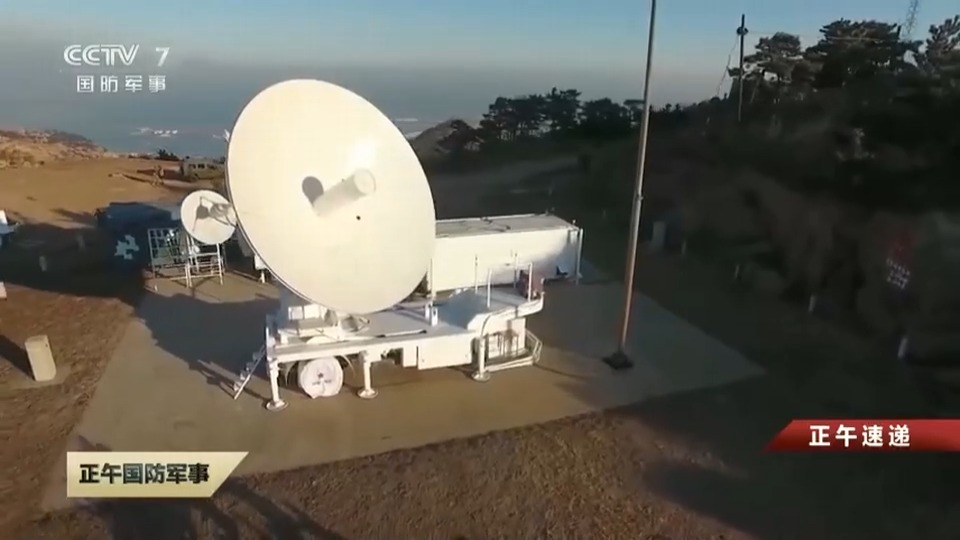
Li Yaqiang also stated that this weapon system is a complex and large system, with interlocking components to ensure absolute reliability.
Li Yaqiang: Under what circumstances, using what weapons, and how to transition, if any step is not completed, how to transition to the next step of defense? The entire system engineering is quite difficult and complex; it is not just about being responsible for launching the countermeasure missile. What if the countermeasure missile fails? Then we need to switch to air defense missiles to intercept. Did we shoot down the incoming missile? If not, then the next step is to use the close-in gun. It must form a complete system; this is the missile defense system.
How to effectively simulate a strong enemy's attack scenario?
In this final testing task, multiple unmanned target aircraft simulated a realistic strong enemy attack scenario with high-difficulty tactical maneuvers such as flying at ultra-low altitudes and stealthy penetration. Military commentator Song Xiaojun said this was to simulate the combat environment of small targets and hypersonic missiles attacking.
Song Xiaojun: Small targets are divided into two types: one is hypersonic missiles, and there is a type of anti-ship missile that is very fast, even flying at low altitudes. You must quickly capture it and then intercept it. The second type is drones, which generally use a swarm approach, targeting multiple objectives. If decoys are deployed, some real targets will be filtered out, and then relevant weapon platforms will be locked onto them for interception. Especially, intercepting such low, slow, small targets is very troublesome. This is also a very important gap-filling aspect of current naval operations.
Song Xiaojun further pointed out that from the perspective of the "asymmetric" combat advantages of drones, the terminal defense system is extremely important.
Song Xiaojun: The so-called asymmetric advantage means that the opponent's cost is very low, which can consume high-cost interceptors. However, if there is a terminal interception system that is roughly equal in cost to the opponent, it can offset the opponent's asymmetric warfare. Relatively speaking, the development of such a weapon is urgently needed; it can be said to be a weapon that eliminates the opponent's asymmetric advantage under conditions of cost parity.
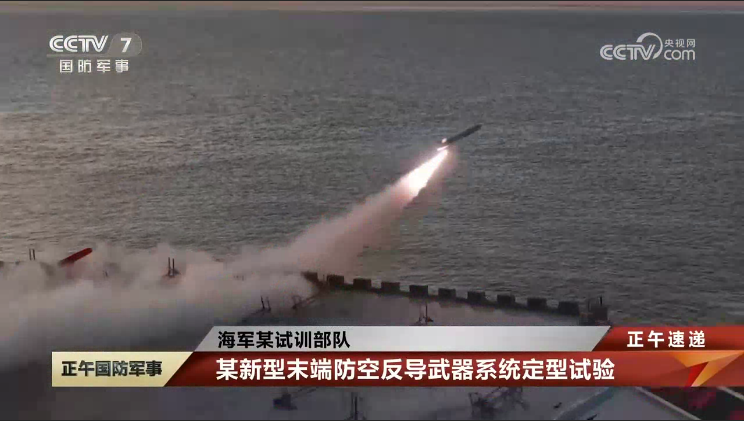
In addition to simulating ultra-low altitude penetration conditions, this test also set up a complex electromagnetic environment.
Li Yaqiang: Electronic interference can be said to be commonly used in actual combat, even a type of combat style. How to effectively overcome these interferences is a problem that our current weaponry must solve. Therefore, this complex environment also indicates that our technology in this area is already quite mature and is about to be successfully applied to our weaponry.
How important is the terminal air defense missile system?
The successful final testing of this new type of terminal air defense missile system not only enhances our military defense capabilities but also showcases the rapid development of China's military technology. Li Yaqiang stated that the development of new equipment is crucial for our navy's overall defense system and operations in both nearshore and offshore areas.
Li Yaqiang: The combination of offense and defense has always been a relationship that we must resolve in military affairs. When the entire offensive weaponry develops, defensive weaponry must also develop accordingly. What I can defend against now, I must still be able to defend against in the future. Even if I cannot defend against what exists now, I must retain certain interfaces and leave room for expansion. If you develop, I will also develop; after development, it must be compatible with existing equipment, and with slight improvements, it can respond to future new situations. What is new about the weapon? It is new in these aspects.
Reporter丨Yang Kai, Wang Dongyu
Video丨Lian Jinliang
The Naval Training Unit successfully completed the final test of a new terminal air defense missile system in the Bohai Sea. This system is anticipated to be integrated into naval platforms such as frigates and destroyers. The test simulated attacks from drones and hypersonic missiles, demonstrating the system's capability to counter asymmetric threats and enhance China's military defense capabilities.
- A new terminal air defense missile system has successfully completed its final test in the Bohai Sea.
- The system is expected to be integrated into various naval platforms including frigates and destroyers.
- The testing involved simulating attacks from drones and hypersonic missiles.
- The system is designed to counter asymmetric threats effectively.
- The successful test enhances China's military defense capabilities.