
The second American electromagnetic aircraft carrier completes its first sea trial.
The U.S. Navy's "Ford" class aircraft carrier "John F. Kennedy" recently completed its first week-long sea trial and has returned to the shipyard in Virginia. The carrier is expected to be delivered to the U.S. Navy early next year.
Performance Leap
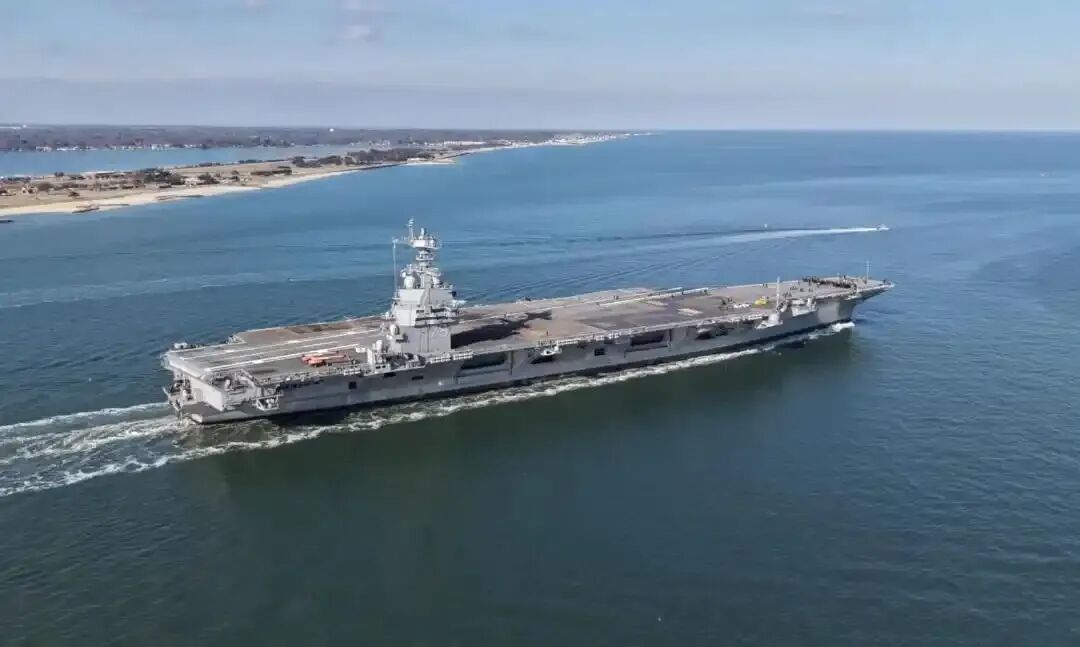
File photo: U.S. aircraft carrier "John F. Kennedy" departs for sea trials (Source: Reference News)
As a new generation of nuclear-powered aircraft carriers for the U.S. Navy, what improvements does the "Ford" class have compared to the "Nimitz" class? Military observer Cui Yiliang analyzed this.
Cui Yiliang:
The "Ford" class aircraft carrier adopts a completely new overall design, with comprehensive upgrades in nuclear power systems, flight deck layout, as well as the catapult and arrestor recovery systems. The electromagnetic catapult system equipped on the "Ford" class is said to significantly enhance the sortie rate of carrier-based aircraft; a higher sortie rate means stronger attack capability. At the same time, the "Ford" class is equipped with upgraded dual reactors, which significantly enhance power generation capacity, providing ample power support for the electromagnetic catapult system.
Political Intervention
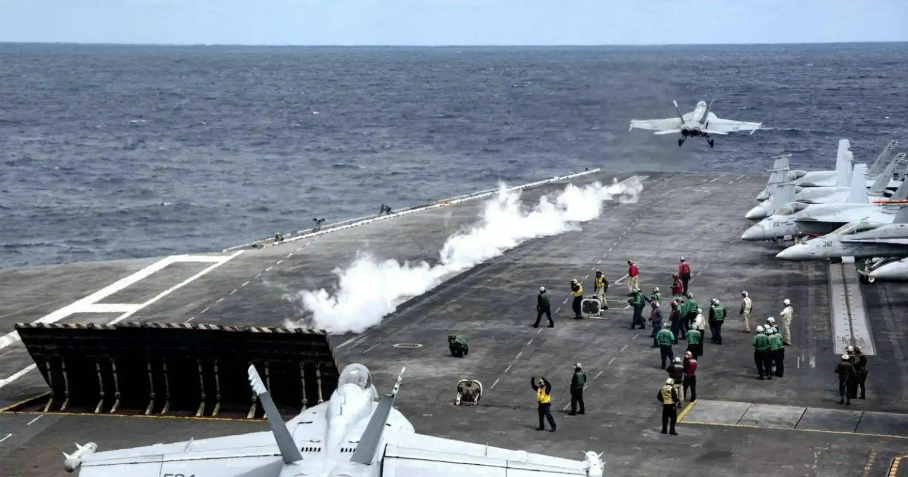
File photo: A steam catapult launching a carrier-based aircraft (Source: The Paper)
Although the lead ship of the U.S. "Ford" class nuclear-powered aircraft carriers, the "Gerald R. Ford," has been in service for many years, it still suffers from the instability of the electromagnetic catapult's performance. Therefore, U.S. President Trump announced last October that he would sign a presidential executive order requiring U.S. aircraft carriers to revert to using steam catapults. This technical regression for aircraft carriers immediately sparked a huge controversy.
In Cui Yiliang's view, if the U.S. Navy's future aircraft carriers really return to traditional steam-powered catapults, it will affect the combat capability generation of U.S. aircraft carriers.
Cui Yiliang:
Although the current maturity of the "Ford" class's electromagnetic catapult system is insufficient, this does not mean that its technological direction is wrong; it simply indicates that the technology is not yet mature. The most reasonable path should be to enhance the maturity of this system rather than abandon this technological route. If the order from Trump leads to a return to steam catapults, it will significantly impact the construction progress and combat capability generation of U.S. aircraft carriers.
Two-Ocean Layout
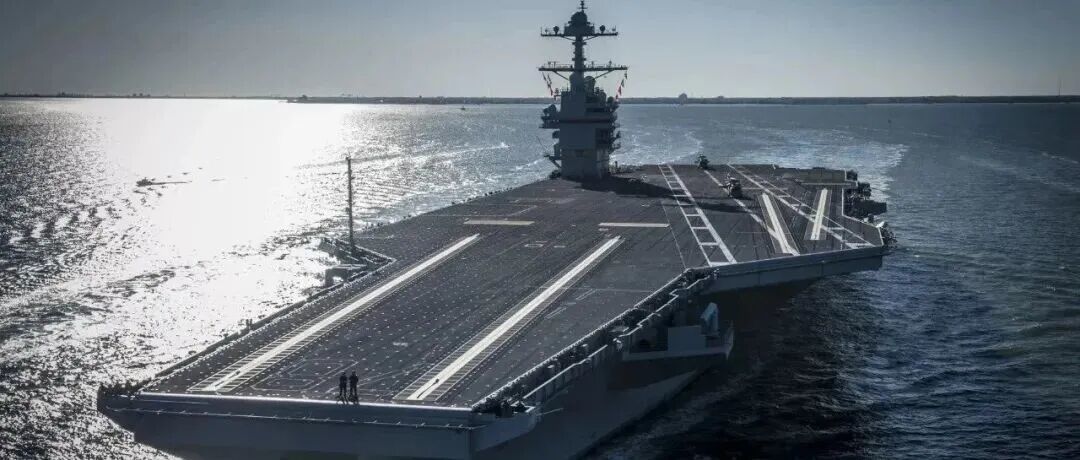
File photo: U.S. "Gerald R. Ford" aircraft carrier
It is understood that the home port of the "Gerald R. Ford" aircraft carrier is located at the Norfolk Naval Base in Virginia. After entering service, the "John F. Kennedy" aircraft carrier is expected to be stationed at the Kitsap Naval Base west of Seattle, thus the U.S. Navy will deploy one of its latest aircraft carriers on each coast of the United States.
Regarding the intentions behind this layout, Cui Yiliang provided the following analysis.
Cui Yiliang:
This is actually related to the U.S. "Two-Ocean Fleet" concept. The U.S. considers both the Atlantic and Pacific Oceans to be crucial, thus balancing the deployment of the latest aircraft carriers in both ocean directions. This move aims to ensure that the U.S. military can respond quickly in wartime to effectively intervene in regional situations.
Value Justification
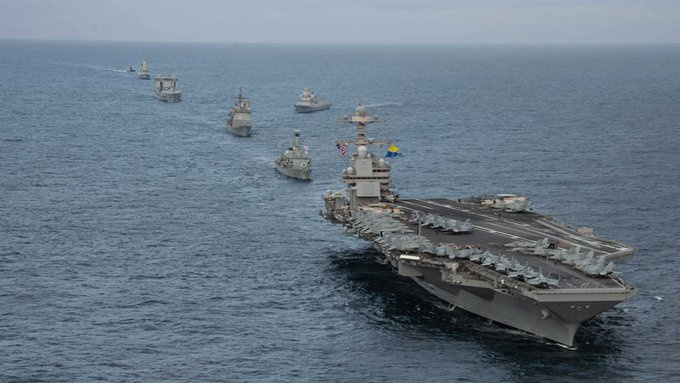
File photo: U.S. "Gerald R. Ford" carrier strike group
In modern warfare, with the accelerated application of artificial intelligence technology in the military field, the number of weapons that can threaten aircraft carriers is increasing, and the barriers to entry are gradually lowering. For example, anti-ship cruise missiles and suicide drones can pose threats to aircraft carriers. At the same time, the cost of large and medium-sized aircraft carriers is becoming increasingly high, and they require a strong and complete combat system for support. Therefore, in recent years, there has been a discourse promoting the so-called "carrier irrelevance theory."
Cui Yiliang believes that although technological development poses more threats to aircraft carriers, their unique role in power projection at sea cannot be replaced for the time being. The key to winning future naval battles will be systematic operations rather than relying on a single platform, so the value of aircraft carriers needs to be dynamically assessed in conjunction with new forms of warfare.
Cui Yiliang:
In recent years, with breakthroughs in technologies such as space-based sensors, unmanned equipment, and hypersonic weapons, the traditional dominance of aircraft carriers at sea has faced more severe challenges. But can we conclude that aircraft carriers are now "useless"? The answer is no. Aircraft carriers can provide many capabilities, especially when operating far from home, where they can exert the power of force projection, which is difficult to replace with other means.
How to respond to the new threats facing aircraft carriers? This needs to be considered from the perspective of operational concepts. In actual combat, aircraft carriers do not operate alone but will form task forces. Therefore, evaluating whether aircraft carriers are useful should be done comprehensively from the perspective of joint operational systems. Of course, we must face the reality that aircraft carriers are facing an increasing number of threats, which is an issue that any country must consider when developing aircraft carriers in the future.
Reporter: Yu Lan
USS John F. Kennedy (CVN-79) completed its first sea trial in Norfolk, Virginia, and is expected to be delivered to the U.S. Navy early next year. The Ford-class carrier features an advanced Electromagnetic Aircraft Launch System (EMALS), which aims to enhance aircraft launch capabilities. Concerns remain regarding the reliability of this new system compared to traditional steam catapults, and the Kennedy is anticipated to be stationed at a naval base on the West Coast after entering service.
- USS John F. Kennedy completed its first sea trial recently.
- The carrier is expected to be delivered to the U.S. Navy early next year.
- The Ford-class carriers feature an Electromagnetic Aircraft Launch System (EMALS).
- There are concerns about the reliability of the EMALS system compared to traditional steam catapults.
- The U.S. Navy plans to deploy the Kennedy on the West Coast after commissioning.