
The US Army's 2026 PrSM Push Finally Targets China's Fleet
 Marcus Chen
The US Army's 2026 PrSM Push Finally Targets China's Fleet
Five companies have been selected to prototype the U.S. Army's next long-range maritime-strike missile. That announcement, reported by USNI News on October 1, 2026, matters less because five prototypes will suddenly change the balance around Taiwan than because Washington is finally treating land-based anti-ship fire as a magazine problem, not a slogan.
The program is tied to the Precision Strike Missile (PrSM) family, fired from the M142 High Mobility Artillery Rocket System (HIMARS) and M270 Multiple Launch Rocket System. The baseline missile has a published range exceeding 400 kilometers, while the proposed Increment 4 is intended to push farther and improve the Army's ability to engage maritime targets. The key word is intended. A prototype competition is not a deployed weapon, and a range figure is not the same thing as a kill chain.
Five Prototypes Are a Signal, Not a Capability
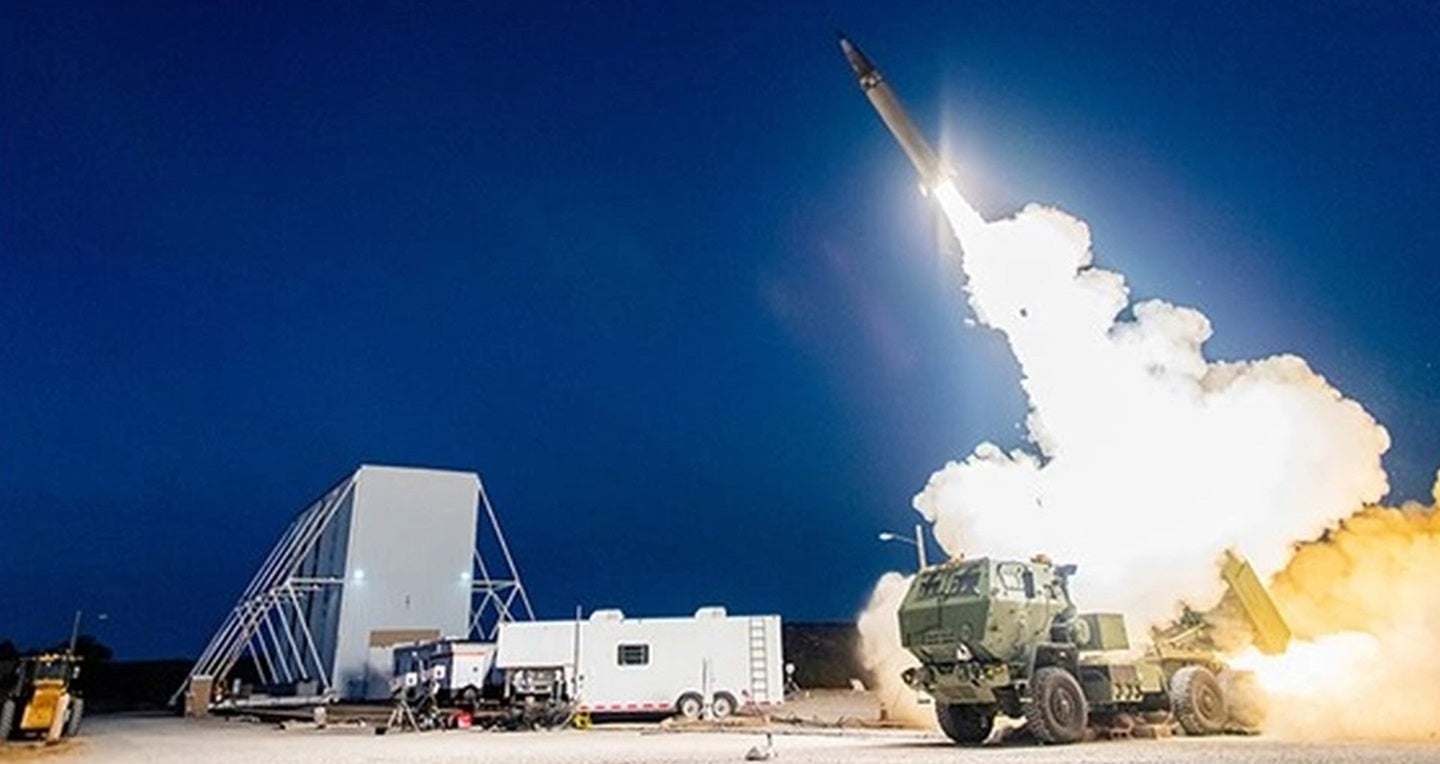
The Army's decision to fund five design teams creates competition at the point where the U.S. defense industrial base is weakest: affordable, producible missiles. It also gives the service options if one seeker, propulsion package, or production line fails. That is good acquisition practice. It is not yet a deterrent in the Western Pacific.
For the five prototypes to become useful in combat, the Army needs more than a missile that can fly a long distance. It needs a seeker that can find and discriminate a moving ship, targeting data that remains valid after launch, communications that survive jamming, and launchers that can relocate before Chinese surveillance finds them. The missile is only one part of the system. Anyone who has operated a surface combatant knows the uncomfortable truth: the weapon is often easier to count than the sensors and networks that make it lethal.
Why Land-Based Maritime Strike Fits the Indo-Pacific
China's naval advantage near its coast is built around geography. The People's Liberation Army Navy can operate from mainland bases, protected airfields, and a dense sensor network. U.S. and allied ships must enter the same battlespace through a small number of approaches. A distributed Army force armed with PrSM can complicate that geometry by placing launchers on islands, coastal positions, or allied territory without exposing a destroyer or carrier to every engagement.
That is the logic behind the Army's move toward maritime fires. A mobile launcher carrying two PrSMs can hide, fire, and move. A HIMARS battery is easier to disperse than a surface action group and cheaper to replace than a major combatant. If linked to aircraft, unmanned systems, and maritime patrol assets, several small units can create overlapping danger zones across the Luzon Strait, Philippine Sea approaches, or the first island chain.
But the geography cuts both ways. The most useful firing positions are also the most visible and politically sensitive. A missile unit in the Philippines requires access agreements, fuel, reloads, air defense, and a plan for surviving Chinese strikes. A launcher that cannot be resupplied after the first salvo is a one-day asset. The Army's procurement documents usually emphasize range. The operational question is how many missiles can be delivered, from how many locations, for how many days.
The Kill Chain Is Harder Than the Missile
Maritime targeting is a moving problem. A ship traveling at 20 knots can move more than 30 kilometers during a short targeting delay. In a contested electromagnetic environment, the initial position may be stale before the missile leaves the rail. Chinese electronic warfare, decoys, emissions control, and layered air defenses will all attack the chain between detection and impact.
This is where Increment 4 must prove its value. An extended-range missile with a credible maritime seeker could force Chinese ships to operate farther from the island chain. But the Army should not confuse a better terminal seeker with an independent targeting architecture. The missile still needs a scout, a track, a firing solution, and battle-damage assessment. If the United States buys thousands of rounds but cannot provide persistent sensing, it will have purchased expensive ammunition for a situationally blind force.
There is also a magazine question. A Chinese naval task group may present multiple ships, decoys, and escorts. The United States and its allies must be able to fire enough weapons to saturate defenses while retaining a reserve for the next day. Five competing prototypes can improve the design. They do not automatically solve the industrial math. The program will need a production rate that matches wartime expenditure, not a peacetime demonstration schedule.
What Washington Should Measure Next
- Range under operational conditions: the useful figure includes weather, maneuver, seeker performance, and realistic routing, not a clean test trajectory.
- Targeting resilience: the system must work with intermittent communications and incomplete tracks under Chinese jamming.
- Reload and movement: survivability depends on how quickly units can displace and replenish after firing.
- Alliance access: a missile stationed nowhere is a policy concept, not a combat capability.
- Production: the Army should publish credible annual output and stockpile objectives before calling the system a deterrent.
The Pentagon has spent years describing the Indo-Pacific as a theater that demands distributed fires. The PrSM maritime-strike competition is one of the few efforts that turns that phrase into a procurement decision. It could give the Army a meaningful role in sea denial and force Chinese planners to account for launchers that do not look like ships.
But the announcement is the start of the arithmetic. Until the missile, sensor network, basing agreements, reload pipeline, and production line exist together, the U.S. Army has a promising prototype program—not a fleet-killing force. China will not be deterred by five designs on a briefing slide. It will be deterred by survivable launchers with enough rounds, connected to enough sensors, ready to fire again tomorrow.
Sources
The U.S. Army is developing five prototypes of the Precision Strike Missile (PrSM) to enhance its long-range maritime-strike capabilities against China's naval fleet. This initiative, announced on October 1, 2026, aims to improve the Army's ability to engage maritime targets and complicate China's naval operations near Taiwan and the Philippines. The program emphasizes the need for effective targeting systems and survivable launchers to ensure operational effectiveness in contested environments.
- Five companies selected to prototype the U.S. Army's long-range maritime-strike missile.
- The missile has a range exceeding 400 kilometers.
- The program aims to enhance the Army's ability to engage maritime targets.
- The U.S. Army's procurement emphasizes the need for survivable launchers and effective targeting systems.
- The PrSM program is part of a broader strategy to counter China's naval advantage.