

The Grumman A-6 Intruder was one of the Navy’s most innovative and successful strike aircraft. In the mid-1950s, the Navy sought an all-weather attack bomber that could precisely hit targets at sea and on land. This new aircraft would replace Douglas Aircraft’s venerable A-1 Skyraider. While the Skyraider was an outstanding close-air-support bomber, it was propeller-driven, and its relatively slow speed made it vulnerable to ground fire and the emerging technology of radar-guided surface-to-air missiles.
The A-6 Intruder, A “Tadpole?” Or A “Drumstick?” It Sure Wasn’t Pretty
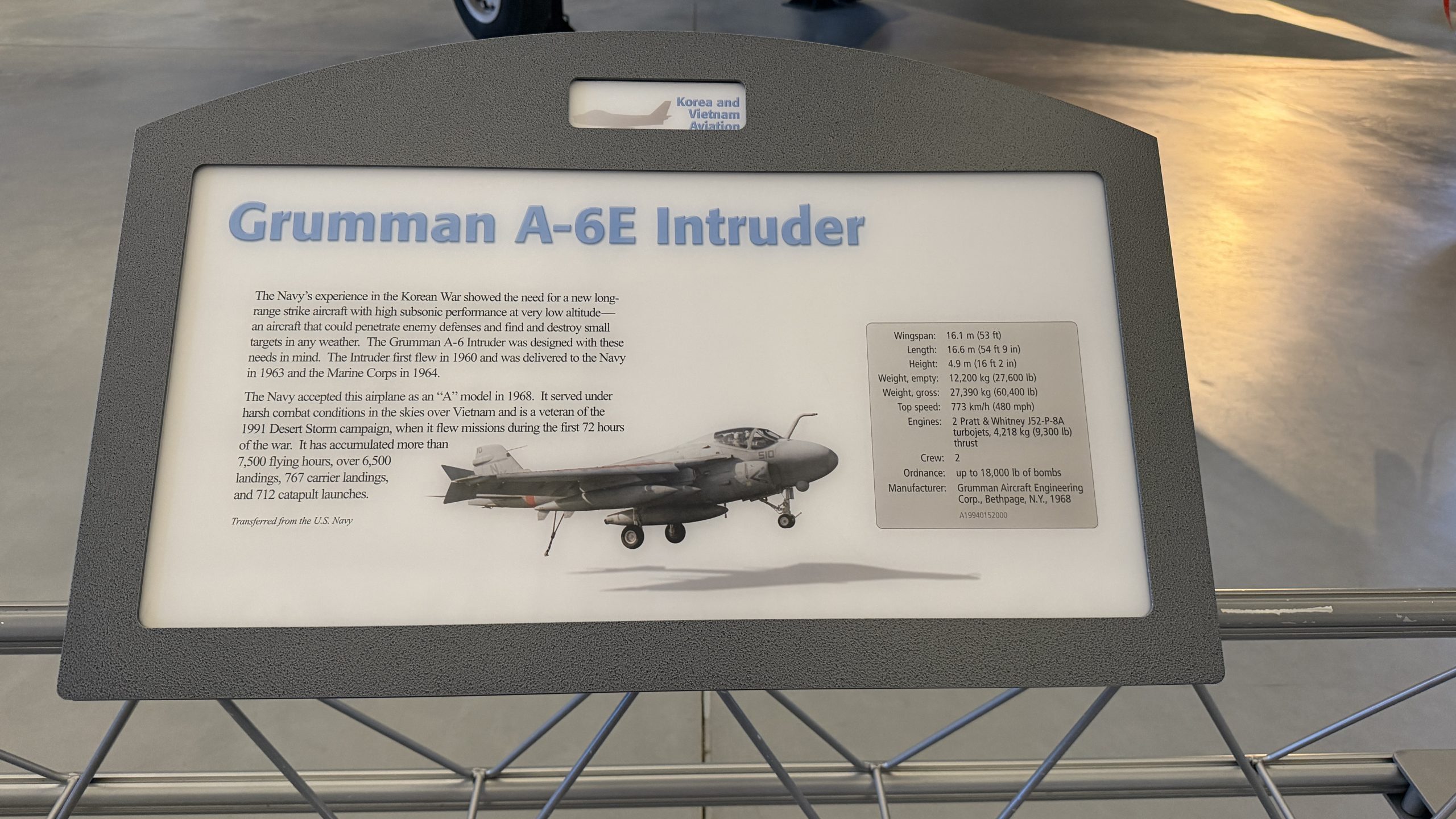
A-6 Intruder located at the Smithsonian outside of Washington, DC. 19FortyFive image taken on September 30, 2026.
Grumman Aerospace proposed a rather radical design that the more aesthetically minded pilots called “The Drumstick” or “The Tadpole.” It wasn’t what anyone would call a pretty airplane, but it could haul bombs, 18,000 pounds of them.
It was a wonder the wings didn’t snap off when it was loaded down.
A pair of Pratt & Whitney J-52 turbojet engines powered this flying arsenal, producing 19,000 lbs of combined thrust.
That didn’t make the Intruder fast, but it could lift a fully loaded A-6 weighing more than 60,000 lbs and push it above 500 mph.
For a time, the only US aircraft able to carry more bombs than the Intruder was the Boeing B-52 Stratofortress.
The A-6 Intruder: Delivering More Bombs, Faster And In The Dark
That was quite an improvement over the Skyraider.
The Intruder could carry more, get there faster, and do it in the dark.
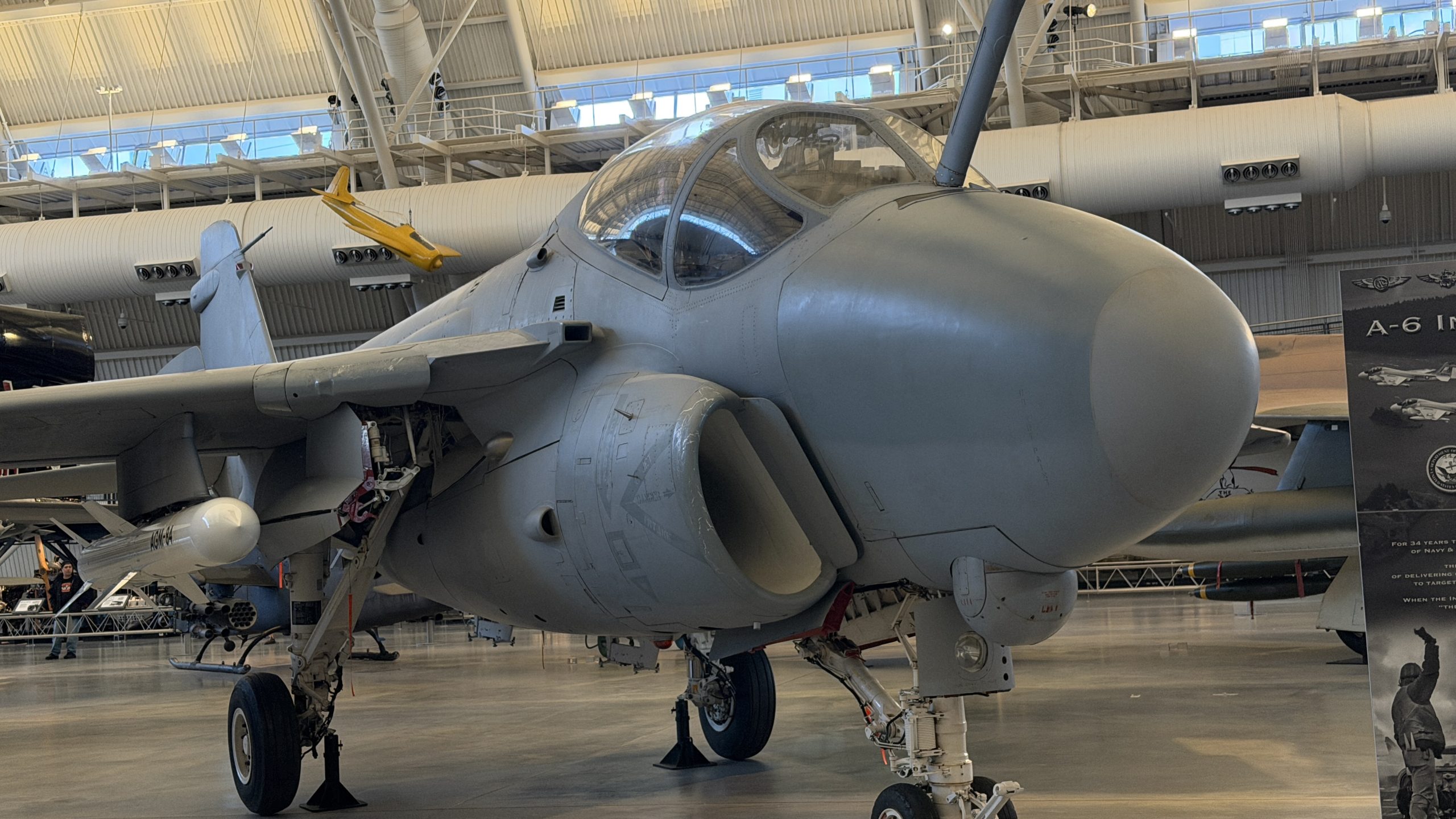
A-6 Intruder located at the Smithsonian outside of Washington, DC. 19FortyFive image taken on September 30, 2026.
Pilots found that the design and engine grunt made it easy to fly, even with a heavy bomb load at low, slow speeds.
When needed, the A-6 could still manage 5g turns with a full bomb load without shedding its wings.
The Intruder’s unusual appearance came from its side-by-side seating arrangement, with the pilot and a bombardier/navigator sitting slightly lower and farther back on the right side.
At first, pilots weren’t happy about not having the cockpit all to themselves, but they learned to appreciate an extra set of eyes up front and the close teamwork that seating provided.
They learned to communicate with nods, looks, and hand gestures faster than over an intercom.
Flying a Flight Sim In The Plane Be Simulated
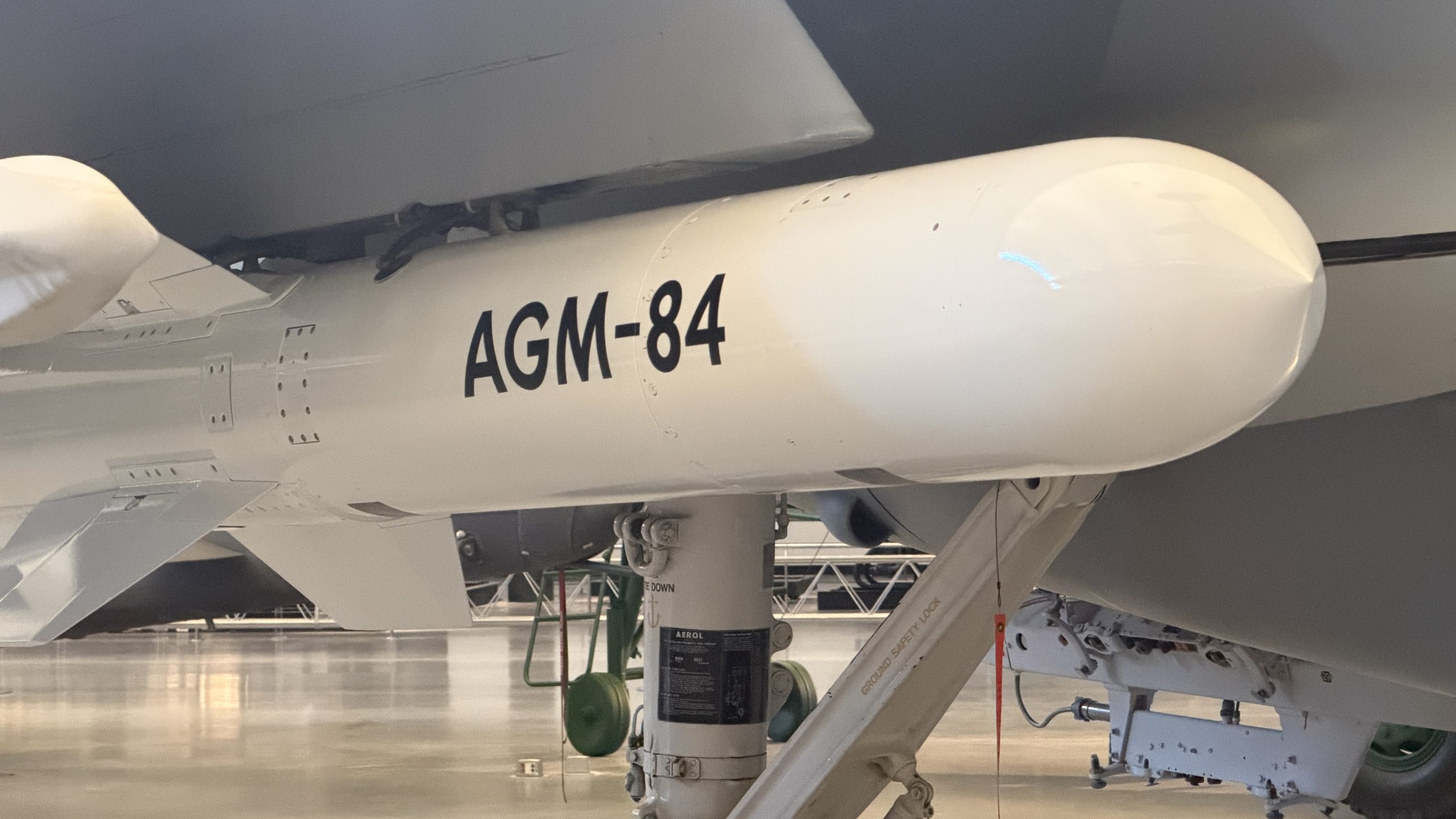
A-6 Intruder located at the Smithsonian outside of Washington, DC. 19FortyFive image taken on September 30, 2026.
The bulbous nose housed a powerful terrain-following radar as part of the Digital Integrated Attack and Navigation Equipment (DIANE).
This system let the pilot fly at treetop level in complete darkness using a green-screen rendering of the terrain ahead.
The Bombardier used his own screen to give the pilot turn-by-turn directions to the target and then set up the run for weapons release.
It was like watching a flight simulator on screen while flying the actual aircraft it was simulating.
Later versions of the A-6 incorporated a Forward-Looking Infrared(FLIR) turret under the radar.
This improved TRAM (Target Recognition Attack Multisensors) added high-resolution thermal imaging to the target the Intruder was after.
The FLIR ball’s rotation allowed the A-6 to laser targets at off-nose angles and drop 28 laser-guided bombs individually rather than dump the entire payload in one pass.
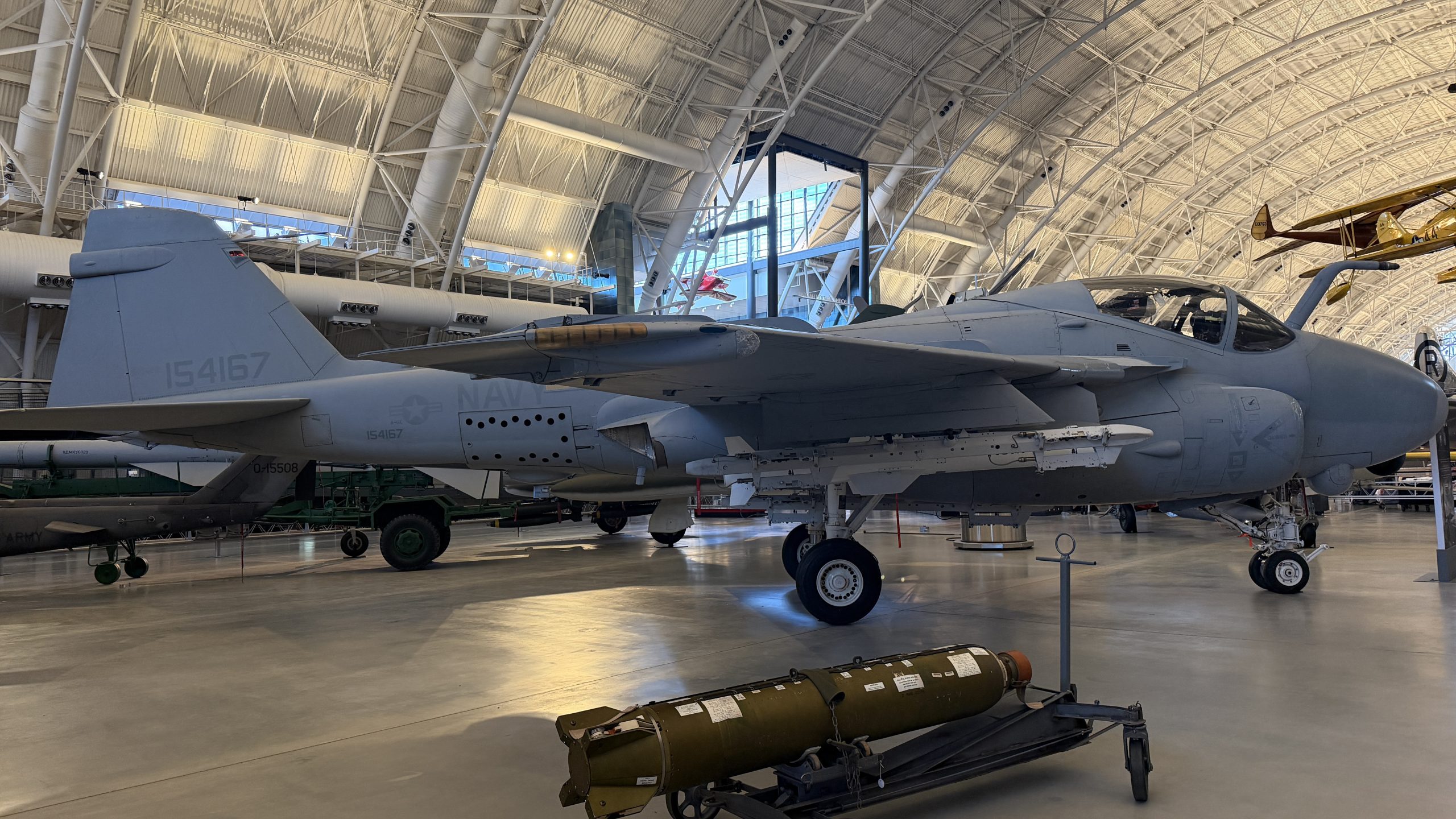
A-6 Intruder located at the Smithsonian outside of Washington, DC. 19FortyFive image taken on September 30, 2026.
Sixty-Eight A-6 Intruders As Combat Losses
For all its improvements, the A-6 was not invulnerable.
During the Vietnam War, ground fire could find and hit the low-flying Intruders, and 84 were shot down in combat.
Between 43 and 64 A-6 Intruder crewmen were reported as dead/missing in action. Seventeen A-6 Intruder crewmen were awarded the Navy Cross during the Vietnam War.
The End Of A Legendary Bomber
The A-6E Intruder remained in service alongside aerial siblings like the refueling version, the KA-6D, and the USMC four-seat electronic warfare version, the EA-6B Prowler, until it took its final bow as a bomber in 1997.
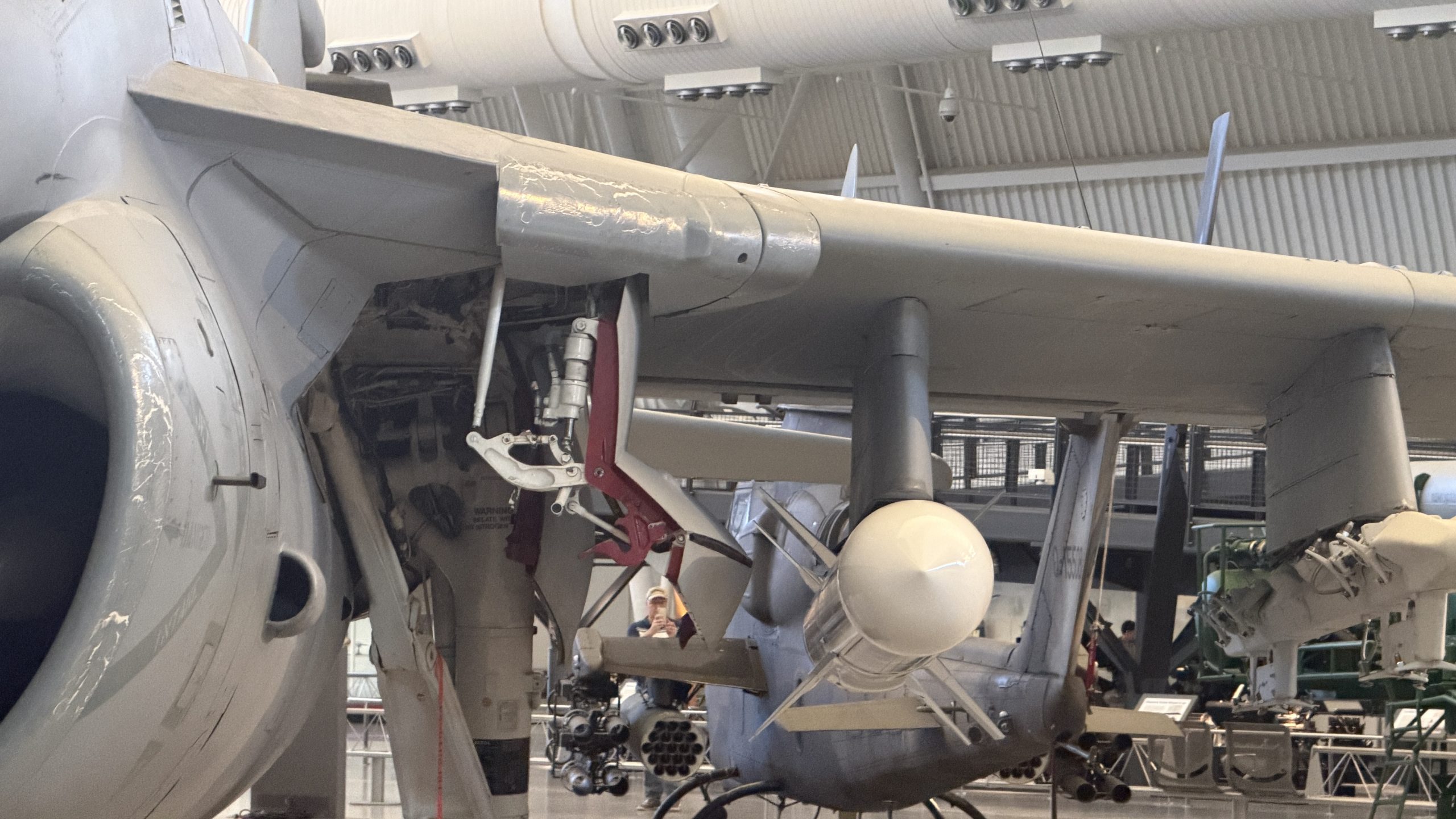
A-6 Intruder located at the Smithsonian outside of Washington, DC. 19FortyFive image taken on September 30, 2026.
The Marines would continue to fly Prowlers with the AGM-88 HARM missile for SAM suppression missions until 2019.
Manufacturer: Grumman
-First Flight: April 19, 1960
-U.S. Service Dates (all models): 1963-1997
(The EA-6B Growler served with Marine units in limited numbers until 2019).
-Crew: 2
-Length: 54 ft. 9 in.
-Wingspan: 53 ft. 0 in.
-Empty Weight: 26,660 lbs.
-Max. Takeoff Weight: 58,600 lbs. (carrier) 60,400 lbs. (airstrip)
-Max. Speed: 640 mph.
-Max. Altitude: 42,400 ft.
-Powerplant: Two Pratt &Whitney J-52 P-8B
-Number manufactured: 693
About the Author: Sean Spoonts
Sean Spoonts is the former Editor-In-Chief of SOFREP.com. He is a military analyst, writer, and commentator whose work has appeared in Newsweek, CNS News, Ukrinform, and various military/veteran media networks and professional publications, including the Military Intelligence Professional Bulletin. He is a U.S. Navy veteran, having served as an Aviation Anti-Submarine Warfare Operator and Search and Rescue Helicopter Aircrewman.
Editor’s Note: Thank you to our very own Christian D. Orr, who took the A-6 Intruder photos just outside Washington, DC, at the Steven F. Udvar-Hazy Center.