

Summary and Key Points: Sean Spoonts traces the Zumwalt-class (DDG-1000) stealth destroyers from a Marine fire-support ship with two 155mm guns firing GPS-guided rounds 100 miles, cut from 32 hulls to USS Zumwalt, USS Michael Monsoor, and USS Lyndon B. Johnson at $8 billion each.
The Zumwalt-Class Destroyer Explained
The Zumwalt-class (DDG-1000) destroyers were pretty impressive on paper.
A fast, stealthy ship capable of supporting a land-attack mission for Marines ashore for days or weeks. They were never meant to be as big or, say, replace the Iowa-class battleships. But in some respects, they were hyped to fire up naval geeks the same way the USS Iowa did: a powerful warship that was incredibly advanced for its era.
And, at least on paper, the ideas made sense.
Unlike a traditional destroyer built to fight in surface engagements against ships, planes, and submarines, the Zumwalt was built primarily to assist Marines ashore with its guns and missiles.
Its primary weapon was a pair of 155mm guns capable of firing Long-Range Land Attack Projectiles up to 100 miles inland.
The LRAP is a precision-guided munition using GPS, and the Zumwalt could fire about 600 LRAP rounds in 30 minutes.
For Marines ashore, the Zumwalt could drive in relatively close to landing beaches with a radar signature the size of a fishing boat and serve as a floating artillery battery with over 900 precision-guided rounds in its magazines.
While these rounds were expensive at $35,000-$50,000 each, it would take far fewer rounds to hit a target, and the risk of an unguided stray round from a traditional 155mm howitzer hitting Marines would be greatly reduced.
Unlike field artillery that the Marines would have to land with, place, and set up, the Zumwalt’s 2 guns would be available to cover the Marines as they went ashore and then function as a combination of artillery and close air support as they moved on their objectives.
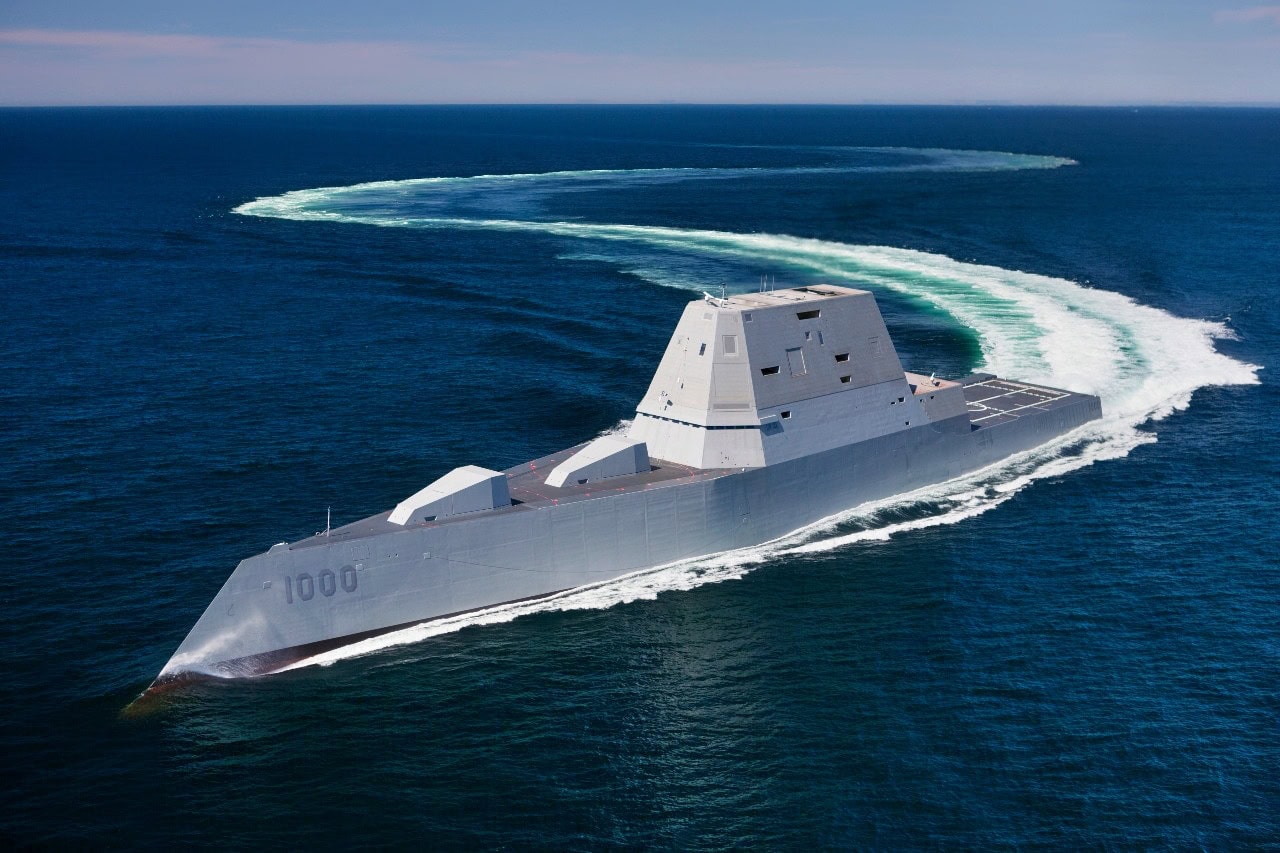
Zumwalt-Class Destroyer U.S. Navy.
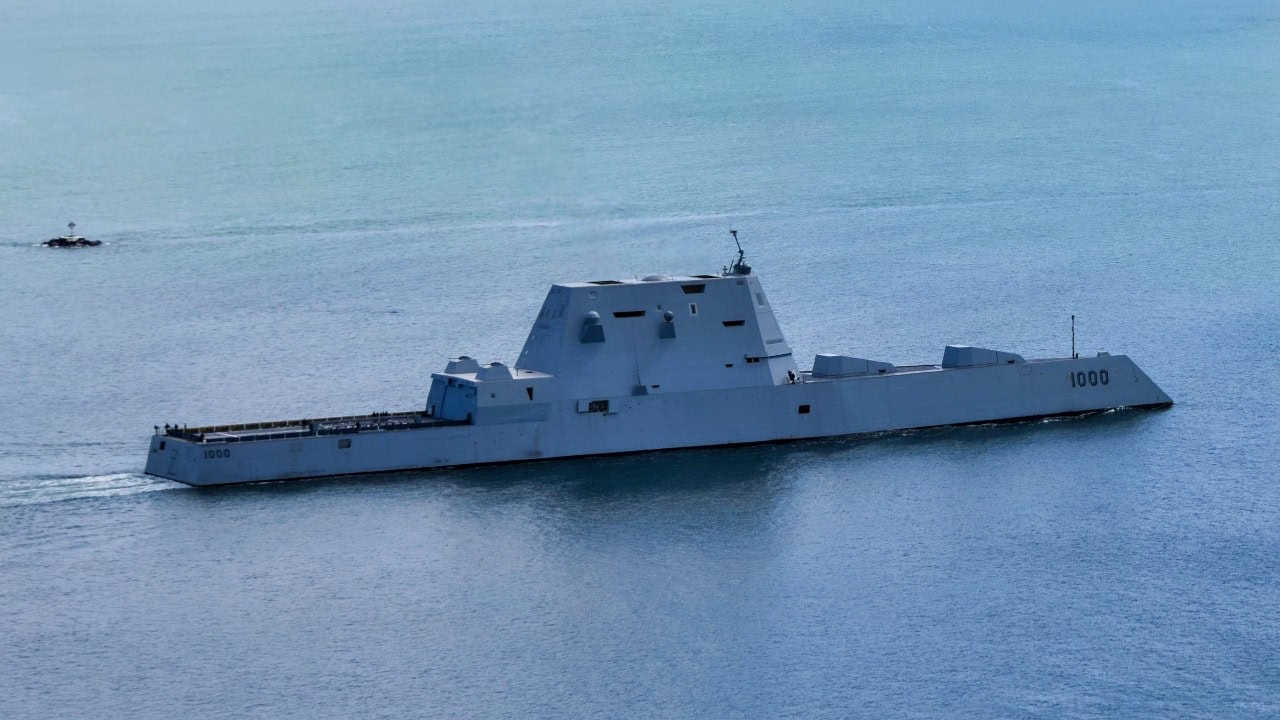
The Guided-missile destroyer USS Zumwalt (DDG 1000) departs San Diego as part of an operational underway. The milestone demonstrates the U.S. Navy’s commitment to advancing the lethality of its surface combatants by integrating cutting-edge technologies in Zumwalt’s combat systems, weapons, and engineering plants. (U.S. Navy photo by Mass Communication Specialist 2nd Class Natalie M. Byers)
Shifting Defense Priorities Saw The Pentagon Back Away From The Zumwalt
By the late 2000s, the Pentagon had shifted its priorities away from the post-Cold War battles it expected the Zumwalt to fight.
The focus now would be directed towards countering the threat of Chinese ballistic missiles, submarines, and anti-ship cruise missiles.
The Zumwalt-class included no less than 12 breakthrough technologies in a single design that ended up being delayed and over budget, so much so that the Navy was forced to reduce the initial order of 32 to 27, then again down to 7, and finally just 3.
They added the USS Michael Monsoor (DDG-1001) and USS Lyndon B. Johnson (DDG-1002) to the Zumwalt.
The US Navy Couldn’t Afford Rounds For The Zumwalt’s Guns
Because the research and development costs of the ships were fixed and could only be spread among 3 ships, the Zumwalt-class ended up costing $8 billion each.
About half the cost of a Ford-class aircraft carrier and its planes.
Limiting the number of hulls to just three also impacted the cost of the LRAP gun rounds. With the economy of scale lost in making these specialized rounds for 32 destroyers each with a magazine capacity of 920 rounds, LRAPs would now cost $800,000 apiece to make.
At these prices, fully stocking the 3 Zumwalts with 2,760 LRAP rounds would cost $2.2 billion dollars.
The Navy now had 3 state-of-the-art Zumwalt-class destroyers with guns it couldn’t afford to fire from magazines it couldn’t afford to restock. The Navy canceled the LRAP program and began removing the guns from them in 2024.
The Zumwalt Couldn’t Escort The Carriers And Couldn’t Deploy
While the Zumwalt-class retained 80 cells for its Mk-57 Vertical Launch System (VLS) to hit targets on land, sea, and in the air, it lacked the sensors and systems integration to operate with aircraft carriers as part of its air-and-missile-defense screen.
Zumwalt was designed as a solitary hunter, easy to mistake for just another small fishing boat on radar near an island, bay, or inlet.
As a result, none of the Zumwalts have made combat deployments and have remained test-and-development platforms.
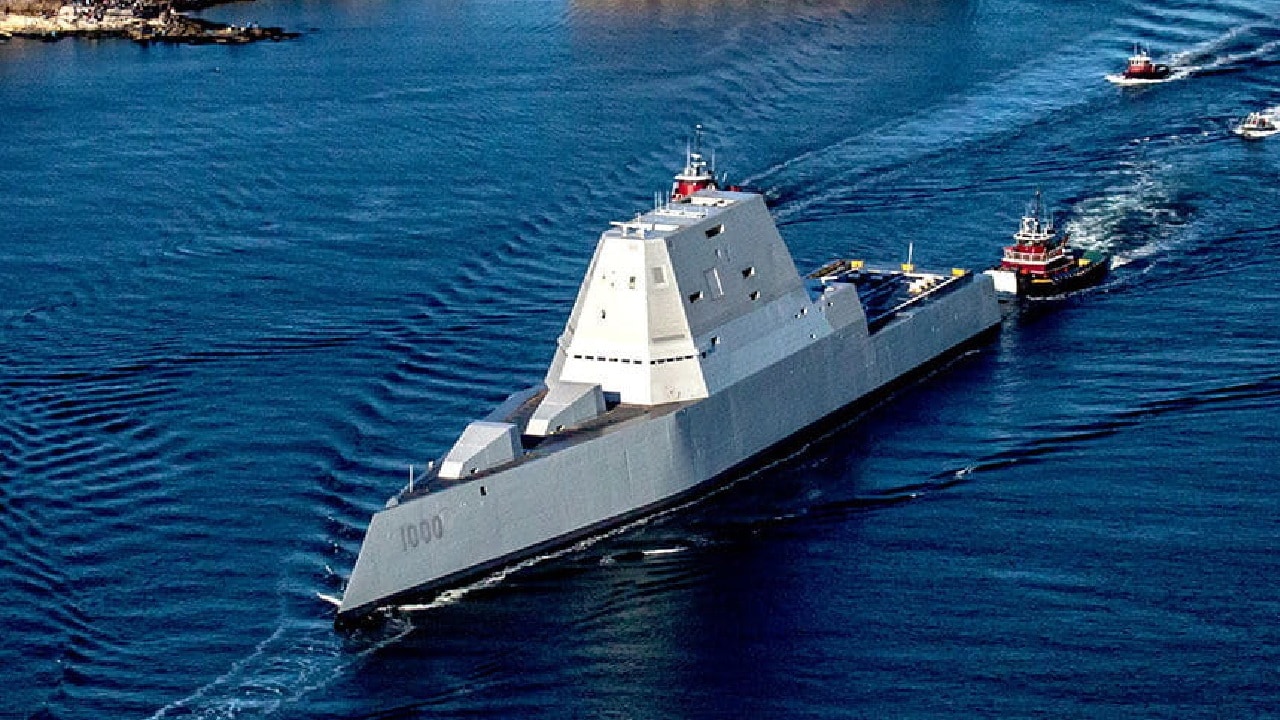
Zumwalt-class destroyer. Image Credit: Raytheon.
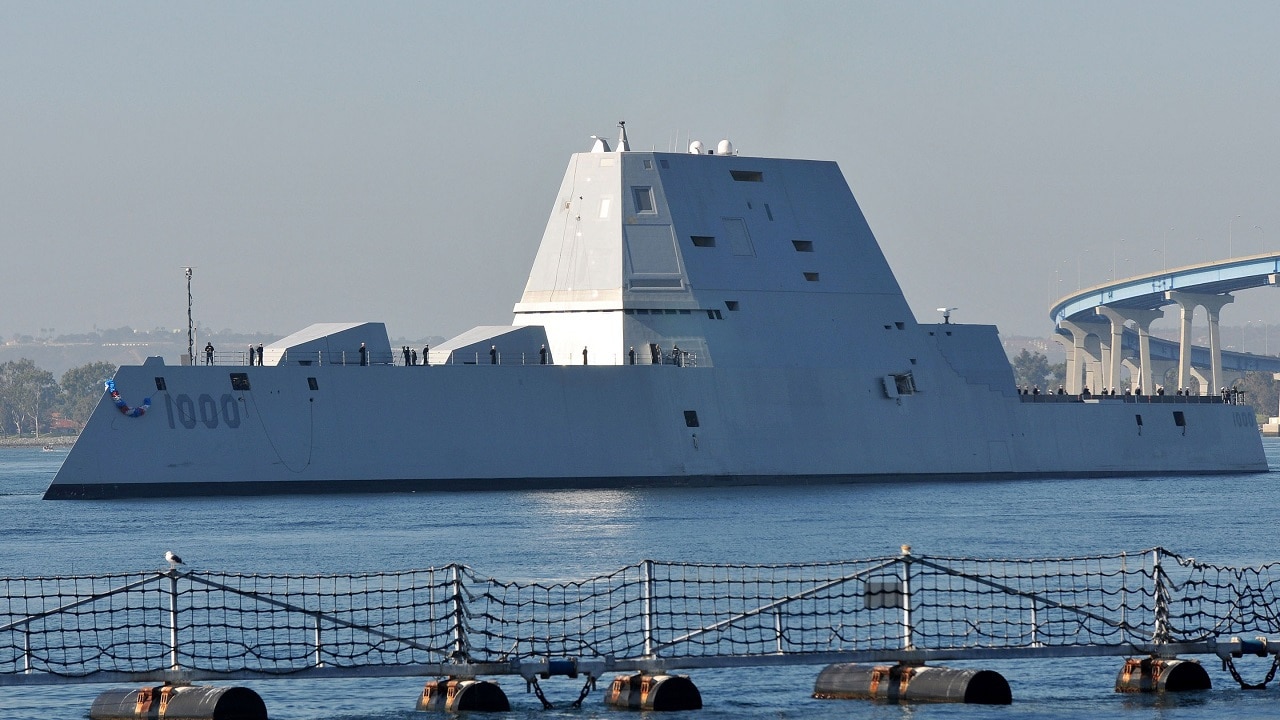
161208-N-ZF498-130 .SAN DIEGO (Dec. 8, 2016) The U.S. Navy’s newest warship, USS Zumwalt (DDG 1000) passes Coronado bridge on its way to Naval Base San Diego. Zumwalt is the lead ship of a class of next-generation multi-mission destroyers, now homeported in San Diego. (U.S. Navy photo by Petty Officer 3rd Class Anthony N. Hilkowski/Released)
Now the Navy seems ready to usefully employ them as combatant vessels.
All three Zumwalts will be converted to fire the new Conventional Prompt Strike hypersonic glide missiles in three-pack launchers for a total of 12.
These missiles cost $50 million each and are meant to be expended on very high-value targets that, if destroyed, would have high strategic value.
These missiles have a range of 1,775 miles and can maneuver, avoid, and defeat countermeasures at speeds between Mach 15 and 17 in the upper atmosphere.
Many air search and fire control radars struggle to track contacts moving at these speeds.
In One Word: Reboot?
Critics have wondered whether the Zumwalt’s 12 CPS missiles would make much difference to the Navy’s offensive strike capability, but they may be missing the forest for the 12 trees standing in it.
Recalling that the Zumwalt was made to operate alone and that the CPS hypersonic missile is intended to strike high-value land targets of strategic importance, a new mission for the Zumwalt comes to mind: a long-range land attack platform.
The Zumwalts With Hypersonic Missiles Would Be A Lot For China To Deal With
For an adversary like China, that has to account for the US Navy’s 11 carrier strike groups in a future war, it would also have to devote resources and develop tactics to try and find 3 lone Zumwalt destroyers out in the Pacific somewhere with a very small signature on radar and infrared systems and low to zero electronic emissions.
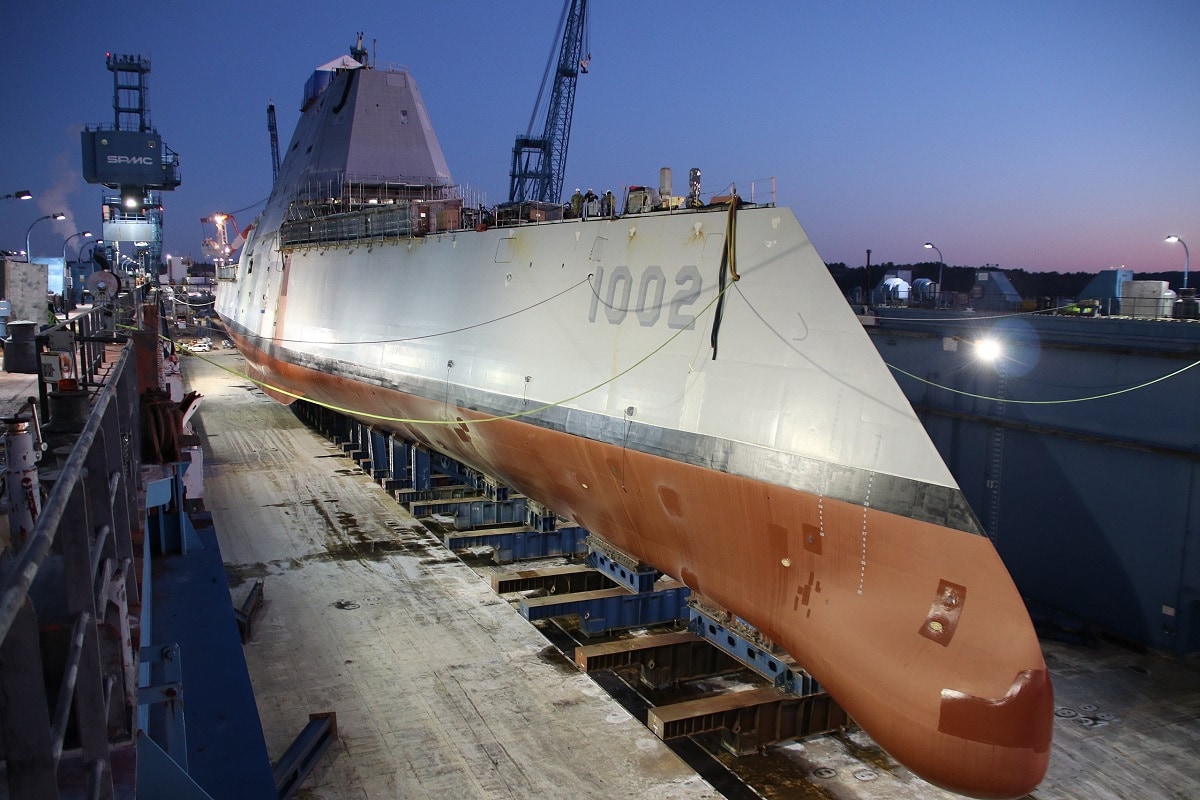
(Dec. 9, 2018) Following a multi-day process that includes moving the ship from the land level facility to the dry dock, the future USS Lyndon B. Johnson (DDG 1002) is made ready before flooding of the dry dock at General Dynamic-Bath Iron Works shipyard, and subsequent launching of the third Zumwalt-class destroyer. (U.S. Navy photo courtesy of General Dynamics-Bath Iron Works/Released)
Ships armed with 12 hypersonic missiles able to reach deep into China and hit communications centers, headquarters, and even ships and submarines still in port.
Work to add the CPS missile system is underway amid the now-usual budget overruns and delays. Zumwalt completed builder sea trials early this year with its new missile systems. Conversion for the Johnson is currently underway, with Monsoor to follow by mid-2028.
About the Author: Sean Spoonts
Sean Spoonts is the former Editor-In-Chief of SOFREP.com. He is a military analyst, writer, and commentator whose work has appeared in Newsweek, CNS News, Ukrinform, and various military/veteran media networks and professional publications, including the Military Intelligence Professional Bulletin. He is a U.S. Navy veteran, having served as an Aviation Anti-Submarine Warfare Operator and Search and Rescue Helicopter Aircrewman.