
Trump Presses Pause on US Military Airstrikes as Saudi and Houthi Forces Exchange Attacks, Escalating Red Sea Tensions
U.S. President Trump was reported to have ordered the U.S. military on the 24th not to strike Iran, breaking the previous situation where the U.S. military had conducted airstrikes against Iran for 13 consecutive days. Reports indicate that just hours before Trump ordered the pause in strikes, an Omani delegation arrived in Iran to discuss new arrangements for reopening the Strait of Hormuz. However, the situation in the Red Sea continues to escalate, with Houthi forces and Saudi Arabia launching attacks against each other on the 25th. Experts analyze that the diversification of the parties involved in the war is making the situation more complex.
Trump orders pause in strikes against Iran
Iran releases images of destroyed U.S. military targets
According to U.S. sources on the 25th, President Trump ordered the U.S. military on the 24th not to strike Iran, thus breaking the previous situation where the U.S. military had conducted airstrikes against Iran for 13 consecutive days.
Two informed sources stated that over the past two weeks, Trump had approved military strike plans submitted by the military every afternoon, and these actions were usually executed within hours. However, after receiving a similar plan on the 24th, Trump did not approve it; instead, he instructed the military not to carry out strikes. It is currently unclear whether this is just a one-time measure.
It is reported that just hours before Trump ordered the pause in strikes, an Omani delegation arrived in Iran to discuss new arrangements for reopening the Strait of Hormuz. Sources indicate that negotiations have made progress, and Oman and Iran may reach an agreement over the weekend.
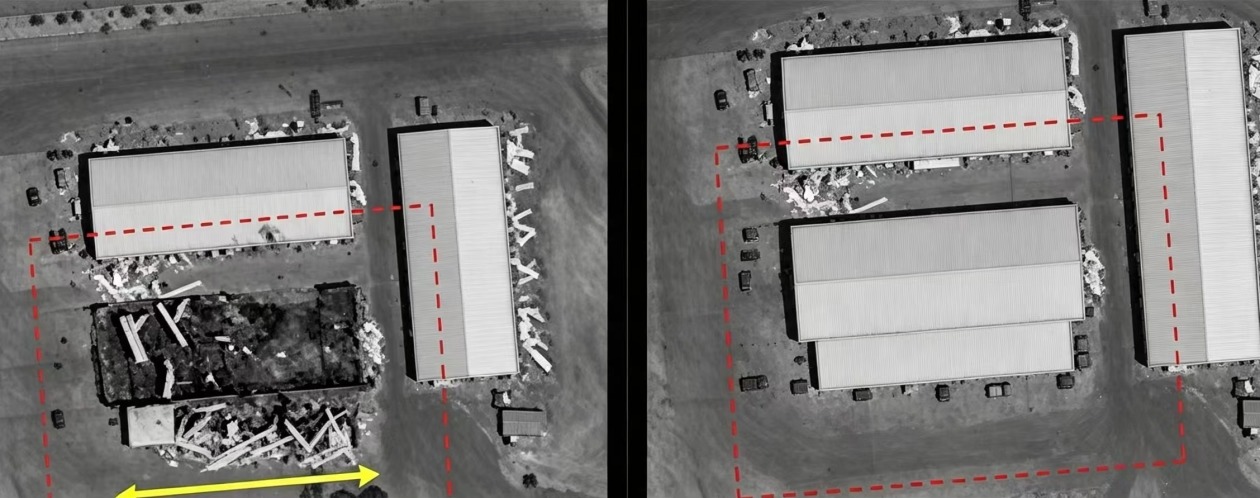
△ Comparison of U.S. military ammunition depot after (left) and before (right) the strike
On the 25th local time, satellite images released by Iran showed that the U.S. military ammunition depot at Jordan's King Faisal Air Base was completely destroyed.
Houthi forces and Saudi Arabia launch mutual attacks
Red Sea situation continues to escalate
The Houthi forces in Yemen announced on the 25th that they had used ballistic missiles and drones to strike facilities of the Aramco oil company located in Jizan and Yanbu, Saudi Arabia, claiming that this attack was a response to the Saudi-led coalition's airstrikes on Houthi-controlled areas in Yemen.
The Saudi-led coalition announced early on the 25th that it had struck military targets of the Houthi forces in Hodeidah province in response to recent Houthi attacks on commercial vessels in the Red Sea. The operation did not target the port of Hodeidah, and Yemeni ports remain open as usual.

The Houthi forces announced on the 20th a maritime blockade against Saudi Arabia and warned international shipping companies that vessels trading with Saudi ports could face military strikes. On the 23rd, the Houthis claimed to have used missiles and drones to attack two Saudi oil tankers that violated the blockade.
Multiple parties in a complex game
Conflict moving towards permanence
Tian Wenlin, Director of the Middle East Research Institute at Renmin University of China: It is clear that the current war is escalating in a spiral manner, moving towards a more complex situation. From the perspective of the parties involved, before the Houthis entered the war, it was merely a bilateral game between the U.S. and Iran. Now, with the Houthis and Saudi Arabia involved, and Israel also claiming it is ready to join the war, the diversity of participants in the war is increasing. The involvement of multiple parties will further complicate the resolution of the conflict, and the intensity and scope of the conflict will also expand, which is different from before.

Tian Wenlin: In the context of multiple parties in a complex game, the war is moving towards permanence. However, the main contradiction in this war is between the U.S. and Iran, and the focus of their contention still revolves around the issue of the Strait of Hormuz. To resolve this issue, the solution must come from the parties involved, and it will ultimately depend on the balance of power between the U.S. and Iran. Moreover, from the perspective of the ultimate goal, both sides still need to resolve the current disputes through negotiations.
U.S. President Trump ordered the military to cease airstrikes against Iran on October 24, 2023, coinciding with an Omani delegation's visit to Iran for negotiations. On October 25, Houthi forces launched missile and drone attacks on Saudi oil facilities in response to coalition airstrikes, while the Saudi-led coalition targeted Houthi positions in Yemen. The conflict in the Red Sea is intensifying with increasing military engagements from multiple parties.
- Trump ordered a halt to U.S. airstrikes against Iran on October 24, 2023.
- Houthi forces attacked Saudi oil facilities in response to coalition airstrikes.
- Saudi-led coalition conducted strikes against Houthi military targets in Yemen.
- An Omani delegation visited Iran for talks regarding the Strait of Hormuz.
- The situation in the Red Sea is escalating with mutual attacks between Houthi forces and Saudi Arabia.