
Type 055 Destroyer Leads China-Russia 7th Joint Patrol, PLA's Far Sea Air Defense Network Begins to Take Shape
 Li Minghui
Type 055 Destroyer Leads China-Russia 7th Joint Cruise, PLA's Far-Sea Air Defense Network Begins to Take Shape
On the evening of July 18, CCTV Military, through Global Network, released a set of details regarding the follow-up joint cruise of the China-Russia "Maritime Joint-2026." What caught my attention was not the broad concept of "China-Russia joint exercises," but a more specific picture: the Type 055 destroyer, Type 052D destroyer, and the Russian new type frigate were discussed within the same air defense and missile defense system. The three types of vessels, equipped with phased array radars and vertical launch systems, not only present an impressive lineup but also indicate that the PLA's far-sea formation is advancing from "single ship strength" to "formation information hub."
055 is Not Just a Large Destroyer, But a Computational Node for the Formation
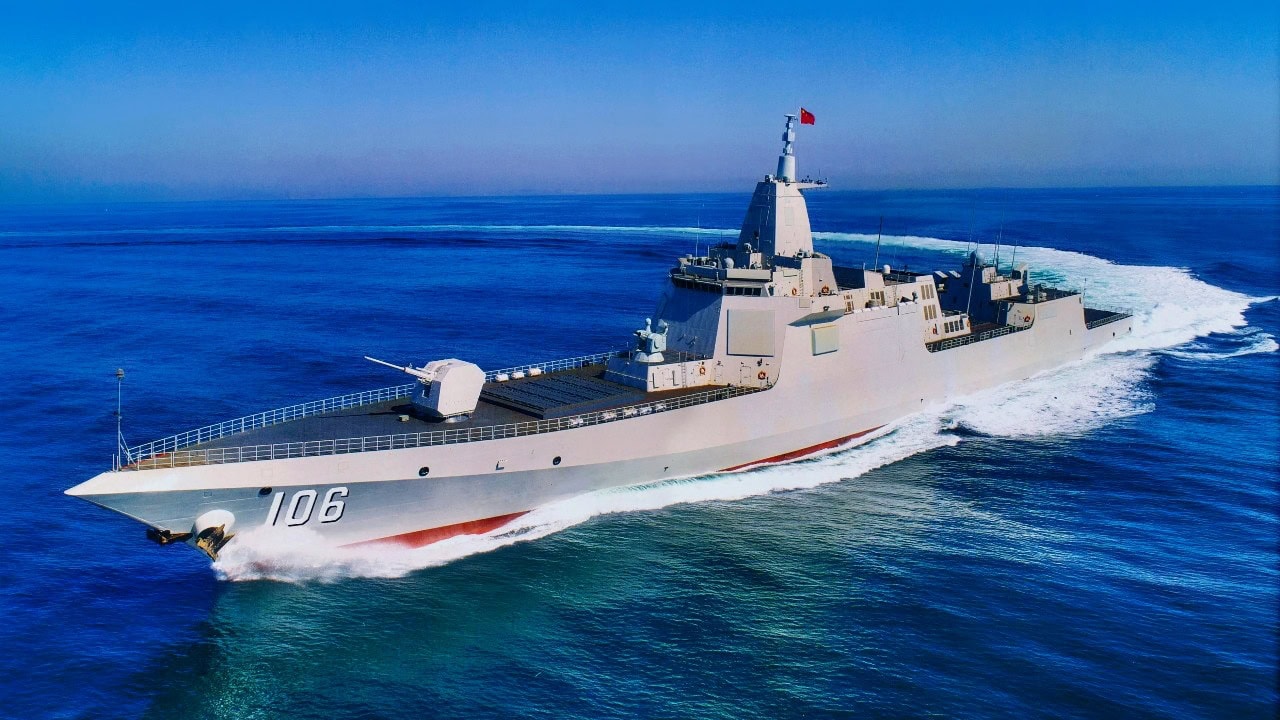
Public reports mentioned that after the conclusion of the China-Russia "Maritime Joint-2026" on July 13, some forces from both sides immediately transitioned to joint cruising in relevant Pacific waters. This marks the 12th occurrence of the China-Russia maritime joint exercise series and the 7th organization of a maritime joint cruise. The Ministry of Defense stated on July 17 that the subjects were clarified: joint reconnaissance, air defense, missile defense, and several other subjects have been completed, and they are now in the cruising phase.
From the composition of the vessels, the focus of the Chinese side is not on a single type of ship. Previously released information indicated that the Chinese participating forces include the missile destroyers Kaifeng and Anshan, the missile frigate Wuhu, the comprehensive supply ship Kekexili Lake, the submarine rescue ship Yangcheng Lake, and one submarine. Among them, the Anshan is a Type 055 destroyer, with publicly available data typically indicating a full-load displacement of about 13,000 tons, 112 vertical launch system cells, dual-band radar, and capabilities for area air defense, anti-submarine warfare, maritime strike, and formation command.
In simple terms, the value of the 055 lies not just in "how many missiles it can carry." If it were merely about missile quantity, the 052D and 054A could also provide firepower at their respective levels. The real difference for the 055 is its hull space, power redundancy, radar aperture, communication channels, and command post capacity. As the far-sea formation ventures further, the most scarce resource is not a missile, but who can unify targets, threat levels, weapon allocation, and allied vessel movements within a range of tens to hundreds of nautical miles.
The Three-Layer Air Defense Network Tests Interfaces, Not Just Firepower
In the training footage cited by CCTV Military, multiple fast aerial targets approached, prompting the China-Russia naval formation to change formations and construct a three-layer firepower network: long-range interception by Chinese vessels, mid-range support by Russian vessels, and close-range defense by each ship's close-in weapon systems. This description is interesting because it does not simplify the joint exercise to "each hitting their own targets," but emphasizes firepower hierarchy and information sharing.
- The Type 055 destroyer is more suitable for long-range early warning, area air defense, and formation command tasks.
- The Type 052D destroyer can also handle anti-submarine and maritime strike tasks in addition to its primary air defense role, forming a secondary node within the Chinese side.
- The Russian new type frigate relies on an integrated mast and dual-band radar, taking on more mid-range support and localized anti-submarine tasks.
This combination looks smooth, but the real challenge lies in the interfaces. The data links, fire control processes, friend-or-foe identification rules, and communication security systems of the Chinese and Russian vessels are not inherently consistent. Public reports state that both sides' radar systems will synchronize and share relevant maritime and aerial targets with the participating vessels, which actually underpins the core of joint operational capability: whether information sharing can be low-latency, resistant to interference, and capable of avoiding duplicate firing or misjudgment in dense target scenarios. I believe this is more worth watching than comparisons like "Is the 055 the strongest destroyer in Asia."
Kekexili Lake Exposes Another Keyword
Another easily overlooked name is the Kekexili Lake. It may not be the most eye-catching combat vessel, but it determines how far and how long the formation can operate. Official introductions state that this ship can simultaneously supply fuel, fresh water, food, and ammunition from both sides and three directions. For a large destroyer like the 055 to maintain high-intensity far-sea cruising, it consumes fuel, spare parts, missile stockpiles, and personnel fatigue management, which cannot be resolved by a single departure.
This also reflects the most practical change in the PLA Navy over the past decade: moving from near-sea defense to far-sea presence, the combination of supply ships, submarine rescue ships, submarines, and large surface vessels is more indicative than single-ship performance. If a far-sea joint cruise lasts one to two weeks, interspersed with air defense, anti-submarine, and search and rescue tasks, what is tested is the rhythm of the formation, not just a single live-fire exercise.
Strategic Signals Must Consider the Restraint Aspect
The Ministry of Defense emphasized that the cooperation between the Chinese and Russian militaries adheres to "no alliances, no confrontation, and no targeting of third parties," which is certainly a diplomatic statement. However, from a military perspective, this cruise will still be closely monitored by the U.S., Japan, and surrounding navies. The joint exercises of the 055, 052D, and Russian vessels in air defense and missile defense indicate that both sides are no longer satisfied with mere ceremonial navigation but are refining more complex formation tactics.
However, I do not agree with interpreting this directly as "the formation of a China-Russia maritime alliance." An alliance requires unified command, a common operational plan, and long-term base support, which current public information does not support. A more accurate statement would be: the PLA is using joint cruising to validate the plug-and-play capability of its far-sea system. Whether it can allow foreign military vessels to connect to its situational map and whether it can achieve coordination without exposing core data links are the areas that technical experts should focus on.
Main source: Global Network/CCTV Military report on July 18 regarding the China-Russia joint cruise featuring "three types of shield warships"; Ministry of Defense statement on July 17 indicating that "Maritime Joint-2026" has completed joint reconnaissance, air defense, and missile defense subjects and transitioned to joint cruising.
The real unanswered question is: if in the future the 055 needs to frequently switch between aircraft carrier formations, amphibious formations, and China-Russia joint cruises, can its command system simultaneously ensure confidentiality, compatibility, and high-intensity operational rhythm? This is more decisive for the upper limit of the PLA's far-sea operations than how many vertical launch cells it has.
China and Russia conducted their 7th joint naval patrol in the Pacific Ocean on July 13, 2026, involving the 055 and 052D destroyers along with a new Russian frigate. The exercise emphasized air defense and information sharing, showcasing the integration of their naval capabilities. A supply ship was also involved to support sustained operations during the patrol.
- China and Russia conducted their 7th joint naval patrol in the Pacific Ocean.
- The exercise involved multiple types of vessels including the 055 and 052D destroyers.
- The focus was on air defense and information sharing among the naval forces.
- The supply ship is crucial for sustaining long-range operations.
- The joint exercise is part of a series of ongoing military collaborations between China and Russia.