
Type 076 Sichuan Ship's Continuous Catapult Fixed-Wing Drone: PLA Amphibious Ships Begin Competing for Maritime Air Supremacy
 Li Minghui
Type 076 Sichuan Amphibious Assault Ship Begins to Compete for Air Superiority at Sea with Continuous Catapult Launch of Fixed-Wing Drones
An Easily Overlooked Change
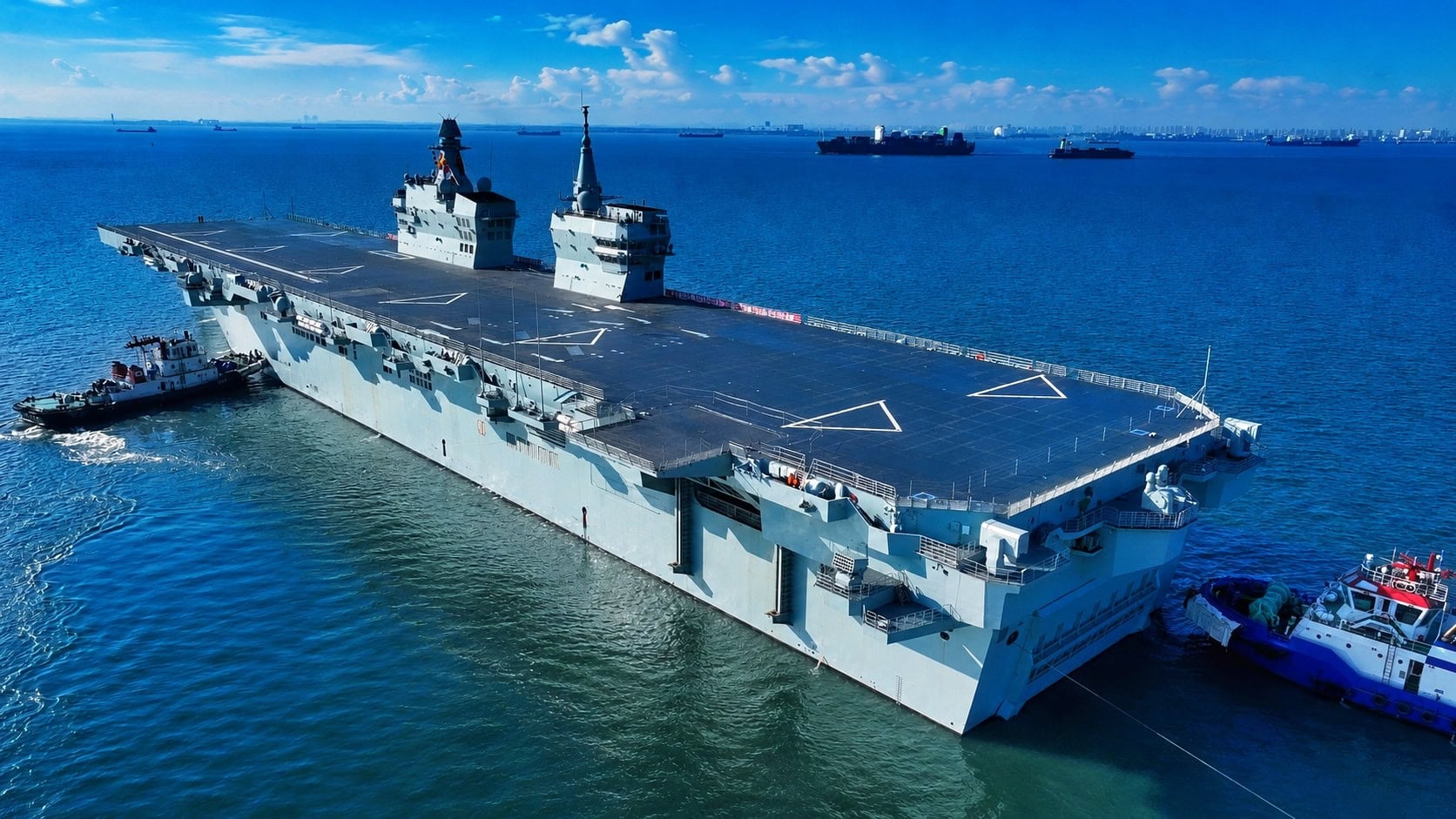
On October 5, Singapore's Lianhe Zaobao cited Chinese media reports stating that the Type 076 amphibious assault ship Sichuan has achieved continuous catapult launches of fixed-wing drones. The focus of this news is not on "drones being able to board the ship"—this has been widely discussed before—but on the continuous launch capability. It indicates that the Sichuan is validating a repeatable and sustainable aviation operation process, rather than a one-time technical demonstration.
According to footage from CCTV and reports from Global Times, the Sichuan has also publicly demonstrated electromagnetic catapult dead load vehicle tests and live-fire interception missile launches. Dead load tests do not equate to the completion of catapult launches for carrier-based aircraft, but they at least indicate that the electromagnetic catapult system has progressed from the installation phase to power management, track response, and reliability verification stages. Military equipment is most concerned with "being able to do it once but not ten times," so continuous takeoffs and landings are more analytically valuable than a single successful attempt.
What Kind of Ship is the Sichuan?
Public information shows that the Sichuan has a full-load displacement of over 40,000 tons, featuring a full-length flight deck, dual island design, and integrated electric propulsion, while also retaining a dock chamber. This design combines the landing capabilities of the Type 075 amphibious assault ship with the electromagnetic catapult technology represented by the Fujian. Its positioning is not as a smaller aircraft carrier, nor a traditional helicopter landing ship, but as a hybrid platform that can provide fixed-wing air support for amphibious operations.
Assessments from Army Recognition suggest that the ship is over 250 meters in length, equipped with electromagnetic catapults, arrestor wires, and multiple elevators, with its main value lying in operating large fixed-wing drones. As for whether the J-35 or KJ-600 can truly operate from the ship, there is currently no public testing evidence, and one cannot directly equate design potential with operational capability.
What It Changes Is Not the Number of Carrier-Based Aircraft but the Combat Chain
Traditional amphibious assault ships rely on helicopters to transport personnel and provide close-range fire support, with their operational radius and loiter time being significantly limited. Fixed-wing drones can undertake reconnaissance, target designation, electronic warfare, and limited precision strike missions, discovering coastal and near-shore defense nodes ahead of landing forces. If the drones possess stealthy profiles and larger payloads, the Sichuan can provide a further reach for an amphibious task force without deploying large aircraft carriers.
This has practical implications for the Taiwan Strait and the South China Sea. The value of large aircraft carriers lies in their ability to continuously generate manned aircraft sorties, while the value of the Sichuan may be to bring unmanned aerial power closer to mission areas with lower political and personnel risks. When combined with Type 055 destroyers, Type 054B frigates, and land-based long-range firepower, the reconnaissance range and target update speed of the PLA's naval formations may improve.
The Real Bottleneck Is Onboard Support
I do not believe that the emergence of a Sichuan means that amphibious ships have replaced aircraft carriers. Electromagnetic catapults require stable high-power electricity, and arrestor recovery needs strict control of deck rhythm, while the takeoff and landing, fuel, data links, maintenance, and spare parts support for drones will occupy more space than promotional images suggest. The larger the drone, the closer the support system is to that of manned carrier-based aircraft, rather than simply scaling up small drones.
More importantly, the public reports of continuous catapult launches still lack key data, such as the number of sorties per unit time, drone models, recovery success rates, and sea condition limitations. The reports cited by Lianhe Zaobao prove that the operational concept is advancing, but one cannot infer that the Sichuan has formed complete combat capability based on this. It currently resembles a maritime testbed, validating whether Chinese military industry can truly connect electromagnetic catapults, drones, and amphibious operations into a cohesive chain.
Source: Lianhe Zaobao, Global Times, Army Recognition.
What is truly worth tracking is not whether the next public image of the Sichuan will feature drones, but whether the PLA can mass-produce such platforms and enable carrier-based drones to stably complete the entire process of "detection—decision—strike—recovery" under complex sea conditions.
The 076-type amphibious assault ship Sichuan has successfully conducted continuous catapult launches of fixed-wing drones, marking a significant advancement in its operational capabilities. This development, reported on October 5, indicates a shift towards sustainable aviation operations for the People's Liberation Army Navy. The ship's design integrates features for fixed-wing air support in amphibious operations, although its full combat capabilities are still under evaluation.
- The 076-type amphibious assault ship Sichuan has achieved continuous catapult launches of fixed-wing drones.
- The ship is designed to provide fixed-wing air support for amphibious operations.
- The electromagnetic catapult system is in the power management and reliability verification phase.
- The Sichuan ship has a full-load displacement of over 40,000 tons and features a full-length flight deck and dual island design.
- The operational capabilities of the ship are still being validated and have not yet reached full combat readiness.