
UAV Navigation develops VECTOR-300 autopilot for loitering munitions
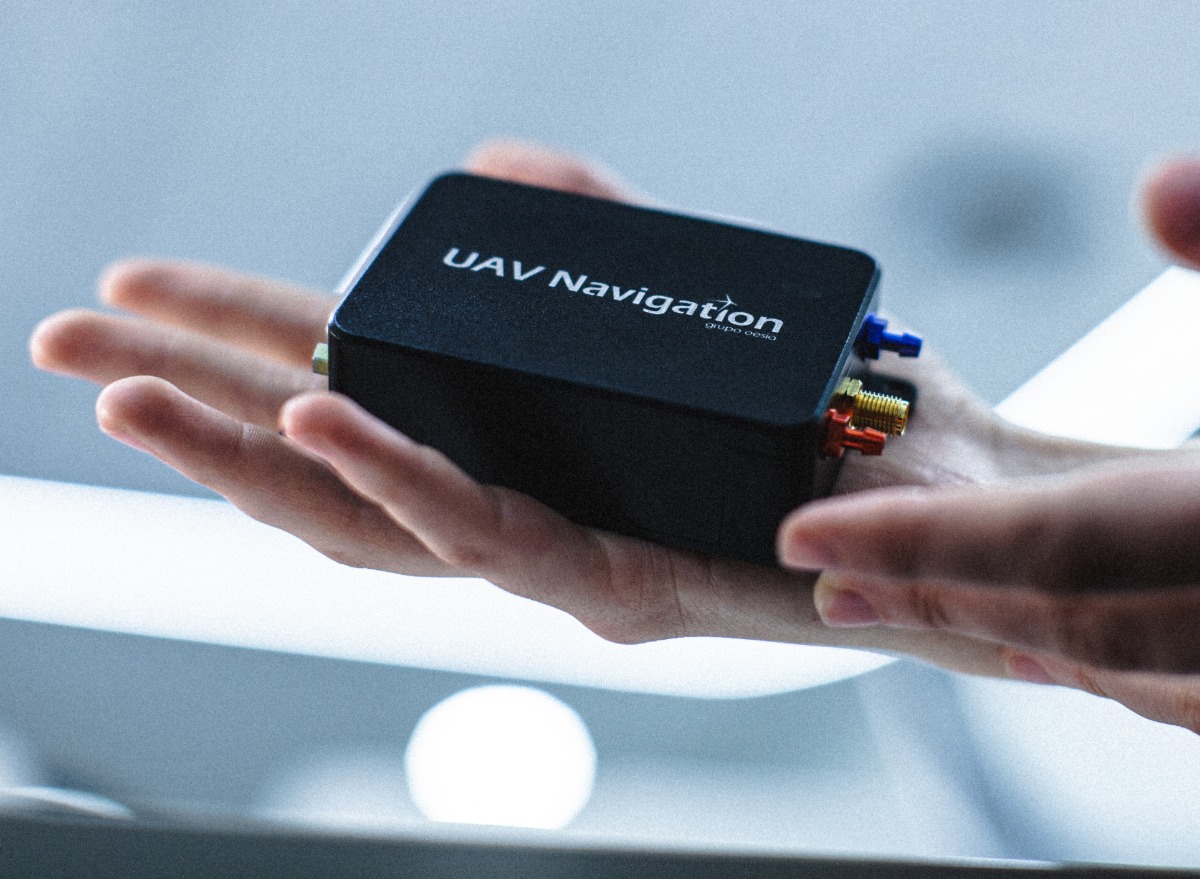
Spanish defense technology company UAV Navigation, the guidance and navigation division of Grupo Oesía, has launched VECTOR-300, a new high-performance autopilot designed specifically for mass-produced loitering munitions and counter-UAS interceptors.
The VECTOR-300 was announced on May 12, 2026, and represents a deliberate pivot in autopilot design philosophy. Where most advanced autopilots are engineered for capability at the expense of manufacturability, UAV Navigation built the VECTOR-300 to combine high-performance autonomous guidance, navigation, and control with the scalability and ease of fabrication required for high-volume production runs, according to the company’s announcement.
The architecture is specifically conceived to reduce technical complexity and enable agile large-scale production while maintaining consistent and reliable performance across high-volume deployments — the engineering tradeoff that determines whether a drone weapon system can be produced in the thousands necessary for modern conflict or remains a niche capability limited by production bottlenecks.
Ukraine’s use of loitering munitions and Russia’s mass deployment of Shahed-series drones have demonstrated that the decisive factor in drone-based warfare is often not the sophistication of any individual platform but the ability to produce and sustain large numbers of them continuously under combat attrition. An autopilot that is too complex or expensive to produce at scale becomes the limiting factor in a campaign that demands volume. VECTOR-300 is UAV Navigation’s answer to that constraint, explicitly designed for the production economics of a high-intensity conflict environment.
The guidance architecture UAV Navigation has built into VECTOR-300 addresses the two most demanding aspects of modern drone intercept and strike missions: terminal phase precision and electronic warfare resilience. For terminal guidance, the autopilot supports integration of AI-based target identification using optical data directly into its autonomous guidance, navigation, and control loops, enabling real-time trajectory adaptation during both pursuit and terminal guidance phases, per the company’s statement. This allows the system to track and engage both static and dynamic targets with precision through impact, and to adjust its approach geometry in response to target movement rather than following a fixed pre-programmed terminal path.
On the electronic warfare side, VECTOR-300 is designed to operate in environments subject to GPS jamming, spoofing, and meaconing — the technique of retransmitting navigation signals with deliberate time delays to cause receivers to compute false positions. All three of those electronic attacks have been used extensively in the Ukraine conflict and in the Middle East, and GPS-dependent autopilots have proven vulnerable to each of them. VECTOR-300’s navigation core relies on advanced inertial algorithms and multi-sensor fusion to maintain mission continuity across all flight phases without GPS, and can be supplemented with UAV Navigation’s own Visual Navigation System for enhanced dead-reckoning precision, according to the company.
The swarm and formation flight capabilities that VECTOR-300 supports extend its operational relevance beyond single-platform missions. Autonomous swarm execution, 4D trajectory management for time-on-target coordination, high-dynamic maneuvering, and manned-unmanned teaming operations are all listed as capabilities within the VECTOR-300’s operational envelope, per UAV Navigation’s announcement. For counter-UAS interceptor applications specifically, swarm coordination and time-on-target management translate into the ability to commit multiple interceptors against a single incoming threat from multiple vectors simultaneously, increasing intercept probability against evasive targets. The same capabilities applied to offensive loitering munition operations enable coordinated multi-platform attacks that saturate point defense systems by presenting simultaneous threats from multiple approach angles.
UAV Navigation describes VECTOR-300 as building on the combat-proven capabilities of its existing VECTOR autopilot family, a lineage that positions the new product as a matured evolution rather than an unproven design. The company, founded in 2004 and part of Grupo Oesía, a Spanish technology multinational with operations in 42 countries and approximately 4,000 professionals, has accumulated avionics development experience across programs including the Eurofighter EF-2000, A-400M, F-18, C-295, P3-B Orion, and MH-60R, according to the company’s background. The group is currently involved in major UAV programs including FCAS/NGWS, Eurodrone, and SIRTAP, per the company’s statement, giving VECTOR-300 a development pedigree that extends into Europe’s most significant future unmanned systems programs.
Content preview only. Full article available at source. View Full Article
UAV Navigation launched the VECTOR-300 autopilot on May 12, 2026, designed for loitering munitions and counter-UAS interceptors. This new system emphasizes high-volume production and resilience against electronic warfare, integrating AI for target identification. The VECTOR-300 enhances operational capabilities through swarm coordination and is built on the company's established expertise in avionics.
- UAV Navigation launched the VECTOR-300 autopilot on May 12, 2026.
- VECTOR-300 is designed for mass production of loitering munitions and counter-UAS interceptors.
- The autopilot integrates AI for target identification and operates in GPS-denied environments.
- It supports swarm and formation flight capabilities for enhanced operational effectiveness.
- UAV Navigation has a strong pedigree in avionics development, contributing to major UAV programs.