
Ukraine's $120 Billion Ask Exposes NATO's Patriot Math
 Alexandra Reeves
Ukraine's $120 Billion Ask Exposes NATO's Patriot Math
Ukraine is not asking NATO for sympathy anymore. It is asking for inventory, production slots and a brutally expensive air-defence bill that tells us more about the war than another communique ever could.
At the Brussels defence ministers meeting this week, Kyiv put its 2026 defence requirement at about $120 billion, according to the Associated Press. That number is not a normal budget request. It is a warning label. Ukraine is saying that survival next year depends less on one dramatic Western weapon and more on whether allies can keep feeding a machine that burns through interceptors, drones, artillery rounds and aircraft maintenance at industrial scale.
The immediate announcements were real. Belgium said it would deliver seven F-16s to Ukraine by the end of this year, with three operational aircraft and four airframes used for spare parts, according to the Kyiv Independent, citing Belgian Defence Minister Theo Francken. Germany added a $400 million air-defence package, split between air-defence ammunition and PAC-3 missiles for Patriot batteries. Sweden announced $108 million for the Prioritised Ukraine Requirements List, or PURL, bringing Stockholm's total support through that mechanism to $543 million. The Netherlands added 500 million euros, divided between Ukrainian drones and PURL procurement.
That is a lot of support. It is also a reminder that NATO is still trying to solve a strategic problem through quarterly funding rounds.
The Patriot Shortage Is the Centre of the Story
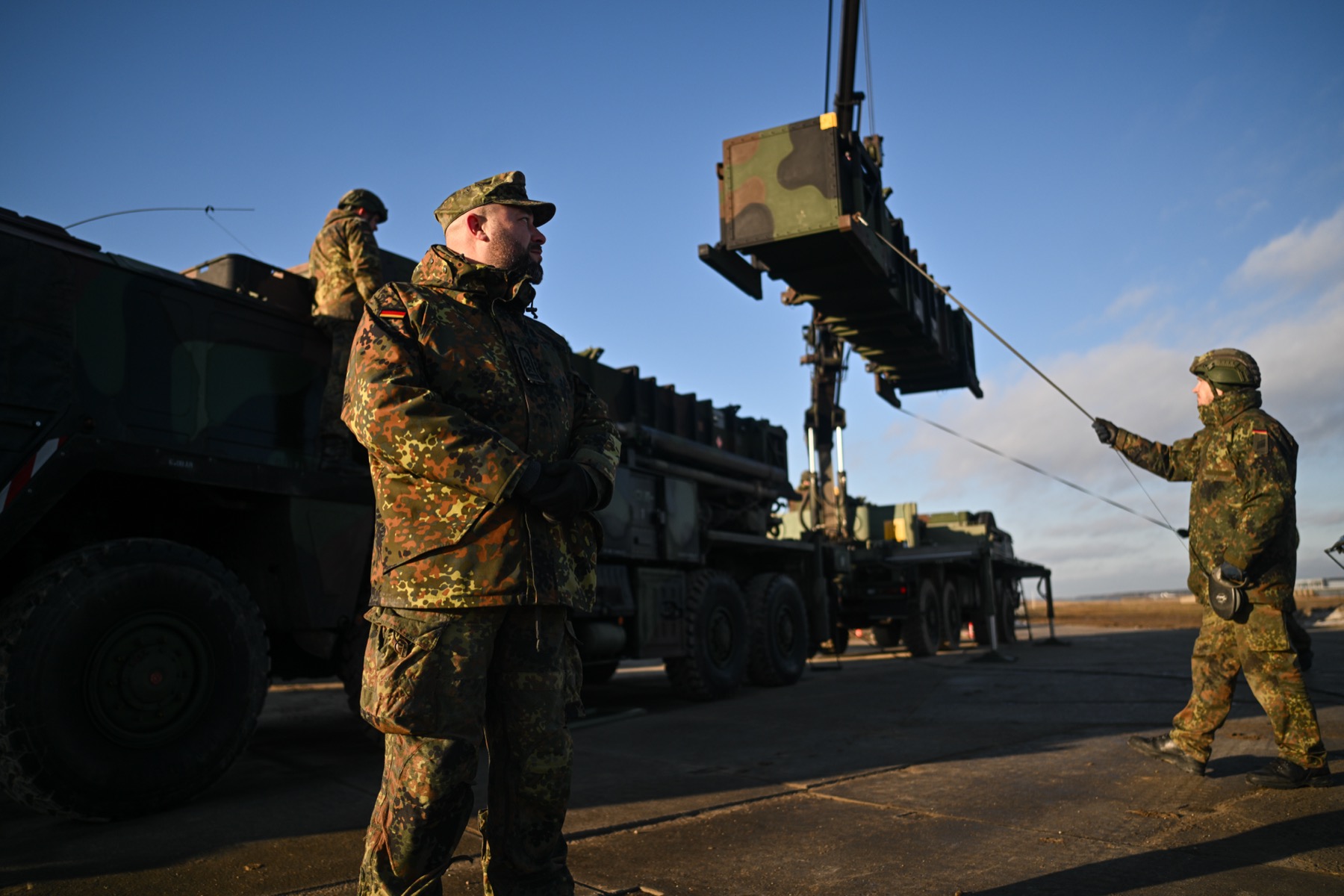
The technical heart of this package is not the F-16. It is the Patriot interceptor.
A Patriot battery normally combines AN/MPQ-53 or AN/MPQ-65 radar, engagement control stations, launchers and interceptor missiles. For Ukraine, the critical munition is the PAC-3 family, especially against ballistic missiles. PAC-3 interceptors are hit-to-kill weapons designed to physically collide with incoming targets rather than simply detonate nearby. That makes them valuable against weapons such as Iskander-M ballistic missiles and certain air-launched ballistic threats where older systems have a much narrower engagement window.
Here is the problem: PAC-3 missiles are expensive, slow to produce and in demand everywhere. A single Russian salvo can force Ukraine to make decisions that no air-defence commander wants to make: spend a high-end interceptor on a missile headed for a city, hold fire to protect a more valuable target, or rely on cheaper systems against threats they were never designed to defeat.
Germany's new $400 million pledge matters because $200 million is earmarked for PAC-3 missiles under the Jumpstart mechanism, according to the Kyiv Independent. That sounds substantial until you remember the scale of Russian attacks. Ukrainian officials said air defence and anti-ballistic missiles were priority items heading into the NATO meeting because Russia continues large missile and drone barrages against Ukrainian cities. The arithmetic is ugly. NATO can announce hundreds of millions in aid and Ukraine can still be short after one month of heavy Russian strikes.
PURL Is a Useful Fix for a Bigger Failure
PURL deserves more attention than it gets. The Swedish Defence Ministry describes it as a U.S. initiative administered by NATO that allows allies and partners to finance high-priority American defence materiel for Ukraine, including advanced air-defence systems and ammunition. In plain English: Europe pays, the United States releases equipment, NATO handles the lane discipline.
That is useful. It gives Ukraine a faster route to systems that only the United States can supply in enough quantity. It also lets European governments support Ukraine without pretending they can instantly manufacture American interceptors or missiles at home.
But there is an uncomfortable trade-off. PURL keeps Ukraine alive while reinforcing dependence on U.S. inventories and U.S. political approval. Everyone in Brussels likes to talk about European strategic autonomy until the shopping list includes PAC-3s, ATACMS-class effects or other systems sitting inside American supply chains. The short answer is that Europe has money, but it does not yet have enough munitions sovereignty.
Sweden's fourth PURL contribution, now totaling $543 million, is serious by any fair measure. The Dutch 500 million euro package, with half for drones and half for PURL, is also well aimed. Yet the structure is revealing. Europe is increasingly financing the war it cannot fully equip from its own factories.
F-16s Help but They Do Not Change the Air War Alone
Belgium's seven F-16s will be welcomed in Kyiv, especially the three operational jets. The other four matter too because spare parts are not a side issue for Ukraine's emerging F-16 fleet. They are the difference between a photo opportunity and a flyable force.
The F-16 gives Ukraine a more flexible platform for air defence patrols, precision strike, suppression tasks and integration with Western weapons. But nobody should confuse a handful of aircraft with air superiority. Russia still fields dense ground-based air defence, long-range strike aircraft and a deep missile inventory. Ukrainian F-16s will operate under constraints: limited numbers, pilot availability, maintenance complexity and the need to preserve the aircraft rather than trade them casually for marginal tactical gains.
The political value may be almost as important as the operational value. Belgium is signaling that the European F-16 coalition is not finished. Francken's suggestion that Belgium could eventually transfer all remaining F-16s, depending on F-35 deliveries, shows the logic now driving European air forces. Ukraine gets legacy fourth-generation aircraft as NATO countries transition to newer fleets. That is sensible. It is also slow, conditional and hostage to replacement timelines.
Russia Is Betting on NATO Fatigue
Moscow does not need to defeat NATO industry outright. It needs to make support for Ukraine feel endless, expensive and politically unrewarding. The $120 billion figure for 2026 is exactly the kind of number Russian information operations will use to argue that Kyiv is a bottomless pit.
That argument is cynical, but not stupid. Democracies are bad at indefinite expenditure when the benefits are preventive rather than visible. Air defence is especially hard to sell because success often looks like nothing happened. A Patriot interceptor saves a power plant or apartment block, and the political news cycle moves on. A shortage produces dead civilians and dramatic footage.
The strategic impact of this week's pledges therefore depends on what follows. If NATO treats them as a bridge toward larger ammunition production, deeper European air-defence procurement and predictable 2026 funding, they matter. If they are another batch of emergency gestures, Russia will absorb the news and keep testing the system with missiles and drones.
What to Watch Next
- Whether more countries join PURL packages focused specifically on PAC-3 and other anti-ballistic interceptors.
- How quickly Belgium can deliver the three operational F-16s and whether additional European airframes follow before winter.
- Whether the Dutch drone funding produces scalable Ukrainian strike and interceptor-drone capacity, not just procurement headlines.
- Whether NATO turns Ukraine's $120 billion estimate into a coordinated 2026 plan or leaves Kyiv to rebuild the coalition every few months.
The key finding is simple: Ukraine's defence problem is becoming less about access to individual Western systems and more about sustained access to industrial output. Patriots, F-16s and drones all matter, but the decisive variable is whether NATO can turn scattered pledges into a production-backed pipeline.
That is the uncomfortable part. NATO has enough wealth to keep Ukraine fighting. What is still unclear is whether it has enough urgency to stop treating the war like an annual funding argument.
Ukraine requested $120 billion in military aid from NATO, emphasizing the need for air defense systems and munitions. Belgium pledged seven F-16s, while Germany announced a $400 million air-defense package. Sweden and the Netherlands also contributed significant financial support for Ukraine's defense needs. The situation highlights the ongoing military and political dynamics in the region as NATO countries respond to Ukraine's urgent requirements.
- Ukraine's defense requirement for 2026 is estimated at $120 billion.
- Belgium will deliver seven F-16s to Ukraine by the end of the year.
- Germany announced a $400 million air-defense package, including PAC-3 missiles.
- Sweden's total support through PURL is now $543 million.
- The Netherlands contributed 500 million euros for drones and PURL procurement.