
Ukrainian F-16s Destroy 2500 Drones and Highlight Europe's SHORAD Gap 2026
 Dr. Klaus Weber
Ukrainian F-16s Destroy 2,500 Drones and Highlight Europe's SHORAD Gap 2026
2,500 downed Geran and Gerbera drones initially sound like a success story. In reality, they mark a wear-and-tear bill that is militarily uncomfortable for Kyiv and institutionally for Europe: The F-16s, which Western countries have been supplying to Ukraine since mid-2024, are increasingly being consumed for tasks that a modern multirole fighter is too expensive, too scarce, and too maintenance-intensive for.
The latest analysis by Justin Bronk for RUSI and the subsequent reporting by Defense News on July 30 accurately describe the core of the problem. Ukrainian F-16s have now destroyed more than 2,500 Russian one-way attack drones. At the same time, Russia is reportedly producing more than 6,000 such drones per month, according to RUSI. When these numbers are placed side by side, the operational asymmetry becomes immediately apparent: Russia is scaling cheap targets, while Ukraine is limited by flight hours, pilots, and air-to-air munitions.
The F-16 Success Becomes a Maintenance Problem
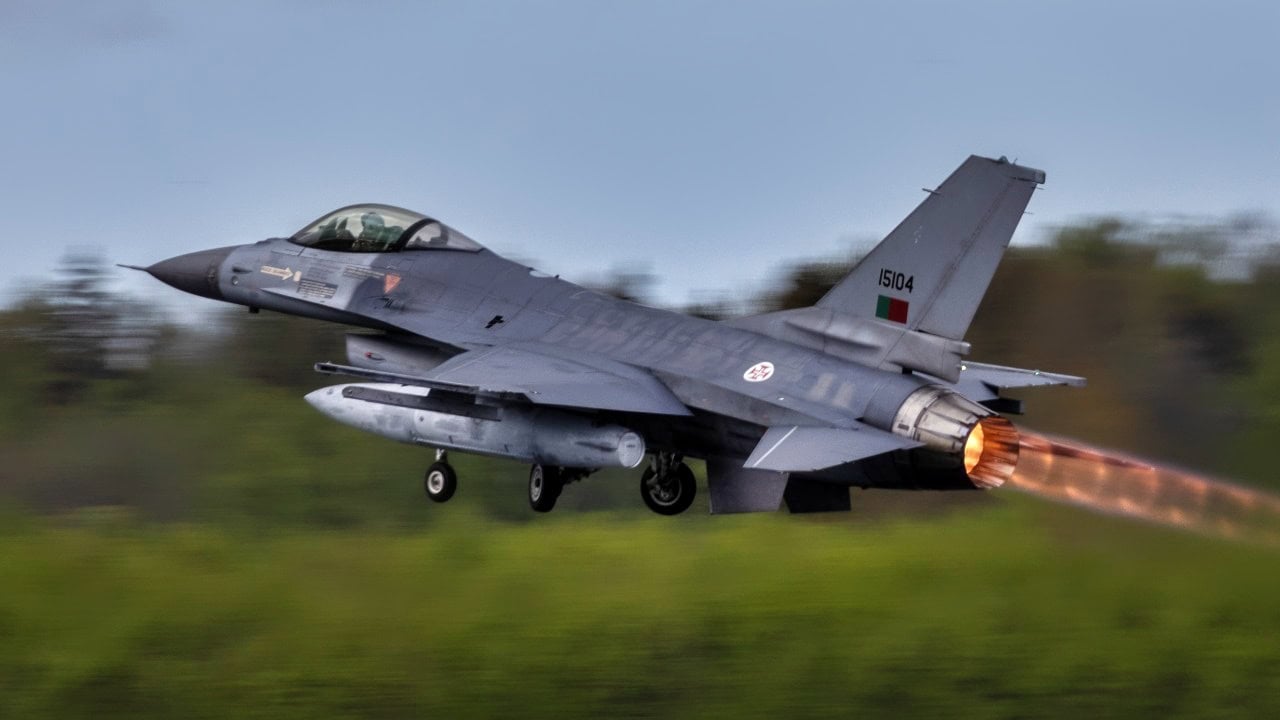
The F-16 is not a bad instrument. On the contrary. Precisely because it is flexible for Ukrainian conditions, it is being overburdened. It can engage Russian cruise missiles, deploy JDAM and AASM Hammer glide bombs, complement HARM missions, and in some cases even challenge the Russian air superiority weapon. Defense News reported on July 23 about the confirmed downing of a Russian Su-35 by a Ukrainian F-16. This is tactically noteworthy because the Su-35 fundamentally retains advantages in radar performance and missile range.
But this creates the wrong operational logic. An F-16 pursuing a Geran-2 is not protecting a formation at that moment, is not attacking a Russian logistics node, and is not conserving scarce Patriot or SAMP/T interceptors for ballistic targets. It is consuming flight hours, maintenance reserves, and possibly AIM-9 Sidewinder, Magic-2 munitions, or APKWS-II missiles against a target whose political-military purpose is precisely to tie up defense systems.
RUSI states it soberly: Combat aircraft have a finite number of flight hours before deep maintenance cycles become necessary in shipyards or specialized facilities. This technical banality is missing in many European debates. People count delivered aircraft, not available sorties. They count commitments, not maintenance capacity. They count headlines about F-16s, not the mechanics, spare parts, and munitions chains that sustain an operational fleet over the years.
79 Committed Aircraft Are Not 79 Operational Aircraft
According to publicly available Ukrainian and Western sources, Ukraine has been promised a total of around 79 F-16s. RBC Ukraine refers to about 39 currently operational aircraft, while Belgium and Norway together have not yet delivered 36 aircraft. Belgium is tying its schedule to its own F-35 deliveries, while Norway's aircraft are reportedly stuck in a Belgian maintenance loop; about 100 components are allegedly missing per aircraft. These numbers are not just a delivery statistic. They reveal the actual European weakness: Even used platforms cannot simply be extracted from national stocks without the donating states reorganizing their own force structure, training, and spare parts supply.
This is not solely a Belgian or Norwegian failure. It is a pattern of European defense policy. The platform is politically promised, but the logistical reality follows with delays. It was similar with the Leopard 2, even more severe with the Patriot, and particularly visible with the F-16 because the platform ages daily in operation. An aircraft that chases drones today may be missing tomorrow in a mission against a Kh-101 salvo or for a strike with GBU-39 Small Diameter Bombs against Russian supply routes.
SHORAD Is Cheaper, but Institutionally Harder
The obvious answer is: Drones must be countered with cheap short-range air defense. Ukrainian mobile teams use machine guns, anti-aircraft cannons, Gepard, Shilka, MANPADS, Stinger, Igla, and increasingly more intercept drones. This mix is not elegant, but it is cost-logically reasonable. A cheap drone should not regularly be neutralized by a scarce fighter jet.
The catch lies in the density. SHORAD systems cover small areas. To be effective against swarms of Geran, Gerbera, and decoys, one needs depth, personnel, sensor networking, and a large number of distributed teams. RUSI therefore points to an uncomfortable lesson for NATO Europe: The alliance cannot simply replicate the Ukrainian SHORAD density because the personnel requirements would be enormous in the long run. Particularly those European states that have cheerfully announced percentage targets in recent years are simultaneously struggling with recruitment gaps, aging reserve structures, and scarce non-commissioned officer cadres.
This is the Weber point: Capability building is not identical to procurement. Radar-guided anti-aircraft cannons, cheaper air-to-ground missiles in the APKWS style, mobile sensors, and intercept drones are not glamorous systems. They do not generate ministerial photo opportunities like a fighter jet transfer. But they determine whether expensive combat aircraft remain available for strategically more valuable tasks.
Europe Funds the Platform, but Not the Operational Economy
European support for Ukraine has qualitatively changed since 2022. Initially, it was about anti-tank weapons, then artillery, then air defense, then battle tanks and combat aircraft. This escalation of aid was militarily necessary. However, the wear and tear of the F-16s shows that Europe continues to think too much in terms of symbolic platforms. An F-16 transfer is visible. A sustainable spare parts and maintenance regime is boring. A multi-layered SHORAD architecture is even more boring. That is precisely why it is politically underestimated.
For Ukraine, the situation is immediate. Russian attacks combine waves of drones, cruise missiles like Kh-101, ground-launched Iskander-K, ballistic Iskander-M, and Kinzhal. SHORAD can hit many drones, but ballistic missiles require Patriot or SAMP/T. F-16s and Mirage 2000-5 can engage cruise missiles and deploy glide bombs, but they must not become the routine response to every cheap air target. The optimal division of labor would be clear: cheap systems against cheap targets, scarce high-end systems against targets that only they can engage.
For Europe, the lesson is more strategic. If NATO states want to protect their own airfields, depots, ports, and headquarters against Russian drone and cruise missile campaigns, neither a higher spending target nor the next big fighter jet contract will suffice. What is needed is a defense economy that treats wear and tear, munitions consumption, maintenance cycles, and personnel retention as core parameters.
The F-16 saves Ukrainian cities, but it simultaneously exposes Europe's calculation errors: We deliver high-value platforms faster than we build the cheap layers that protect them from misuse.
The paradox is uncomfortable. Without F-16s, Ukraine would have a larger gap against Russian air attacks and less capability for precise counterattacks. However, with the F-16, a new dependency on maintenance, spare parts, pilots, and Western munitions supply arises. More help is necessary. But if Europe does not learn to consider the operational economy behind the aid, every delivered fighter jet will simultaneously serve as proof of how incomplete Europe's defense turnaround still is.
Sources
- Defense News, July 30, 2026, Ukraine’s F-16s are being worn out from intercepting Russian drones.
- RUSI, Justin Bronk, Four Years On: An Update on the Air War Over Ukraine.
- RBC Ukraine, Promises vs reality: Who holds back F-16s for Ukraine?
- Defense News, July 23, 2026, Ukrainian F-16 downs Russian fighter jet for first time.
Ukrainian F-16s have destroyed over 2,500 Russian drones since mid-2024, revealing significant operational challenges and maintenance issues. With 79 F-16s pledged, only 39 are currently operational, as logistical delays hinder effective deployment. The report emphasizes the need for improved short-range air defense systems to counter the high volume of Russian drone production. This situation underscores the operational asymmetry faced by Ukraine in its air defense efforts.
- Ukrainian F-16s have destroyed over 2,500 Russian drones since mid-2024.
- Russia produces over 6,000 drones per month, creating operational asymmetry.
- 79 F-16s have been pledged to Ukraine, with only 39 currently operational.
- Maintenance and logistical issues are affecting the operational capacity of the F-16s.
- The report highlights the need for effective short-range air defense (SHORAD) systems.