
Unheeded lessons from the US warship nearly sunk by an Iranian mine
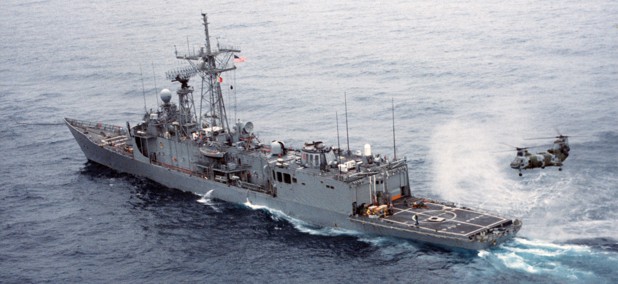
Thirty-eight years ago today, an Iranian mine tore a hole in the hull of the USS Samuel B. Roberts, a guided missile frigate that had been helping to escort reflagged Kuwaiti tankers through the Strait of Hormuz. The blast broke the frigate's keel, flooded its engineroom, and lit fires on several decks. Only its well-trained crew saved the Roberts from sinking.
The story has become a touchstone of Navy schoolhouses, where instructors exhort officers and enlisted sailors alike to take seriously the grueling business of damage control. But a strangely amnesiac effect seems to surround the threat of mines.
The attack on the Roberts came nearly a year after Iranian minelayers had first taken U.S. planners by surprise. In early 1987, Washington agreed to shepherd Kuwaiti tankers through the Persian Gulf, where Iran and Iraq were striking at each other's economic jugulars. The very first convoy of Operation Earnest Will began with three U.S. Navy warships surrounding the supertanker Bridgeton—until the giant ship hit a mine. The Bridgeton’s double hull enabled her to sail onward. But the thin-skinned U.S. warships followed in her wake, huddling behind the damaged tanker for safety.
"The assumption that the Iranians 'wouldn’t dare' was shattered,” an official Navy history recounts. “The incident also revealed that despite all the preparation for the convoy, the United States had virtually no mine-warfare assets in the Arabian Gulf. Further convoys were postponed during the scramble to deploy eight MH-53 Sea Stallion mine-warfare helicopters and eventually eight ocean-going minesweepers (MSOs) and six coastal minesweepers (MSCs)."
This was a puzzling oversight. No weapon had sunk more ships since World War II. But once shocked into action, the Pentagon responded forcefully. Besides the overt dispatch of the minesweeping vessels and aircraft, the Pentagon also launched a covert operation: Prime Chance, the first big mission of the new U.S. Special Operations Command.
Navy SEALs ran patrol boats from a pair of leased oil barges in the Gulf, while elite Army aviators flew Little Bird helicopters from U.S. warships. Together, they sank and captured enough Iranian boats to bring mine attacks to a halt as the year drew to a close.
But even the newly joint special operators couldn’t stop Iranian boats from sneaking into the Gulf. On April 14, 1988, the Roberts ran into a string of newly laid mines. They were traced to Iran, which led to Operation Praying Mantis, a one-day war of retribution. On April 18, U.S. naval forces shelled Iranian operating bases in the Gulf, sank two Iranian warships, and did yet more damage before President Reagan called the shooting to a halt.
Repairing the damage to the Roberts required 18 months and $90 million—nearly a quarter-billion in today's money. The mine that did the damage cost far less. Based on a 1908 design for the Russian empire, it likely cost around a thousand bucks.
Did the Navy emerge from the incident determined to bulk up its perennially underfunded minehunting capabilities? It did not, and has not, despite innumerable Pentagon wargames that have since underscored a continuing and urgent need for minesweepers.
Now once again, Iran is disrupting shipping through the Strait of Hormuz. Despite its advancements in missiles and drones, the humble naval mine remains a potent part of Tehran’s arsenal. Within weeks of the U.S. attack, Iranian boats began slipping mines into the strait.
The move caught the Trump administration by surprise. Just weeks earlier, the Navy had loaded its four Avenger-class minehunting vessels onto an even larger ship, and sent them thousands of miles away. “The Pentagon and National Security Council significantly underestimated Iran’s willingness to close the Strait of Hormuz in response to U.S. military strikes while planning the ongoing operation,” CNN reported.
Painfully, history is repeating itself.
I wrote a book about the Roberts, its mining, and the enduring lessons we can learn from the incident. One of them was also taught by IEDs in Iraq and Afghanistan: a determined adversary finds cheap ways to hurt technologically advanced forces.
On April 14, 1988, the USS Samuel B. Roberts was damaged by an Iranian mine in the Strait of Hormuz, prompting a significant U.S. naval response. The incident revealed the U.S. Navy's lack of mine-warfare capabilities, leading to the launch of Operation Praying Mantis against Iranian forces. Despite the costly repairs of $90 million, the Navy did not enhance its mine-hunting capabilities, which remain critical today as Iran continues to disrupt shipping in the region.
- The USS Samuel B. Roberts was damaged by an Iranian mine on April 14, 1988.
- The incident led to significant U.S. naval operations in the Persian Gulf.
- The U.S. Navy lacked adequate mine-warfare assets at the time of the incident.
- The Pentagon launched Operation Praying Mantis in response to Iranian mine threats.
- The cost of repairing the Roberts was approximately $90 million.