
U.S. Air Force plans missile warning upgrade for F-15EX
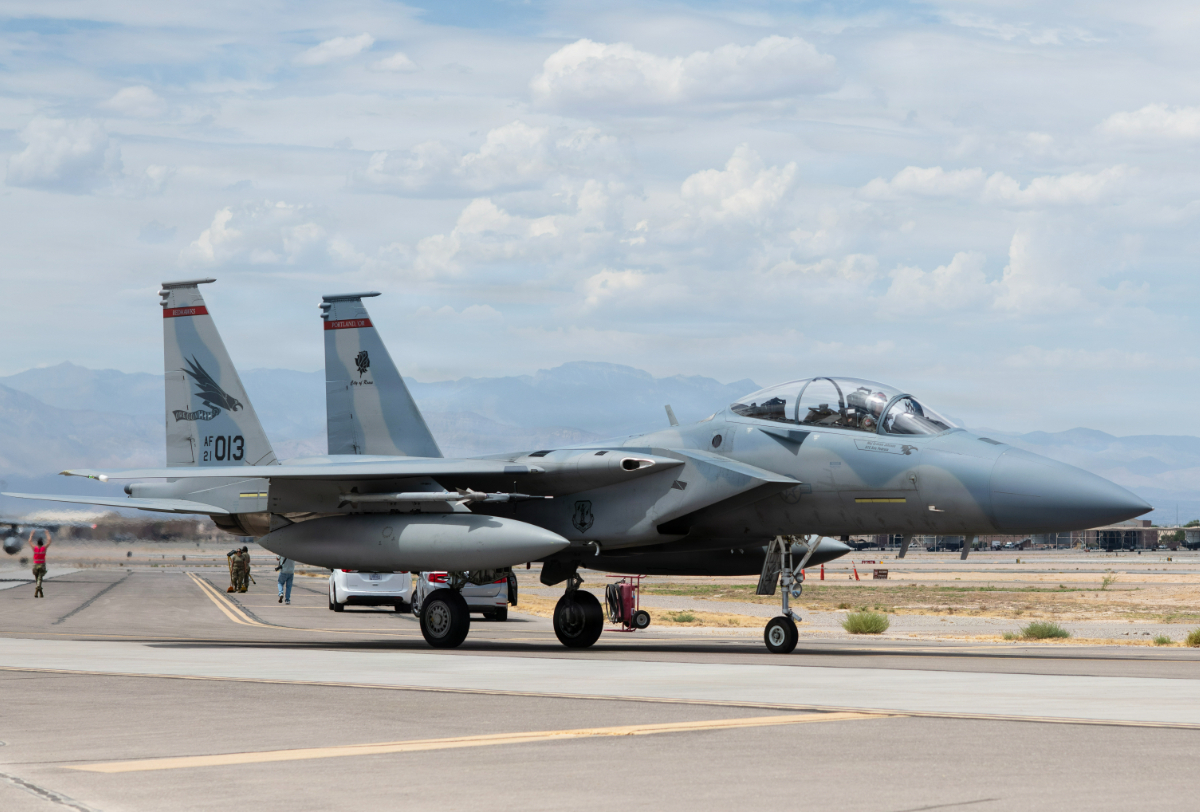
The U.S. Air Force is looking for a system that warns F-15EX Eagle II crews when a missile has been fired at them, and it wants one that is already proven on other military aircraft so it can be fitted to the new fighter quickly.
The F-15 program office at Wright-Patterson Air Force Base, Ohio, posted a sources sought notice on Sept. 29 asking companies to describe an operationally qualified missile launch and approach warning system for rapid integration into the F-15EX fleet. A sources sought notice is market research, not a request for bids, and the U.S. Air Force says it has made no commitment to buy anything. Responses are due Nov. 12.
A missile warning system uses sensors around the aircraft to spot the launch or approach of a missile, typically by detecting the heat or light of its rocket motor, and alerts the crew so they can maneuver or release flares. The U.S. Air Force says the new system must warn F-15EX crews of missile threats without distracting them with too many false alarms.
The notice shows the F-15EX was built with room for such a system. Any candidate must use six existing sensor locations on the aircraft that are set aside for missile warning, along with the jet’s existing data cables, power cables and cooling. Maintainers must be able to install and remove it in the field without changing the aircraft beyond fitting the sensor units into those six spots.
When the first F-15EX flew in 2021, The Aviationist noted that it had mounting points like those used for missile approach warning sensors on Qatar’s F-15QA, but appeared not to carry the sensors themselves.
The F-15EX’s current self-protection comes from BAE Systems’ Eagle Passive/Active Warning Survivability System, known as EPAWSS, an electronic warfare suite that provides radar warning, jamming and control of chaff and flares. Radar warning tells a pilot when enemy radars are tracking the jet, but a dedicated missile warning system is designed to catch missiles, including heat-seeking ones, that may not give off radar signals.
The U.S. Air Force’s questions point toward an existing product. It asks which U.S. military aircraft the system is already cleared to fly on, including approval for airworthiness and cybersecurity, whether it is in production today, and how many months after a contract award it could be delivered. It also asks for contacts at the offices that bought the system for other aircraft.
Several questions deal with fitting the system into Boeing’s jet. The U.S. Air Force wants to know whether it can connect to the aircraft’s standard MIL-STD-1553 data bus and on what terms a company would share its interface specification with Boeing, so the system can exchange data with the F-15EX’s mission computer. It also asks about each unit’s size, weight, power and cooling needs, and whether a vendor plans to adapt its system to a new government reference design for aircraft mission systems.
To avoid handling classified material, the notice does not ask how well each system detects missiles. The program office said it may follow up for that information with companies whose systems look like they would fit the F-15EX.
Content preview only. Full article available at source. View Full Article
The U.S. Air Force is seeking a missile warning system for the F-15EX Eagle II, posting a sources sought notice on September 29, 2023, to identify operationally qualified systems for rapid integration. Responses are due by November 12, 2023. The new system must effectively warn crews of missile threats while minimizing false alarms and should utilize existing sensor locations on the aircraft.
- The U.S. Air Force is looking for a missile warning system for the F-15EX.
- A sources sought notice was posted on September 29, 2023.
- Responses to the notice are due by November 12, 2023.
- The system must be operationally qualified and easily integrated into the F-15EX fleet.
- The current self-protection system for the F-15EX is the EPAWSS.