
US Army helicopter crew saved after crashing near Oman coast
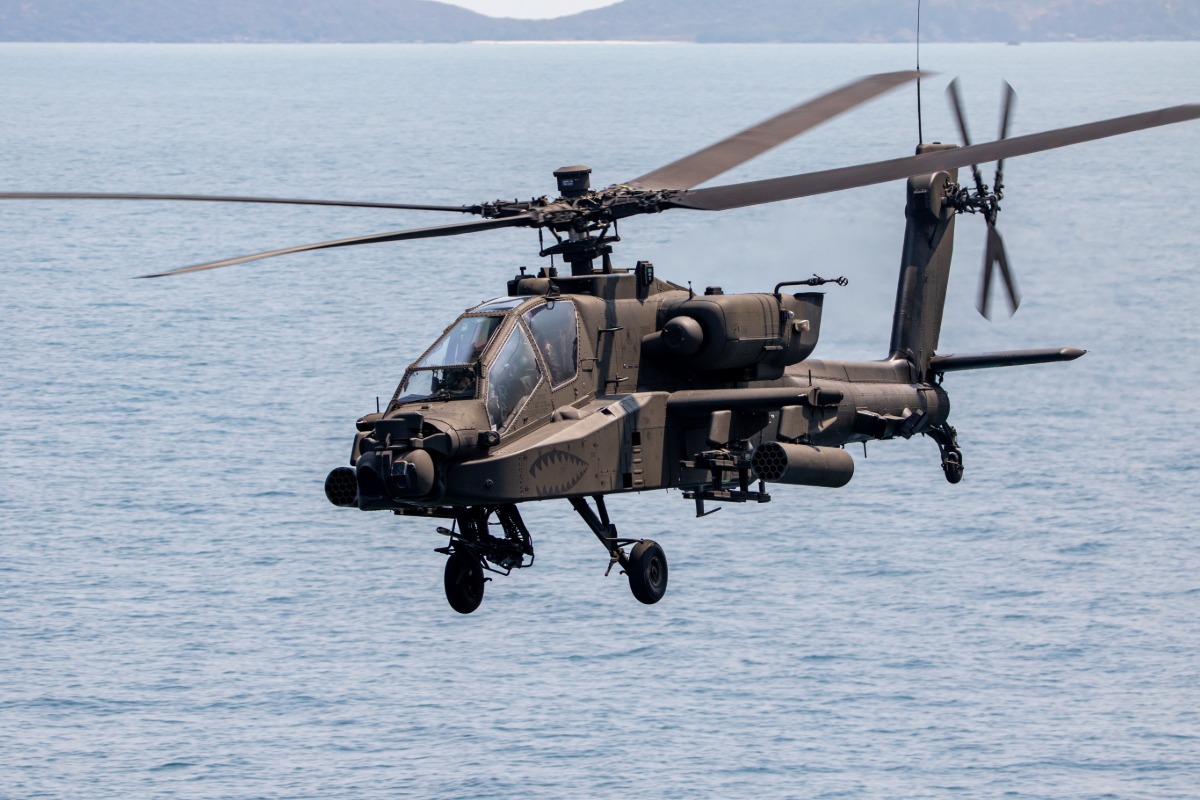
Two U.S. Army soldiers were pulled from the waters off the coast of Oman on June 8 after their helicopter went down during a patrol mission, rescued within two hours by a joint American force that scrambled across multiple military branches to reach them.
U.S. Central Command, the military headquarters overseeing American operations across the Middle East and Central Asia, announced the rescue at 7:33 p.m. Eastern Time on June 8. The helicopter was an AH-64 Apache, the U.S. Army’s primary attack helicopter, a twin-engine aircraft armed with a 30 mm chain gun, Hellfire missiles, and unguided rockets, capable of operating in both day and night conditions and widely used across the CENTCOM area of responsibility for reconnaissance and combat patrol missions. Both crew members, a pilot and a co-pilot/gunner in the Apache’s standard two-seat configuration, were rescued and are in stable condition. The cause of the incident is under investigation, and CENTCOM has not disclosed further details about what brought the aircraft down.
The rescue operation was led by U.S. Naval Forces Central Command and the 82nd Airborne Division, with support from U.S. Air Force and Navy units including Task Force 59, the U.S. 5th Fleet’s unmanned systems task force headquartered in Bahrain. The involvement of multiple branches in a rescue operation that concluded within approximately two hours reflects both the density of American military assets in the region and the well-practiced coordination between those forces that sustained regional operations demand.
Phil Stewart, citing U.S. Central Command, reported that a U.S. Navy unmanned surface vessel located and rescued the two crew from the water, in what appears to be the first time an autonomous crewless boat has recovered personnel in a real-world military emergency. The report was broken by Reuters defense correspondent Phil Stewart. CENTCOM’s initial announcement identified Task Force 59, the 5th Fleet’s dedicated unmanned systems task force, among the rescue participants, but did not specify which asset reached the crew first.
The location of the incident, near the coast of Oman, places it in one of the world’s most strategically sensitive maritime corridors. The waters off Oman’s coast border the Arabian Sea and provide access to the Strait of Hormuz, the narrow chokepoint through which approximately 20 percent of global oil supply transits. The U.S. military maintains a substantial and continuous presence in these waters through the 5th Fleet, operating from Naval Support Activity Bahrain, with assets that include surface warships, submarines, maritime patrol aircraft, and the unmanned surface and aerial systems that Task Force 59 specializes in operating. Apache helicopters patrolling regional waters in this environment are part of the routine security architecture the U.S. maintains to monitor and if necessary respond to threats to maritime traffic, including the Iranian drone and maritime harassment operations that have targeted commercial shipping repeatedly over the past several years.
The AH-64 Apache has been the U.S. Army’s frontline attack helicopter since the mid-1980s and has seen combat in every major American military engagement from the Gulf War through Iraq, Afghanistan, and multiple operations in the Middle East and Africa. The current production variant, the AH-64E Apache Guardian, incorporates upgrades including improved sensors, a more powerful engine, and the ability to control unmanned aerial vehicles from the cockpit, extending the crew’s situational awareness well beyond the aircraft’s direct line of sight. Apache crews operating in the CENTCOM area of responsibility routinely conduct maritime patrol missions over international waters, particularly in the Persian Gulf and Arabian Sea where the threat environment includes fast attack craft, mines, and drone operations attributed to Iran and its proxies.
The circumstances that brought the aircraft down remain unknown pending investigation. Possible causes in a maritime environment include mechanical or engine failure, rotor system issues, inadvertent water contact during low-altitude patrol flight, or other factors that CENTCOM has not publicly addressed. The military’s announcement was deliberately minimal on operational detail, confirming the crew’s safety and the investigation’s initiation without speculating on cause or disclosing the specific location or mission profile beyond the general description of patrolling regional waters near the Omani coast.
What the announcement does confirm is that both crew were alive and stable within two hours of going into the water, a recovery timeline that speaks directly to the readiness of American search and rescue assets in the region and the effectiveness of the multi-branch coordination that CENTCOM operations depend on. In open ocean conditions off Oman, finding two individuals in the water within that window requires precise coordination between aviation, surface, and communications assets that cannot be improvised under pressure.
Content preview only. Full article available at source. View Full Article
Two U.S. Army soldiers were rescued from the waters off the coast of Oman on June 8 after their AH-64 Apache helicopter crashed during a patrol mission. The rescue operation, led by U.S. Naval Forces Central Command and the 82nd Airborne Division, was completed within two hours. The cause of the crash is under investigation, and both crew members are reported to be in stable condition.
- Two U.S. Army soldiers were rescued after their AH-64 Apache helicopter crashed off the coast of Oman.
- The rescue operation was completed within two hours by a joint American force.
- The cause of the helicopter crash is under investigation by CENTCOM.
- The rescue involved multiple military branches, including the U.S. Navy and Air Force.
- The incident occurred in a strategically sensitive maritime corridor.