
U.S. Army scouts armored humanoids for risky missions
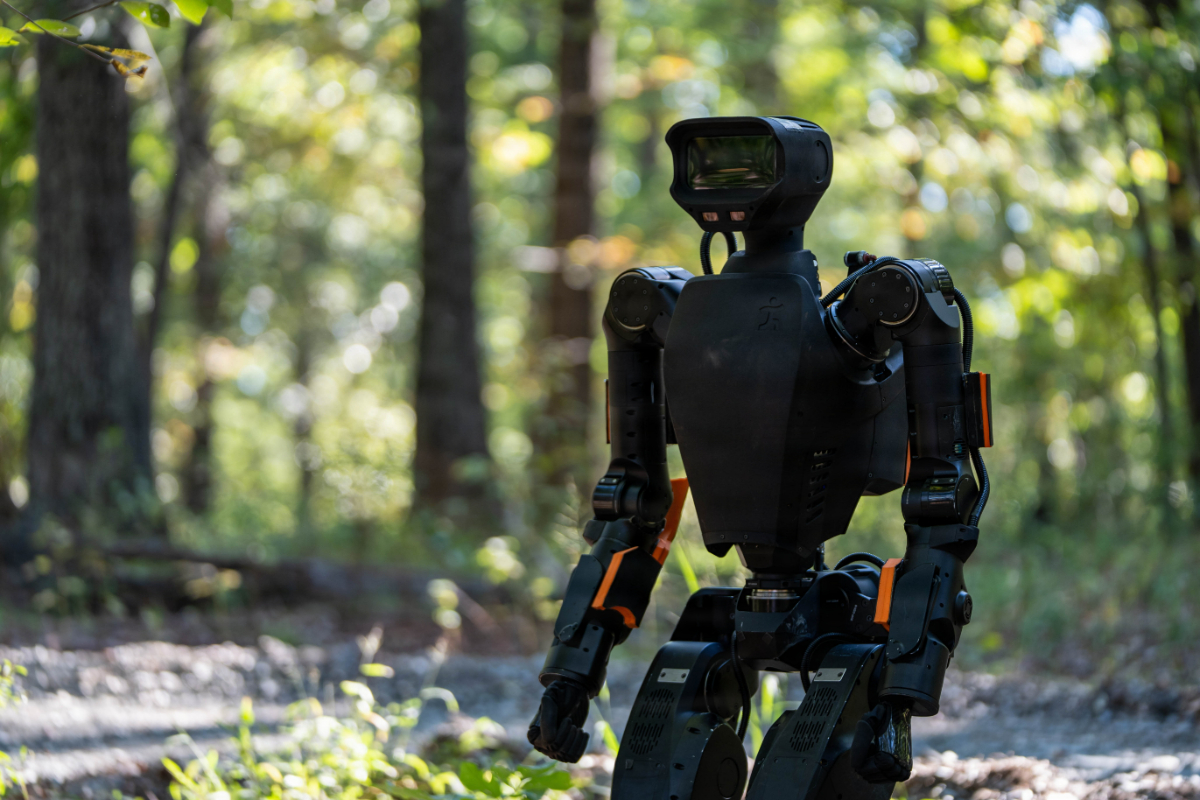
The U.S. Army has picked five winners in a competition to test how commercial humanoid robots could be used by the military, including a two-legged robot called Alex that is built to take hits and carries ballistic protection.
The Army announced the xTechHumanoid winners on Sept. 11, two days after nine finalists demonstrated their technology at Marine Corps Base Quantico, Virginia, in front of military leaders, technical experts and evaluators. The competition drew 103 white paper proposals, which were narrowed to 10 finalists.
Only one of the winners is a complete robot. Alex, developed by the Florida Institute for Human and Machine Cognition, known as IHMC Robotics, uses actuators designed to survive impacts, has ballistic protection, and runs on what the U.S. Army calls hybrid autonomy, combining artificial intelligence with human control for complex and dangerous missions.
The other four winners supply parts a working military humanoid would need. ACES Group offered an integrated power system with scalable energy storage, from individual robot batteries up to larger infrastructure. Hydroplane showed a lightweight, compact mobile generator designed to provide long-duration power where supply lines are under threat. Ras Labs won with fingertip sensors that let a robot feel force, shape and slip when it grips an object, and Velocity Explorations with software that turns commanders’ intent and trusted information into specific actions for a humanoid robot.
The U.S. Army did not say how much each winner received. The competition had a total prize pool of $490,000, with separate follow-on contracts or agreements of up to $1.25 million possible outside the prize competition, Army Recognition reported.
“xTech is our method of surveying the industry landscape and fast-tracking promising technology rather than falling victim to years-long studies,” said U.S. Army Chief Technology Officer Alex Miller.
The U.S. Army says it is looking at robotics and autonomy to keep soldiers away from dangerous and physically demanding tasks. Humanoid designs are appealing because they can, in principle, use equipment, vehicles and buildings made for people, though the service has not said which missions it has in mind for them.
The competition was run by the Army’s FUZE xTech program with the Humanoid Community of Collaboration, a joint group set up in December 2023 to work on developing humanoid robots and fitting them into military operations. The U.S. Army said the results give it and the other services a baseline on how mature commercial humanoid technology is and what problems remain.
“The xTech competition is really an interesting and unique one because it allows you to pressure test your technology in a field exercise paradigm,” said Alec Leesberg, president and co-founder of Velocity Explorations.
Power is one of the problems the U.S. Army has flagged. Two of the five winners focused on energy, and the Humanoid Community of Collaboration said its next work will address power and energy limits that could shape how humanoid and other robots are used in the field.
IHMC, based in Pensacola, Florida, has a long record in humanoid robotics, including a second-place finish at the DARPA Robotics Challenge finals in 2015.
Content preview only. Full article available at source. View Full Article
The U.S. Army announced five winners of a competition to test commercial humanoid robots for military applications on September 11, 2023, at Marine Corps Base Quantico, Virginia. Among the winners is Alex, a two-legged robot designed for risky missions with ballistic protection. The competition aimed to explore the use of robotics and autonomy in military operations, with a total prize pool of $490,000.
- The U.S. Army selected five winners in a competition for humanoid robots.
- The competition was held at Marine Corps Base Quantico, Virginia.
- One of the winners is a two-legged robot named Alex with ballistic protection.
- The total prize pool for the competition was $490,000.
- The U.S. Army aims to use humanoid robots for dangerous missions.