
U.S. Army soldiers test a plug-and-play system for armed drones
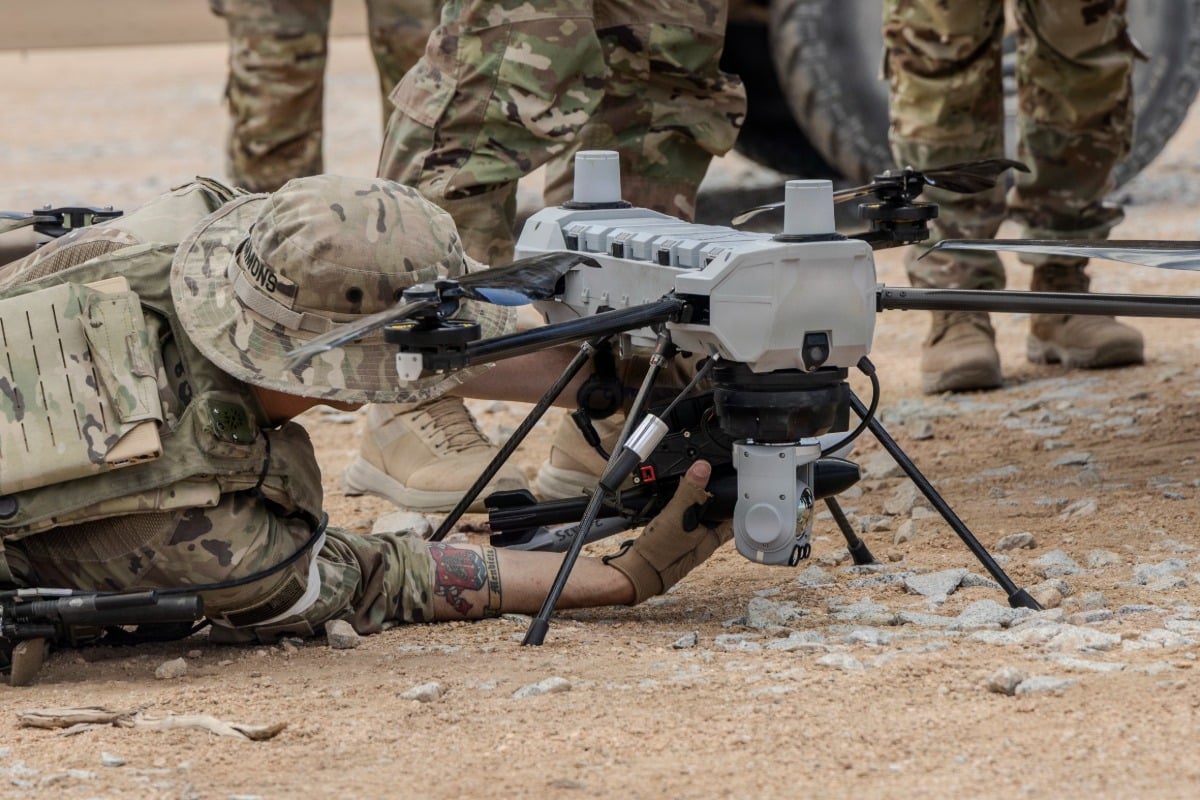
U.S. Army soldiers integrated the Picatinny Common Lethality Integration Kit onto the C100 drone during Project Convergence Capstone 6, a large-scale Army technology experiment held at Fort Irwin, California, that allows the Army, joint force, and multinational partners to test emerging capabilities and collect data supporting the service’s broader modernization push, according to the Army’s Communications and Outreach Office.
Soldiers assembled the kit onto the C100 alongside a munition air-droppable conversion kit built for mortar rounds on July 20, 2026, giving the drone the ability to carry and deploy a lethal payload using a standardized attachment system rather than a custom-built mount unique to that specific weapon.
The C100 is manufactured by Performance Drone Works, known as PDW, and functions as a multi-role platform capable of switching between roles as a scout, a bomber carrying munitions, a cargo transport, or even a mothership that carries and launches smaller first-person-view attack drones to extend their effective range. In that carrier role, the C100 can more than quadruple the effective range of the smaller FPV drones it carries, letting them reach targets more than 50 kilometers (31 miles) away rather than the shorter distances those small drones can typically cover on their own battery power, a technique already demonstrated in Ukraine using a similar carrier drone concept.
The Picatinny Common Lethality Integration Kit, developed by the U.S. Army Combat Capabilities Development Command Armaments Center, functions as a standardized mounting system between drones and lethal payloads, conceptually similar to the Picatinny Rail that has served for decades as the standard interface letting soldiers attach scopes and other accessories to their rifles. Before this kind of standardized kit existed, pairing a new weapon with a new drone typically required custom engineering work specific to that exact combination, creating what defense officials have described as vendor lock, a situation where a military customer becomes stuck relying on a single manufacturer because switching to a different company’s weapon or drone would require rebuilding the entire integration from scratch.
PDW framed the demonstration as proof that its drone’s underlying architecture is built to evolve alongside whatever new weapons or missions the Army develops next, rather than requiring a new aircraft every time requirements shift.
“Battlefield adaptability isn’t a future requirement. It’s mission critical today,” PDW said in a statement.
The company tied that broader philosophy directly to the specific integration Sergeant Simmons performed at Fort Irwin, arguing the exercise demonstrated the practical value of building military hardware around shared standards rather than proprietary systems locked to a single vendor.
“At Project Convergence Capstone 6, US Army soldiers integrated the Picatinny Common Lethality Integration Kit onto the C100, demonstrating how an open architecture enables rapid mission adaptation as operational needs evolve. Modern battlefields demand systems that can integrate new capabilities, adapt to emerging threats, and keep pace with the operator. That’s exactly what the C100 was built to do,” PDW said.
The Army’s own engineers have described the underlying goal behind the Picatinny CLIK in similar terms, framing it as a way to let weapons manufacturers focus purely on building effective lethal payloads rather than spending resources solving integration problems for every individual drone platform on the market. The Armaments Center hosted an industry day focused on the kit in July 2025 that drew more than 300 industry and government experts and over 70 companies specializing in unmanned systems and munitions, reflecting how broadly the Army wants this standard adopted across the defense drone industry rather than limiting it to a single preferred vendor relationship. The same underlying architecture has already supported other rapid weapons integration efforts, including a program called BRAKER that moved from initial concept to a live-fire demonstration of a small drone-deliverable bunker-busting warhead in just two weeks, according to prior Army reporting.
Project Convergence Capstone 6 itself represents the Army’s latest iteration of an annual experimentation series designed to test new technology concepts alongside actual soldiers under realistic field conditions rather than in a sterile laboratory setting, gathering data the service says will directly inform its broader transformation efforts across multiple weapons and equipment programs simultaneously. The event brings together not just Army units but joint force and multinational participants, giving officials a chance to test how new equipment like the C100 and its Picatinny CLIK-mounted payload might function within a coalition operating environment rather than an American unit operating entirely on its own.
Content preview only. Full article available at source. View Full Article
U.S. Army soldiers integrated the Picatinny Common Lethality Integration Kit onto the C100 drone at Fort Irwin, California, on July 20, 2026. This integration allows the drone to carry and deploy lethal payloads, demonstrating its adaptability for various military roles. The exercise was part of Project Convergence Capstone 6, aimed at testing new technology concepts in realistic field conditions.
- U.S. Army soldiers tested the Picatinny Common Lethality Integration Kit on the C100 drone.
- The integration allows the drone to carry and deploy lethal payloads.
- The C100 drone can function in multiple roles, including as a bomber and cargo transport.
- The technology was demonstrated during Project Convergence Capstone 6 at Fort Irwin, California.
- The integration aims to enhance battlefield adaptability and reduce vendor lock.