
US INDOPACOM Mission Network Makes Balikatan 2026 a Targeting Test
 Marcus Chen
US INDOPACOM Mission Network Makes Balikatan 2026 a Targeting Test
Six countries on one command network is the part of Balikatan 2026 that matters more than the missile launches. Tomahawk from Typhon made the cleaner headline. Japan's Type 88 anti-ship shot made the better photograph. But the new INDOPACOM Mission Network, first used operationally as the primary command-and-control network for the multinational force, is the harder problem and the more important test.
Naval News reported that the zero-trust platform linked U.S., Philippine, Australian, Japanese, New Zealand and Canadian forces during the exercise. Admiral Samuel Paparo described it as the first operational employment of the network together, embedded across the multinational force and tied to the new Combined Coordination Center at Camp Aguinaldo. That is not a software footnote. In a Western Pacific fight, the side that can move target-quality data across national boundaries without waiting for a headquarters meeting gets the first usable shot.
The Network Is Now Part of the Weapon
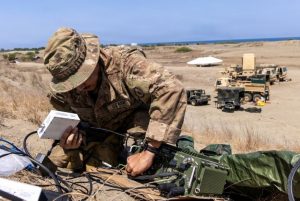
The exercise architecture matters because the geography is brutal. Batanes, Balabac, Palawan, Ilocos Norte and Zambales are not points on a briefing slide. They are separated by water, weather, civilian infrastructure, contested spectrum and different national release rules. A missile battery on Luzon is useful only if it receives a track in time, can trust the track, can deconflict airspace, and can fire before the target leaves the engagement window.
That window is short. A destroyer moving at 20 knots covers roughly 37 kilometers in an hour. A targeting chain that takes 45 minutes to classify, approve and transmit may still be useful against a fixed site. Against a ship, it becomes historical reporting. Anyone who has stood watch on a destroyer knows the difference between a contact report and a fire-control quality track. The former fills the screen. The latter kills or saves ships.
Balikatan's counter-landing live-fire event in Palawan is therefore the right test case. According to Paparo, sensors fed into a combined command-and-control system coordinating fighter aircraft, mortars, machine guns and multinational maneuver forces. Lockheed Martin separately said its NGC2 prototype linked sensors and edge nodes in the Philippines with command nodes in Hawaii and the continental United States, while Apache helicopters, howitzers, mortars and HIMARS executed fires under a live operational picture.
Zero Trust Is a Wartime Requirement
The phrase "zero trust" gets abused in defense marketing, but in this case it points to a real operational problem. A U.S. commander may need data from a Philippine coastal sensor, a Japanese maritime patrol aircraft, an Australian liaison cell and a U.S. airborne ISR feed. Each participant has different networks, authorities and political constraints. If the architecture assumes that everything inside the perimeter is trusted, it breaks the moment the coalition gets wider or the adversary gets inside the network.
The Indo-Pacific Mission Network is meant to control access at the user, device and data level rather than treating the coalition as one trusted pipe. That is slower to build, but closer to how a real crisis will work. Manila will not simply hand every feed to Washington. Tokyo will not treat every Philippine node like a Japanese one. Canberra and Wellington will bring capabilities, but also national caveats.
If this sounds bureaucratic, that is because kill chains are bureaucratic before they are kinetic. The shooter is usually the last thing that arrives. The harder work is making sure the right sensor report can legally, technically and securely reach the right firing unit at the right minute.
China Will Attack the Links First
The People's Liberation Army does not have to sink every HIMARS launcher or shoot down every aircraft to blunt this architecture. It can jam, spoof, delay, flood or politically fracture the network. In a Taiwan or South China Sea crisis, Beijing would likely treat coalition data-sharing as a center of gravity. The obvious tools are electronic warfare and cyber operations. The less obvious tool is ambiguity: forcing allies to ask whether a track is hostile, whether the data can be released, and whether escalation rules permit a shot.
That is why the Combined Coordination Center at Camp Aguinaldo deserves attention. A command-and-control hub between the Armed Forces of the Philippines and U.S. Indo-Pacific Command changes the alliance from episodic exercise cooperation toward standing crisis machinery. Paparo said future Balikatan exercises and multilateral maritime activities can be led through coalition combined command centers. If that becomes normal, the alliance gains something more valuable than another launcher: a rehearsed decision process.
The weakness is that a rehearsed process is not the same as a resilient one. Balikatan is scheduled, instrumented and politically prepared. A real crisis around Second Thomas Shoal, Batanes or the Luzon Strait would be dirty. Communications would be degraded. Civilian networks would be congested. Legal advisers would be in the loop. Senior civilians would want control over shots that could kill Chinese sailors or airmen.
The Missile Math Still Depends on Data
The Philippines wants more missile systems after watching the Balikatan fires, according to comments by Armed Forces chief General Romeo Brawner Jr. That makes sense. Archipelagic defense requires land-based anti-ship, air defense and counter-landing fires. But buying missiles without solving targeting is a familiar trap.
A Typhon battery can launch Tomahawk. HIMARS can eventually fire anti-ship Precision Strike Missile variants. Japan's Type 88 proved it can be fired overseas in a Philippine exercise. None of that answers the central question: who finds the target, who confirms it, who owns the track, and who has authority to shoot? In the first island chain, that question crosses national borders almost immediately.
The U.S. military often talks about distributed operations as if dispersion itself creates survivability. It does not. Dispersion creates survivability only if the dispersed force can still think and shoot as one force. Otherwise it creates isolated launchers with expensive missiles and stale information.
What to Watch Next
The next useful metric is not whether Balikatan 2027 has a larger missile shot. It is whether the mission network handles logistics, air defense and maritime targeting under degraded conditions with more allies connected. Lockheed Martin said its next Lightning Surge event will focus on a logistics mission thread for the 25th Infantry Division. That is less dramatic than sinking a target ship, but probably more important. Ammunition, fuel, spare parts and medical evacuation are where distributed forces either become real or become stranded.
Washington should also be honest about scale. One combined command center and one operational network demonstration do not solve allied C2 in the Indo-Pacific. They prove the problem is finally being tested at the right level. That is progress, but it is not yet combat credibility.
The lesson from Balikatan 2026 is simple: the coalition is learning to connect its sensors and shooters before the shooting starts. If it cannot do that under exercise conditions, it has no chance in a Chinese electronic-warfare environment. If it can, then every island missile battery, patrol aircraft and coastal sensor becomes more than a national asset. It becomes part of a regional fire-control system.
That is the line Beijing will try to cut first.
The U.S. INDOPACOM Mission Network was operationally tested during the Balikatan 2026 military exercise in the Philippines, integrating forces from the U.S., Australia, Japan, New Zealand, Canada, and the Philippines. The exercise focused on command and control operations, utilizing various military equipment including Tomahawk missiles and HIMARS. A Combined Coordination Center was established to enhance coalition data-sharing and operational effectiveness.
- The U.S. INDOPACOM Mission Network was operationally tested during Balikatan 2026.
- Six countries participated in the exercise, focusing on command and control integration.
- The exercise involved various military equipment including Tomahawk missiles and HIMARS.
- The Combined Coordination Center at Camp Aguinaldo was a key component of the exercise.
- Future exercises will build on the lessons learned regarding coalition data-sharing and command processes.