
U.S. Navy switches next Growler jammer batch to extended-range version
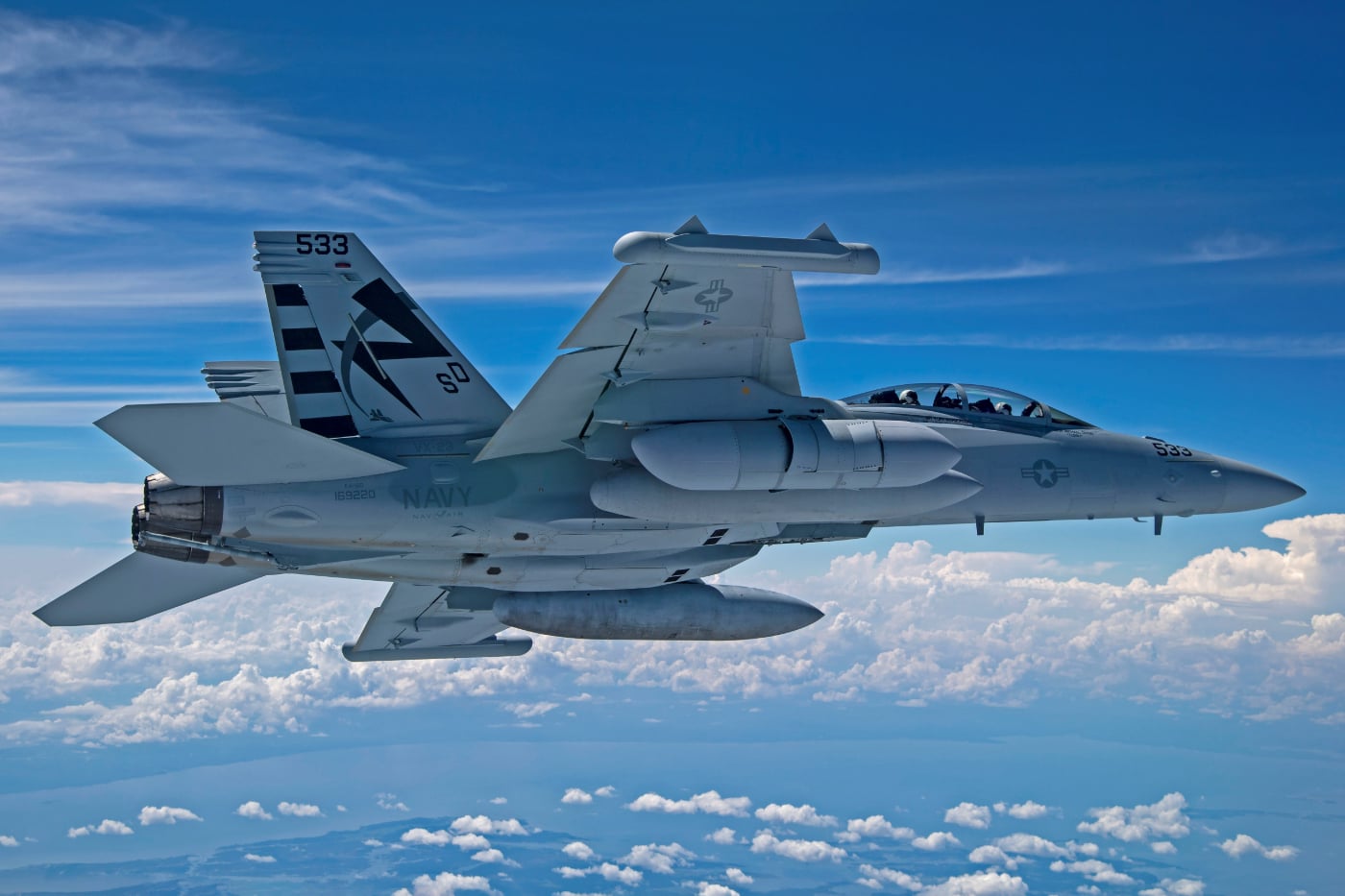
Raytheon will build the newest production batch of the U.S. Navy’s Next Generation Jammer Mid-Band pods in an extended-frequency version under a $42.1 million contract change the U.S. Department of War announced on Nov. 13.
The change brings “the mid-band extended configuration” into Lot Five, the batch the U.S. Navy ordered in May 2025 for $580.6 million. It “converts the existing production requirement” to the new version “without increasing the existing Lot Five quantity,” the announcement said. The U.S. Navy gets the same number of pods, built to a newer standard.
The jammer is designated AN/ALQ-249 and hangs under the Growler’s wings in pairs. Two pods make one shipset. Each pod uses electronically steered antenna arrays to aim jamming energy at enemy radars, communications and data links, and it can work against several targets at once. It replaces the AN/ALQ-99, a system with mechanically steered antennas that dates to the Vietnam War.
The U.S. Navy originally planned three new jammers: low-band, mid-band and high-band. Raytheon won the mid-band work, and L3Harris is developing the low-band pod. The high-band pod was never funded. DefenseScoop reported in 2024 that it hadn’t had a budget line since at least fiscal 2020, and that the U.S. Navy saw stretching the mid-band pod upward as the quickest way to cover near-term threats.
That stretch is the mid-band extended version, usually shortened to MBX. The U.S. Navy started it in 2023 as the first engineering change to the mid-band pod. Its purpose, according to the program’s December 2023 acquisition report, is to “increase the upper frequency limit of NGJ Mid-Band.”
The exact frequencies are classified. Unofficial estimates cited by the Journal of Electromagnetic Dominance put the mid-band pod at roughly 2 to 6 GHz and the unfunded high-band pod at 6 to 18 GHz.
Raytheon got a $192 million contract in October 2024 to develop the extended version. The work centers on two parts: a new antenna array and a new frequency converter module. Raytheon was to deliver 12 prototype arrays and 36 converter modules, with testing scheduled to start in fiscal 2026 and run through fiscal 2028, the journal reported, citing U.S. Navy budget documents.
A Raytheon spokesperson told DefenseScoop at the time that the new arrays would go into new production pods and also be retrofitted to pods already in the fleet. Two months later, when the U.S. Navy placed a $590 million order for Lot Four, the company said that batch would stay in the baseline configuration and the extended version would arrive in a later lot. Lot Five is now that lot.
The conversion adds time. Lot Five was due to finish in November 2028 when it was ordered. The converted work now runs six months longer.
Most of the money comes from U.S. Navy aircraft procurement accounts: $28.8 million from fiscal 2025 and $5.2 million from fiscal 2027. Another $8.05 million, about 19 percent, is listed as “foreign cooperative projects (Navy) funds.” The announcement doesn’t name the partner. Australia joined the program as a cooperative partner in October 2017 and flies its own Growlers. Four of the 13 shipsets in Lot Four were for the Royal Australian Air Force.
Raytheon’s plant in McKinney, Texas, will do 65.7 percent of the conversion work, followed by Forest, Mississippi, with 20.4 percent. That reverses the split in the original Lot Five order, where Forest had 53 percent and McKinney 41 percent. The change was “not competitively procured,” the announcement said.
The baseline pod has already been to war. Electronic Attack Squadron 133 took it on its first deployment in 2024 aboard USS Abraham Lincoln (CVN 72), flying in the Red Sea region, and the U.S. Navy declared initial operational capability that December. Earlier this year, The War Zone reported that Growlers supporting strikes on Iran were flying with one new pod and one old ALQ-99. The same report said the Pentagon’s test office found the pods still faced problems as of the end of fiscal 2025.
Production has been slow to scale. The U.S. Navy picked Raytheon’s design in 2013 and awarded a $1 billion development contract in 2016. Raytheon delivered the first test pod in 2019. The first production lot, worth $172 million, came in July 2021, and a second lot of five shipsets followed that December for $227 million. The U.S. Navy’s plan calls for 129 shipsets, or 258 pods.
Work on the converted lot “is expected to be completed in May 2029,” according to the announcement.
Content preview only. Full article available at source. View Full Article
The U.S. Navy has transitioned the production of its Next Generation Jammer Mid-Band pods to an extended-range version under a $42.1 million contract with Raytheon. This change affects Lot Five, ordered in May 2025, maintaining the same quantity of pods while upgrading their capabilities. The conversion work is set to be completed by May 2029, with significant portions of the work being conducted in McKinney, Texas, and Forest, Mississippi.
- Raytheon awarded a $42.1 million contract for the extended-range Growler jammer pods.
- The U.S. Navy's Lot Five order includes the same number of pods but with upgraded specifications.
- The conversion work is expected to be completed by May 2029.