
Washington Is Counting to Nine. China Is Already Operating Three.
 Marcus Chen
Washington Is Counting to Nine. China Is Already Operating Three.
The Pentagon's annual China military power report, released in December 2025, landed with the usual anxious headlines: China wants nine aircraft carriers by 2035. That number — nine — became the frame for every subsequent analysis. How many years would it take? Could China's shipyards actually deliver? Would it match the U.S. Navy's eleven?
Wrong question. The right question is what China's current three carriers already accomplished in 2025 — and the answer to that should be keeping planners in Pearl Harbor awake at night.
What Three Carriers Actually Did
The CSIS China Power Project published its 2025 operational tempo assessment on February 5, 2026. The numbers are worth sitting with. The PLA conducted 3,764 air incursions into Taiwan's air defense identification zone last year — a 22.4 percent increase over 2024, itself already a record. The PLA ran 163 recorded operations in the South China Sea, including a record number of live-fire drills. China's Coast Guard more than doubled its presence around Scarborough Shoal.
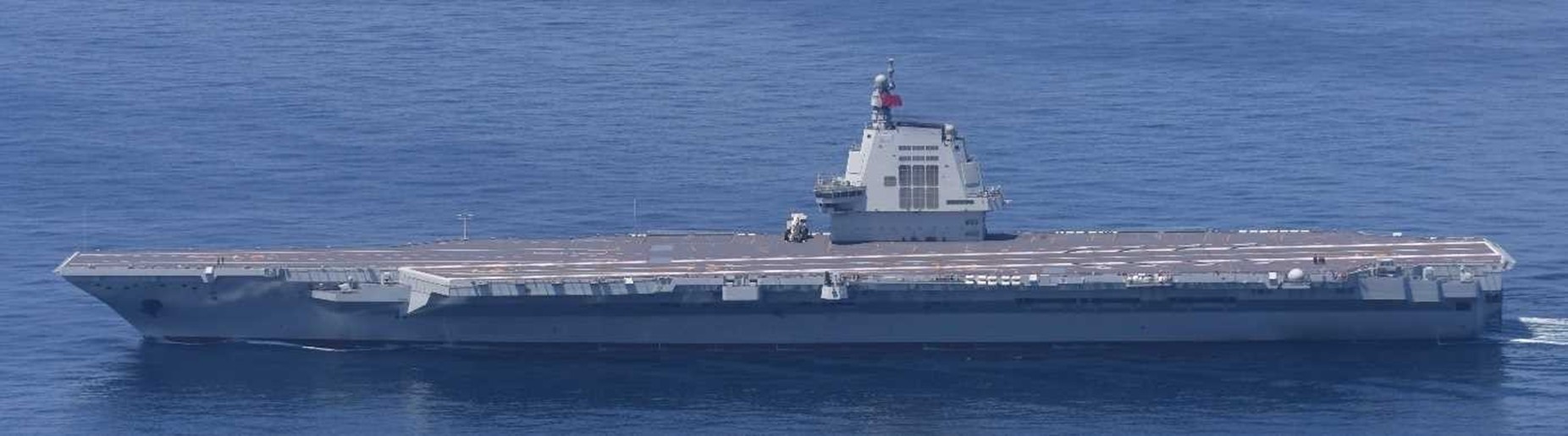
All of that happened with Liaoning and Shandong — neither of which is a modern CATOBAR carrier. The Fujian (CV-18), China's third and most capable flat-top, was commissioned in November 2025. Its Pacific operational contribution is still being calculated.
But here's the data point that matters most: in 2025, for the first time, China conducted simultaneous dual-carrier operations beyond the First Island Chain. Both Liaoning and Shandong deployed concurrently into open Pacific waters. Chinese naval groups conducted live-fire exercises in the vicinity of Australia and New Zealand. That's not a South China Sea patrol. That's blue-water power projection.
Anyone who's tracked carrier schedules knows what this means. Simultaneous multi-carrier deployments require logistics trains, replenishment-at-sea capability, coordinated air wing operations, and command-and-control architectures. China spent the last decade building that infrastructure. In 2025, they used it.
The Fujian Changes the Calculus
The Fujian is not Liaoning. Liaoning is a refitted Soviet hull, essentially a training vessel that taught the PLAN how carriers work. Fujian is purpose-built with electromagnetic catapult launch systems (EMALS equivalent), enabling it to launch heavier aircraft with full weapons loads — including the J-35 stealth fighter. It's based at Sanya, on Hainan Island's southern tip, putting it roughly 1,000 nautical miles from Manila and well within range of the Luzon Strait and the Philippine Sea.
According to Tom Shugart at the Center for a New American Security, Fujian's catapult system points toward "a more survivable, long-range" air wing. That means higher sortie rates, heavier strike packages, and eventually — when the J-35 carrier variant matures — fifth-generation air superiority over contested Pacific approaches.
The U.S. Navy has CATOBAR carriers. It also has eleven of them, which sounds like a comfortable margin until you apply the deployment math. The Navy keeps roughly three to four carriers at sea at any given time. Maintenance cycles, training rotations, and the demands of the Atlantic, Mediterranean, and Persian Gulf mean the Indo-Pacific typically gets one, maybe two carrier strike groups on any given day. China now has one CATOBAR carrier permanently homeported in the South China Sea.
That gap is smaller than it looks in the headline numbers.
What Nine Would Actually Mean
The Pentagon report says China plans six Type 004 nuclear-powered carriers by 2035, bringing the total to nine. Satellite imagery from Jiangnan Shipyard in Shanghai has already confirmed Type 004 construction is underway — a hull section exceeding 320 meters, with reactor compartment covers consistent with nuclear propulsion, estimated displacement between 105,000 and 110,000 tons. That puts it in Ford-class territory.
Nuclear propulsion matters for one specific operational reason: range without replenishment. A nuclear carrier can sustain operations indefinitely without fuel stops. For China, that means carrier strike groups that can operate in the Indian Ocean, the western Pacific, and even the southern Pacific without the logistics tail that currently constrains PLAN deployments. It's the difference between a regional navy and a global one.
Can China build six nuclear carriers in nine years? The more honest question is whether Jiangnan can actually deliver that schedule. China commissioned Fujian in roughly eight years from keel-laying to commission. Nuclear propulsion adds complexity — the U.S. took years longer per hull when it transitioned to nuclear carriers, and even the Gerald R. Ford program ran years over schedule. The Pentagon may be right about China's ambition. Whether the shipyards match it is a different matter.
But note what the debate about 2035 is doing: it's pulling attention away from 2026. China has three carriers now. Fujian just entered service. The operational learning curve that produced simultaneous Pacific deployments in 2025 continues to steepen. Washington is modeling a future threat while the present one is already underway.
The Operational Experience Problem
Carrier aviation is not a capability you buy. It's a capability you accumulate — through hundreds of arrested landings, through night operations in sea state four, through coordinating strike packages with destroyers and submarines in actual ocean environments. The U.S. Navy has seven decades of it. China had essentially none in 2012.
In 2025, China conducted its first simultaneous multi-carrier Pacific deployment. That is the metric that should structure U.S. planning assumptions — not the 2035 headline count. The PLAN is closing the experience gap at a rate that was not anticipated when Liaoning was commissioned a decade ago. By the time Type 004 joins the fleet, the crews operating it will have had years of Fujian deployments behind them.
The U.S. has eleven carriers. It has one Gerald R. Ford-class fully operational, with the program still working through teething issues on subsequent hulls. The Navy's frigate program is in restructuring. The submarine industrial base is strained. AUKUS submarine deliveries to Australia are running behind on a schedule that was already optimistic.
The Number That Actually Matters
Nine by 2035 is a planning horizon. Three in 2026 is the operational reality. The CSIS data from 2025 shows China achieving record operational tempo across every Indo-Pacific metric — Taiwan Strait, South China Sea, Japan's periphery, and beyond the First Island Chain — with a carrier force that has since grown by one third.
The debate over nine assumes the threat crystallizes in 2035. It won't. It's crystallizing now, carrier by carrier, deployment by deployment, each exercise building the institutional knowledge that turns steel into fighting power.
Washington is counting to nine. China stopped counting and started operating.
China's People's Liberation Army Navy (PLAN) conducted simultaneous dual-carrier operations in the Pacific in 2025, marking a significant increase in military activity. The PLAN executed 3,764 air incursions into Taiwan's air defense identification zone and conducted live-fire drills in the South China Sea. The commissioning of the Fujian carrier enhances China's naval capabilities, allowing for more effective power projection. China plans to expand its carrier fleet with six additional nuclear-powered carriers by 2035, indicating a shift towards a more global naval presence.
- China conducted 3,764 air incursions into Taiwan's air defense identification zone in 2025, a 22.4% increase from 2024.
- The PLAN executed 163 operations in the South China Sea, including live-fire drills.
- China's Fujian carrier was commissioned in November 2025, enhancing its naval capabilities.
- Simultaneous dual-carrier operations were conducted beyond the First Island Chain for the first time in 2025.
- China plans to build six Type 004 nuclear-powered carriers by 2035.