Chengdu J-36

🇨🇳China
Chengdu Aircraft Industry Group
2025 – Present
Spotlight

China's largest tailless combat jet - and almost everything about it is inference.

New Chinese fighter jet seen over Chengdu (CNA)

Watch on YouTube
Overview
Chengdu J-36 - Image 1
Chengdu J-36 - Image 2
Chengdu J-36 - Image 3
Chengdu J-36 - Image 4
Chengdu J-36 - Image 5
Chengdu J-36 - Image 6
The Chengdu J-36 is a sixth-generation Chinese fighter aircraft featuring advanced stealth, supercruise capabilities, and a large payload capacity. It is designed for air-to-air engagements, precision strikes, and control of unmanned systems. The aircraft is characterized by its trijet configuration, diverterless supersonic inlets, and a double-swept waverider design.
Specifications

General

Crew2
Radaractive electronically scanned array (AESA)
Engines3
StealthYes
Generation6th
Max Speed Mach2.5 Mach

Other

Length~19 m (est.; ~62 ft measured from commercial satellite imagery, August 2025)
Wingspan~20 m (est.; ~65 ft measured from commercial satellite imagery, August 2025)
Powerplant3 x afterburning turbofans, WS-10 'Taihang' derivatives on prototypes; 2D thrust-vectoring nozzles from the second airframe onward (unconfirmed)
ConfigurationTailless modified delta/diamond wing, no vertical surfaces, three intakes - two ventral plus one dorsal DSI (assessed from imagery)
Program StatusFlight test / technology demonstration; no announced service entry date (assessed as of August 2026)
Designation Status"J-36" is an unofficial analyst label derived from a visible serial number; no PLA designation, name or specification has been released (unconfirmed)
Max Takeoff Weight~45,000-52,000 kg (est.; 100,000-115,000 lb, analyst estimate from landing gear)
Prototypes Observed5 reported as of July 2026 (unconfirmed)
Latest Developments
Aug 17, 2026strong signal
China’s New Chengdu J-36 ‘Diamond’ Stealth Fighter Is a Social Media Superstar That Beijing Won’t Officially Admit Exists Just Yet

In December 2024, the Chengdu J-36 made its first flight, shocking observers worldwide with its tailless diamond-wing design.

Jul 3, 2026strong signal
China Is Mocking the F-47 NGAD Fighter’s Canards: America Flew That Tailless Design 31 Times in 1997 and We Visited It

Observers reported what may be a third J-36 prototype by late 2025, flight testing has continued into 2026, and the aircraft was acknowledged among China’s sixth-generation fighters at Beijing’s September 2025 parade.

Jun 15, 2026strong signal
What Are China’s J-36 And J-50 Sixth-Generation Fighters, And How Far Ahead Are They Of America’s F-47 NGAD?

The most striking detail is the J-36’s engine count.

May 6, 2026strong signal
‘This Would Cripple the U.S. Navy’: Why the F/A-XX Fighter Delay Is Making Russia and China Smile

China has been flight-testing two sixth-generation fighter prototypes — the Chengdu J-36 and the Shenyang J-50 — since December 2024

Feb 25, 2026weak signal
Forget F-35 or F-47: China’s White Emperor Fighter ‘Mock-Up’ Claims Nuclear Hypersonic Capabilities

China is also reported to be developing the Chengdu J-36, a trijet tailless aircraft with a diamond-double-delta wing design, which reportedly has two operational prototypes.

Jan 29, 2026strong signal
From F-22 To F-47 To GCAP: The Case For Bigger, Stealthier Fighters Built For A System Of Systems

China’s tailless, blended-wing-body J-36—reportedly far larger than today’s fighters and employing an unusual three-engine configuration—is framed as an experimental path toward the thrust and onboard power these roles require.

Dec 31, 2025strong signal
China’s Military Just Flashed a Third J-36 Stealth Fighter

China has showcased a third J-36 stealth fighter

Featured Coverage
Research Notes

Emerging Chinese next-generation combat aircraft

medium

Chengdu J-36 is an open-source name for a newly observed Chinese combat-aircraft design, with details still uncertain.

Chengdu J-36 is a current, high-uncertainty aircraft entry. Open-source imagery at the end of 2024 revealed a new Chinese combat-aircraft design associated with Chengdu, and IISS's Military Balance 2026 notes imagery of a new Chinese combat-aircraft design now known as the Chengdu J-36. Air & Space Forces Magazine also discusses Chinese advanced-aircraft sightings and base activity in 2026. Because official data are limited, the page should avoid firm claims about generation, role, engine configuration, or service entry. The useful content is an evidence-based explanation of what is observed and what remains uncertain.

Likely stealth and long-range air-combat emphasis

medium

The aircraft is generally discussed as a large stealthy next-generation design, but its payload, sensors, engines, and mission set remain unconfirmed.

The J-36 is widely discussed as a next-generation stealth combat aircraft, but public evidence does not yet support a full specification sheet. The likely capability questions are range, weapons carriage, sensor fusion, broadband low observability, crewed-uncrewed teaming, and whether the aircraft is primarily an air-superiority platform, strike aircraft, or fighter-bomber. Current sources are mostly imagery analysis and defense-yearbook references rather than official manuals. The HiWars page should therefore be transparent: it can explain likely design drivers and regional implications while labeling performance claims as provisional.

Prototype observation, not operational deployment

medium

As of 2026, the J-36 should be treated as a flight-test or prototype program rather than a fielded combat aircraft.

The operational-history section should be short but explicit: the J-36 is not yet a normal service aircraft with squadrons, basing patterns, or combat records. Available reporting points to prototypes or test articles, including sightings and satellite-imagery analysis. That uncertainty is exactly why the page can be useful. It can help readers distinguish between confirmed aircraft appearance, analyst naming, and speculative capability claims. For AdSense review, this kind of careful sourcing and uncertainty labeling is better than a thin hype-driven page with unsupported specifications.

Key parameters at a glance

medium

China has published no designation, specification or performance figure for this aircraft. Every entry below is an analyst reading of photographs, video and commercial satellite imagery; the name "J-36" is itself an outside convention, not an official one. Treat all figures as working estimates that may be revised.

Designation
"J-36" - unofficial analyst label from a visible airframe serial; no PLA name released(unconfirmed)
Role
Long-range multirole combat aircraft; possibly closer to a regional bomber than a fighter(assessed)
First public sighting
26 December 2024, in daylight over Chengdu, with a J-20S as chase aircraft(observed; no official confirmation at the time)
Configuration
Tailless modified delta/diamond wing, no vertical surfaces, three engines(assessed)
Length
~19m (est., ~62 ft from satellite imagery)
Wingspan
~20m (est., ~65 ft from satellite imagery)
Max takeoff weight
~45,000-52,000kg (est., analyst inference from landing gear)
Crew arrangement
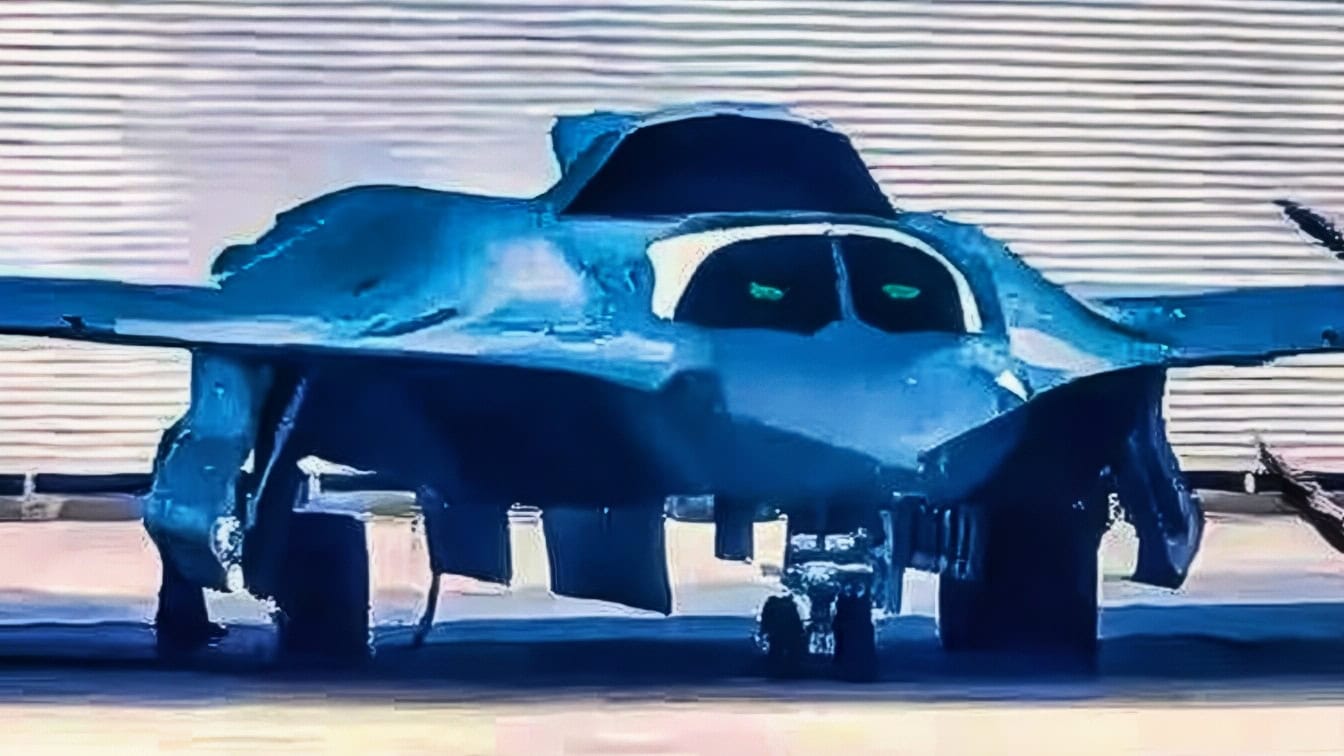
Two, seated side-by-side under a wide bubble canopy(assessed from a single head-on image)
Prototypes observed
5(reported, as of July 2026)
Service entry
No date announced or credibly assessed; aircraft remains in flight test(assessed)

Programme milestones

medium

This timeline is assembled almost entirely from photographs and video posted by observers near Chinese test airfields, plus commercial satellite imagery. Chinese authorities have not confirmed any of these events, and prototype counts and dates should be read as reported rather than established.

2024-12First public sighting

On 26 December 2024 a previously unseen tailless jet was photographed flying in daylight near Chengdu, escorted by a two-seat J-20S chase aircraft. Air data booms and the chase profile pointed to early flight testing, and the timing and daylight exposure were widely read as a deliberate reveal. No Chinese ministry or state outlet commented (reported).

2025-03Second observed flight

New imagery in mid-March 2025 showed the same airframe flying again, ending speculation that the December event was a one-off. Video from a low approach in April gave the first reasonably clear look at the planform (reported).

2025-06First head-on imagery

A frontal photograph circulated in late May and early June 2025 showed a very broad forward fuselage, a large dorsal DSI 'hump', F-22-style trapezoidal lower inlets and what analysts read as two crew seated side-by-side. TWZ noted the image 'appears authentic, but we cannot be certain' (unconfirmed).

2025-08Measured from orbit

Commercial satellite imagery captured the aircraft on 27 August 2025 at a remote airfield near the Lop Nur test area, giving the first measurement-based dimensions: roughly 65 ft (~20 m) span and 62 ft (~19 m) length. A companion tailless design, the J-XDS/J-50, was imaged at the same base weeks later (assessed).

2025-10Second prototype, substantially revised

Imagery released in late October 2025 showed a second airframe with reworked lower intakes, redesigned exhausts and a side-by-side twin-wheel main gear replacing the original tandem arrangement. TWZ assessed the changes 'point to an aircraft still very much in the stages of flight test demonstration/development' rather than one near production (assessed).

2025-11Thrust-vectoring nozzles seen

Views from behind and below confirmed that the second airframe carries two-dimensional thrust-vectoring nozzles on all three engines, broadly similar to the F-22's, replacing the first prototype's recessed YF-23-style troughs. The engines are assessed as WS-10 'Taihang' derivatives (unconfirmed).

2025-12Third prototype reported flying

A third airframe was reported to have flown on 25 December 2025, one year after the first sighting. It appeared to retain the second aircraft's vectoring nozzles while lacking the flight test air data probe carried by the earlier two. Sourcing was low-resolution imagery from Chinese aviation observers (reported).

2026-07Quasi-official footage and a fifth airframe

Brief clips of the aircraft appeared in an official PLA promotional release at the end of June 2026 - the closest thing to state acknowledgment so far - and a fifth prototype was reported in flight test on 23 July 2026. Neither the footage nor the airframe count has been formally confirmed, and no specification accompanied the release (reported/unconfirmed).

Strategic significance

medium

The single most important thing to understand about this aircraft is how little is actually known. China has released no designation, no photographs of its own beyond brief promotional clips, no dimensions and no performance claims. "J-36" is a convenience label adopted by Western and Chinese analysts from a serial number visible on the airframe. Every published figure - length, span, weight, engine type, crew, even the number of prototypes flying - is inferred from enthusiast photography, low-resolution video and commercial satellite passes. Figures elsewhere describing it as a Mach 2.5 sixth-generation fighter already in service should be treated with considerable caution; none of that is established from open sources.

What the imagery does support is that the aircraft is unusually large for something in the fighter lineage. Satellite measurements of roughly 20 m span and 19 m length, combined with a landing gear arrangement suggesting a gross weight above 45 tonnes, put it well beyond the J-20 and closer in mass to a medium bomber than to a conventional air superiority fighter. A tailless planform with no vertical surfaces, three engines and very large internal volume points at a design optimised for range, broadband low observability and internal carriage of big standoff weapons, rather than for classic close-in air combat. Analysts have proposed roles including long-range counter-air, maritime and land strike, suppression of enemy air defences, standoff sensing, and acting as a controller and networking node for uncrewed aircraft. Those are plausible readings of the shape, not confirmed requirements.

Strategically, the interest lies less in any individual capability than in the fact that the aircraft exists at all and is iterating quickly. A sequence of reworked prototypes with changed intakes, exhausts and landing gear within a year of the first sighting indicates an active development programme rather than a one-off demonstrator, and the parallel Shenyang tailless design suggests China is running two next-generation efforts at once. The three-engine layout, meanwhile, is frequently read as a workaround for propulsion limits rather than a preference - a design that needs three current-generation engines to do what a future engine might do with two. Against that, the programme is still years from any credible service date, no weapons or sensors have been publicly identified, and the gap between a flying demonstrator and a fielded, supportable combat system is where many ambitious aircraft programmes have historically slowed down.

Videos

What do we know about China's new '6th generation' fighters? (Sandboxx)

Watch on YouTube

Technical analysis of the two new Chinese combat aircraft: the aerodynamics and propulsion behind the J-36's minimalist shape (Benliu Yinghua)

Watch on Bilibili

China's next-generation jet test flights and the US Air Force response (Guancha.cn)

Watch on Bilibili
Sources & References
Related Discussions

No discussions about Chengdu J-36 yet

Start the first discussion