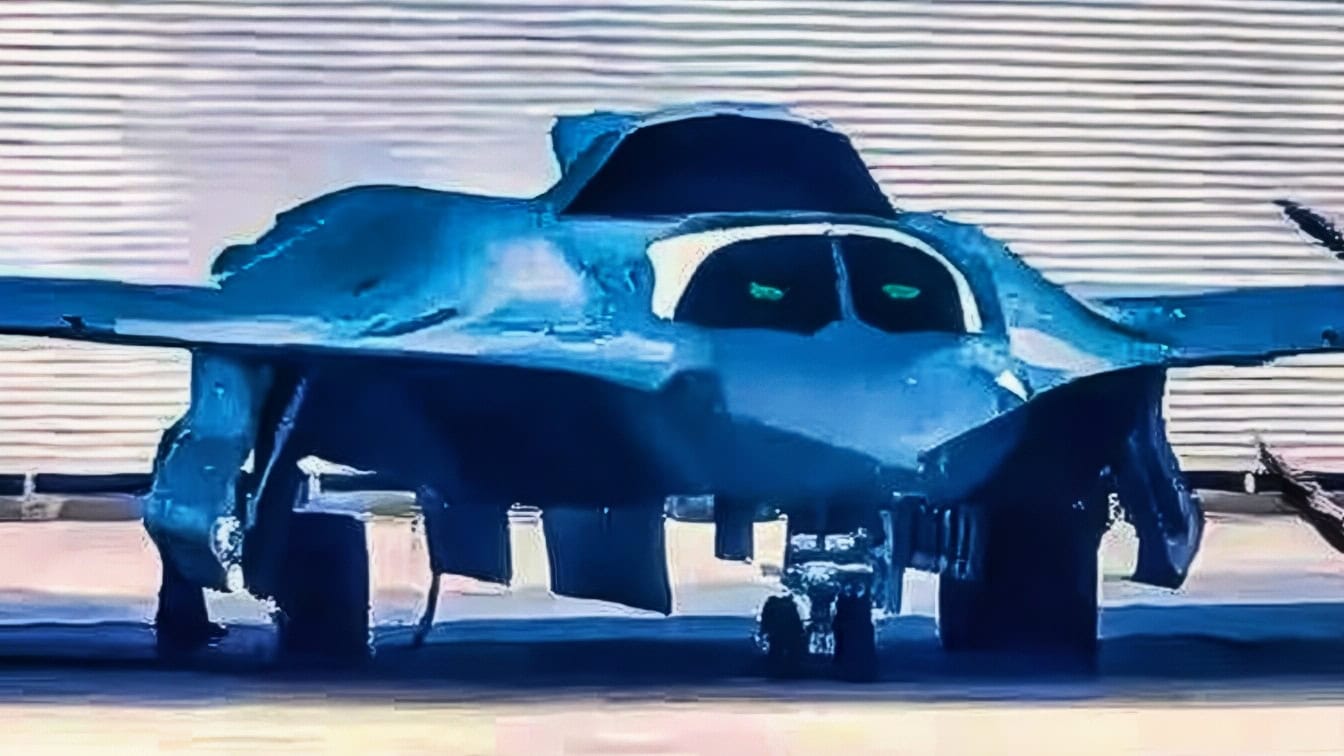
The single most important thing to understand about this aircraft is how little is actually known. China has released no designation, no photographs of its own beyond brief promotional clips, no dimensions and no performance claims. "J-36" is a convenience label adopted by Western and Chinese analysts from a serial number visible on the airframe. Every published figure - length, span, weight, engine type, crew, even the number of prototypes flying - is inferred from enthusiast photography, low-resolution video and commercial satellite passes. Figures elsewhere describing it as a Mach 2.5 sixth-generation fighter already in service should be treated with considerable caution; none of that is established from open sources.
What the imagery does support is that the aircraft is unusually large for something in the fighter lineage. Satellite measurements of roughly 20 m span and 19 m length, combined with a landing gear arrangement suggesting a gross weight above 45 tonnes, put it well beyond the J-20 and closer in mass to a medium bomber than to a conventional air superiority fighter. A tailless planform with no vertical surfaces, three engines and very large internal volume points at a design optimised for range, broadband low observability and internal carriage of big standoff weapons, rather than for classic close-in air combat. Analysts have proposed roles including long-range counter-air, maritime and land strike, suppression of enemy air defences, standoff sensing, and acting as a controller and networking node for uncrewed aircraft. Those are plausible readings of the shape, not confirmed requirements.
Strategically, the interest lies less in any individual capability than in the fact that the aircraft exists at all and is iterating quickly. A sequence of reworked prototypes with changed intakes, exhausts and landing gear within a year of the first sighting indicates an active development programme rather than a one-off demonstrator, and the parallel Shenyang tailless design suggests China is running two next-generation efforts at once. The three-engine layout, meanwhile, is frequently read as a workaround for propulsion limits rather than a preference - a design that needs three current-generation engines to do what a future engine might do with two. Against that, the programme is still years from any credible service date, no weapons or sensors have been publicly identified, and the gap between a flying demonstrator and a fielded, supportable combat system is where many ambitious aircraft programmes have historically slowed down.