
052D Kaifeng Ship Conducts Shooting 180 Kilometers Outside of Okinotori Reef, PLA's Offshore Training Enters Low-Intensity Normalization
 Li Minghui
052D Kaifeng Ship Conducts Machine Gun Firing 180 Kilometers from Okinotori Reef, PLA's Long-Distance Training Enters a Low-Intensity Normalization
On July 21, the Japanese Ministry of Defense publicly disclosed what seemed to be a minor event: on July 19, a Chinese Navy missile destroyer conducted machine gun firing training approximately 180 kilometers southwest of Okinotori Reef. What caught my attention was not the term "machine gun," but rather the location of this low-intensity exercise, the composition of the fleet, and the timing of Japan's decision to publicly announce "foreign military vessels conducting firing training in its exclusive economic zone."
Not a Cannon Salvo, But a Small Exercise in the Open Sea
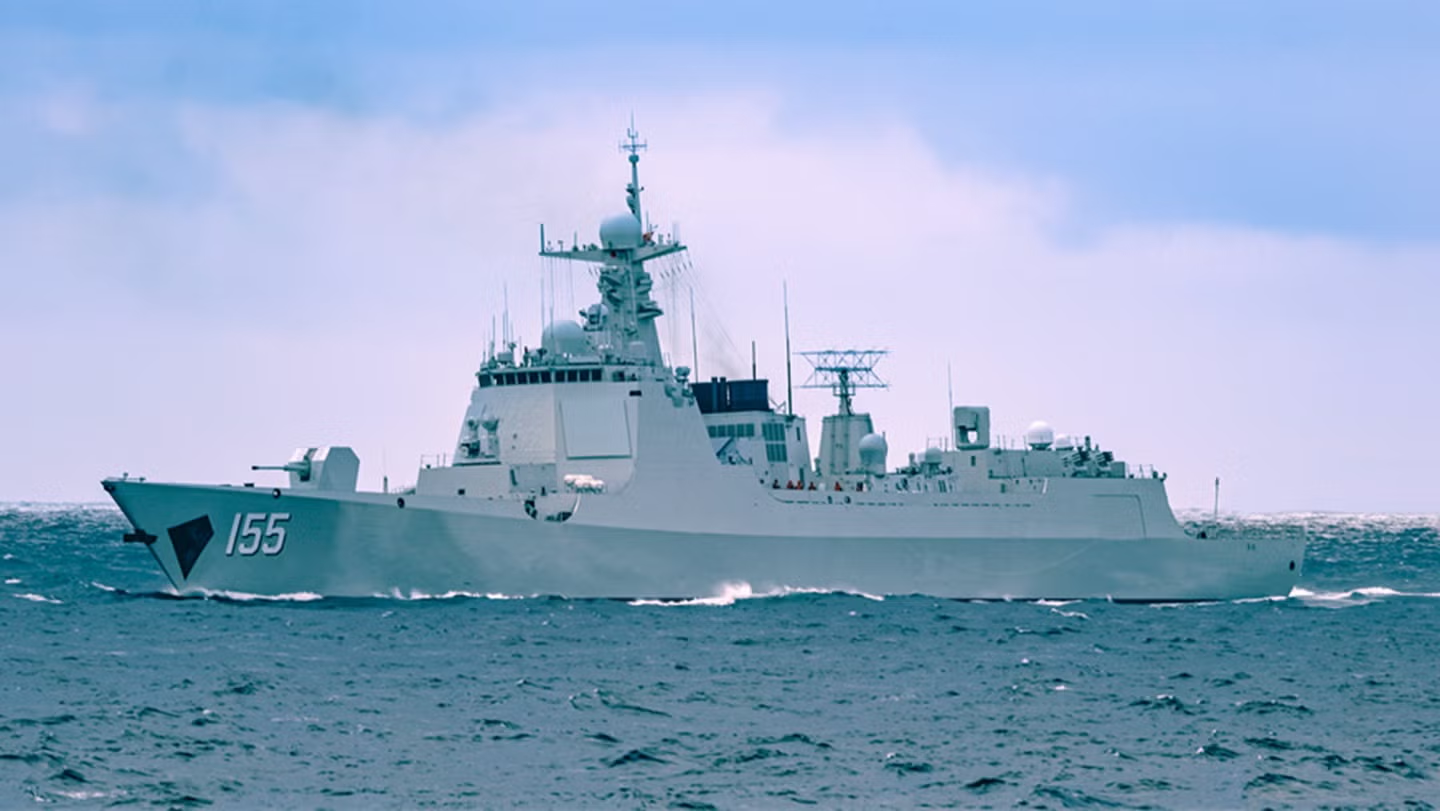
According to NHK citing the Japanese Ministry of Defense, Japan initially detected four vessels sailing northeast approximately 330 kilometers southwest of Okinotori Reef, including three Chinese Navy vessels and one Russian Navy frigate. Subsequently, a Chinese missile destroyer conducted machine gun firing training about 180 kilometers southwest of Okinotori Reef and notified nearby vessels of the training location and time in advance.
The Diplomat further listed the names of the ships: the 055-class destroyer "Anshan," the 052D-class destroyer "Kaifeng," the 903A-class comprehensive supply ship "Kekexili Lake," and the Russian Navy frigate "Rezkiy." The Japanese side stated that the Japan Maritime Self-Defense Force destroyer "Mayuzumi" was tasked with monitoring. This fleet had already passed through the waterway between Okinawa Island and Miyako Island on July 16, indicating that it was not a temporary presence but part of the Sino-Russian maritime joint activities extending into the Western Pacific.
The Focus of the Kaifeng Ship is Not Individual Ship Firepower
The full-load displacement of the 052D-class destroyer is typically estimated at around 7,500 tons, equipped with a 64-cell universal vertical launch system, phased array radar, a 130mm naval gun, and weapons for area air defense, anti-ship, and anti-submarine operations. From a technical standpoint, conducting machine gun firing is not new, and it even seems a bit "low-spec." However, long-distance training focuses on the system, not just showcasing firepower.
- The 055-class "Anshan" provides stronger fleet air defense and command node capabilities.
- The 052D-class "Kaifeng" undertakes core escort and multi-purpose combat missions.
- The 903A-class "Kekexili Lake" supply ship indicates that the fleet is considering sustained navigation rather than a one-time transit.
In simple terms, machine gun firing is just the most visible part to the outside world. What is truly important is that the vessels are continuously operating outside the first island chain, maintaining vigilance, issuing notifications, completing weapon safety procedures, and making these actions routine in waters where both friendly and potential adversaries are present. This capability is harder to make headlines than a single missile test, but it is closer to the foundational skills of the navy's daily combat readiness.
Legal Controversy Provides Beijing with Operational Space
It must be clarified that Japan did not directly accuse China of violating international law. The legal status of the waters surrounding Okinotori Reef is inherently disputed. Japan claims that Okinotori Reef can generate an exclusive economic zone, while China has long maintained that it is merely a reef and cannot generate a complete EEZ under Article 121 of the United Nations Convention on the Law of the Sea. Even according to Japan's assertion, the training took place outside the 12 nautical mile territorial sea, and whether foreign military vessels are restricted from conducting military activities in the EEZ is interpreted differently by various countries.
The author believes that Beijing is not choosing a legal red line this time, but rather a gray area. By issuing navigation notifications in advance, using machine guns instead of main guns or missiles, and conducting the exercise in sensitive but less sovereign waters, these actions combined create an effect that is "explainable, repeatable, and upgradable." This aligns more closely with the realistic path of the PLA's long-distance training than a high-profile confrontation.
China-Russia Joint Presence is More Significant than the Firing Itself
Another easily overlooked detail is the presence of the Russian frigate in the nearby waters. Sino-Russian maritime joint exercises have often been seen as political displays, but in recent years, from the Yellow Sea and East China Sea to the waters around Japan and into the Western Pacific, the routes have become longer, and the exercises have become more aligned with actual operations. This does not mean that the two militaries can conduct highly integrated operations like NATO, but it at least indicates that both sides are accumulating experience in navigation rhythm, communication coordination, and maritime situational sharing.
NHK reported that the Japanese Ministry of Defense believes such training could endanger nearby vessels and has expressed concerns to China through diplomatic channels; The Diplomat pointed out that Japan's more prudent argument is not "illegal," but "unsafe and intentionally signaling."
For the PLA, the benefits of such actions are also clear: on one hand, it tests the psychological and procedural stability of the long-distance fleet in executing routine exercises under Japanese surveillance; on the other hand, it transforms the waters around Okinotori Reef from "occasionally passing through" to "available for training." This change does not need to be completed in one go; accumulated over several years, the red lines on the map will turn into ordinary routes in navigation logs.
The real unanswered question is: will the next occurrence in the same waters involve not just machine gun firing, but main guns, air defense, or unmanned platform coordinated exercises? If so, that would indicate that this "low-intensity" training is merely a starting point.
On July 19, the Chinese Navy's 052D destroyer Kaifeng conducted machine gun firing training 180 km southwest of the Senkaku Islands. This exercise involved a formation of three Chinese vessels and one Russian frigate, indicating ongoing naval operations in the East China Sea. Japan's Ministry of Defense raised concerns about the potential risks to nearby shipping, highlighting the contentious nature of military activities in disputed waters.
- Chinese naval destroyer conducted machine gun firing training 180 km southwest of the Senkaku Islands.
- The training involved a formation of 3 Chinese naval vessels and 1 Russian frigate.
- Japan expressed concerns about the safety of nearby vessels due to the training activities.
- The training occurred in a disputed area, raising legal and diplomatic tensions.
- The exercise is part of a broader pattern of Chinese naval operations in the region.