
Anduril founder calls Ukraine’s drone interceptor output extraordinary

The founder of one of America’s most consequential defense technology companies looked at Ukraine’s drone interceptor production this week and called it extraordinary.
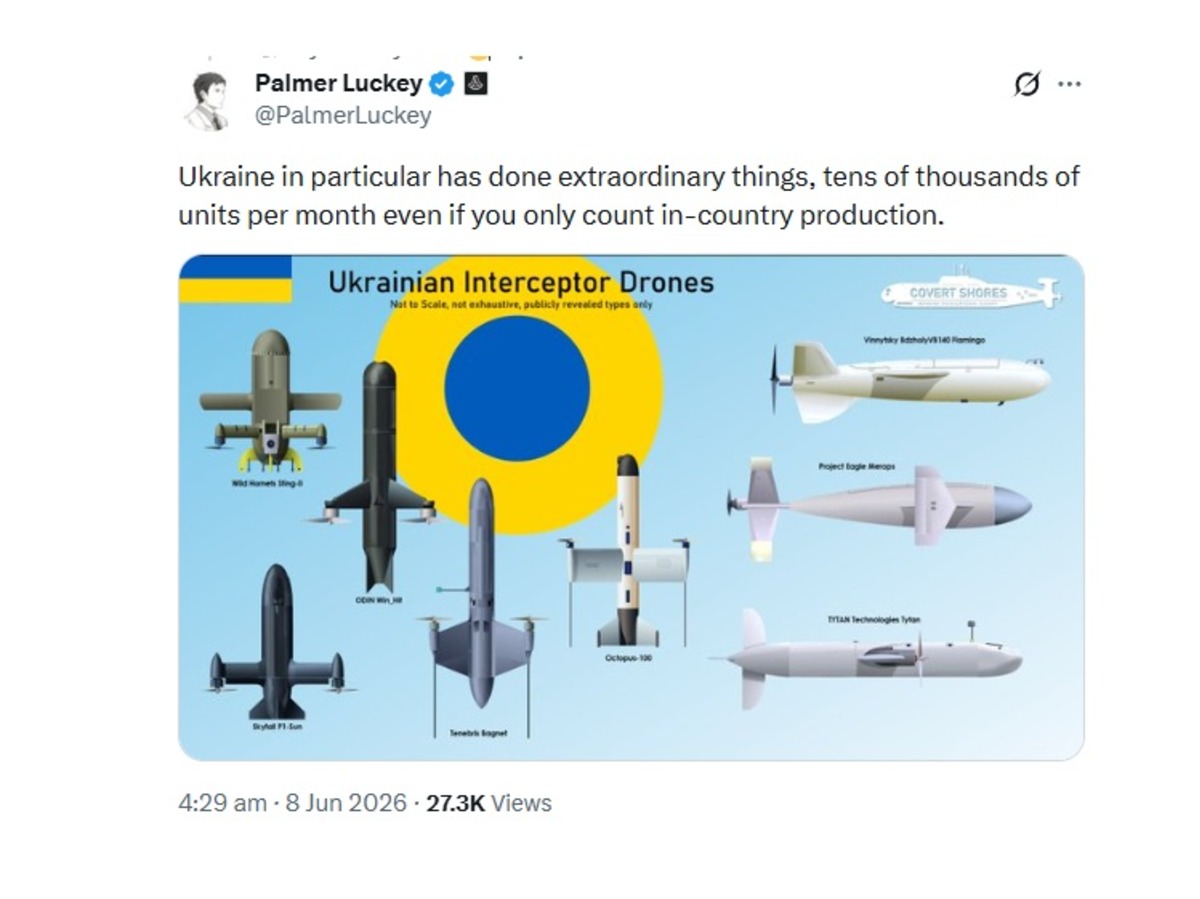
Palmer Luckey, who built Anduril Industries into a defense technology giant now valued at more than $28 billion, posted on June 8 that “Ukraine in particular has done extraordinary things, tens of thousands of units per month even if you only count in-country production,” accompanying his comment with an infographic of Ukrainian interceptor drone types compiled by naval analyst H.I. Sutton of Covert Shores.
He opened the thread by crediting Anduril as the first company to actually build and ship what he called “the science fiction staple of drone that runs into another drone to destroy it,” referencing the Anduril Anvil, a kinetic interceptor drone that the company first demonstrated in 2019, when The Verge covered it destroying an off-the-shelf commercial drone in midflight. At the time, the concept was novel enough to read as a stunt. Luckey’s point on June 8 was that the category has since become a foundational element of modern air defense, and that Ukraine, more than any other country, has scaled it to industrial production levels.
The infographic Luckey reposted from Covert Shores documents the breadth of Ukraine’s interceptor drone portfolio, covering systems including the Wild Hornet Wing-S, the OCAS KPL-88, the SA-FPV PS-Link, the Teramis Bayonet, the OctoAnt-500, the Velorunny Bithiorytr NH Flamingo, the Project Sugar Omega, Merops AS-3 Surveyor, and the T716A Technologies Tytan, among others. That roster, described in the infographic as not exhaustive and covering only publicly revealed types, illustrates how Ukraine has moved far beyond a single interceptor design and built an ecosystem of competing and complementary platforms addressing different threat profiles, ranges, and engagement envelopes.
The drone interceptor concept addresses one of the most pressing tactical problems of the current conflict: how to stop cheap, expendable attack drones without spending more money on the defense than the attacker spent on the offense. A Shahed-136 costs Russia somewhere between $40,000 and $80,000 depending on the source. Intercepting it with a Patriot missile costs several million dollars. That exchange rate is economically ruinous at scale, and it is the core problem that drone interceptors are designed to solve by meeting the threat with a weapon of comparable cost. A drone that rams another drone, guided by computer vision or radio frequency homing, can be built for a fraction of what a conventional interceptor missile costs, and can be produced in volume by light manufacturing facilities rather than specialized defense plants.
Ukraine’s development of interceptor drones at scale reflects the operational necessity that has driven virtually every Ukrainian military innovation since February 2022. Russia’s mass Shahed drone attacks, which have struck Ukrainian cities in waves of dozens to hundreds of drones on single nights, created an urgent requirement for high-volume, low-cost aerial intercept capability that Ukraine’s existing air defense inventory, built around expensive surface-to-air missile systems, could not sustainably provide. Ukrainian engineers responded by adapting and purpose-building drone interceptor systems from commercial components, iterating designs based on immediate battlefield feedback, and scaling production through a network of small manufacturers capable of adjusting specifications faster than any traditional defense procurement cycle allows.
U.S. Secretary of State Marco Rubio acknowledged the broader product of that process in an interview with Fox News published on May 14, calling Ukraine’s armed forces the “strongest, most powerful” military in Europe. “This war has caused the Ukrainians to develop new tactics, new techniques, new equipment, new technology that is creating a sort of hybrid asymmetrical warfare,” Rubio said. U.S. Army Secretary Dan Driscoll went further in Senate Armed Services Committee testimony, singling out Ukraine’s Delta battlefield management system as a model the American Army cannot match. “Ukraine’s Delta common operating system, their modular open system architecture command and control system, is absolutely incredible,” Driscoll testified. “It fully integrates every single drone, every sensor and every shooting platform into just one single network. Ours does not.”
The interceptor drone category that Luckey highlighted sits within a broader Ukrainian drone ecosystem that by independent estimates produced approximately four million unmanned systems of all types in 2025, with projections of five to six million units in 2026, according to Kyiv Post’s reporting on NATO Parliamentary Assembly testimony by Ukraine’s Deputy Defense Minister Mstislav Banik. Those totals span attack drones, reconnaissance systems, maritime unmanned vehicles, and interceptors, but Luckey’s specific focus on the interceptor category points to a sub-segment that has received less public attention than Ukraine’s FPV attack drones despite being operationally critical to the country’s ability to defend its cities against mass aerial attack.
The Anduril Anvil that Luckey cited as the category’s commercial origin point uses a camera and onboard processing to track a target drone and physically collide with it at high speed, destroying both in the intercept. The system was designed to be cheaper than a missile, reusable in the sense that multiple units can be kept on alert simultaneously, and effective against the small commercial-derivative drones that conventional air defense radars struggle to track reliably. Ukraine’s interceptor designs follow the same basic logic but span a wider range of form factors, guidance approaches, and target profiles, reflecting years of development against a real adversary that continuously adapts its own drone designs in response.
Luckey watched an idea he helped pioneer become a weapon category deployed at tens of thousands of units per month by a country defending itself in the most drone-intensive conflict in history. That trajectory, from The Verge covering a novelty demonstration in 2019 to Palmer Luckey calling Ukraine’s production extraordinary in 2026, is one of the more compressed arcs in the history of military technology.
Content preview only. Full article available at source. View Full Article
Palmer Luckey commended Ukraine's drone interceptor production, stating it has reached extraordinary levels with tens of thousands of units produced monthly. This production includes a variety of interceptor drones designed to counter low-cost attack drones effectively. The development reflects Ukraine's urgent need for cost-effective aerial defense solutions amid ongoing conflicts. U.S. officials have acknowledged the innovative tactics and technologies emerging from Ukraine's military efforts.
- Palmer Luckey praised Ukraine's drone interceptor production as extraordinary, producing tens of thousands of units per month.
- Ukraine has developed a diverse range of interceptor drones to counter low-cost attack drones.
- The Anduril Anvil is highlighted as a pioneering drone interceptor design.
- Ukraine's drone production is projected to reach five to six million units in 2026.
- U.S. officials recognize Ukraine's military innovations as significant in modern warfare.