
Army publishes guidebook to help NCOs manage barracks

Source: Task & Purpose
Loading...Strong SignalCredibility: 81%
Report Content
A new guidebook outlines the duties for soldiers in the barracks and offers management tips to noncommissioned officers on how to address emergencies in living spaces.
The “NCO’s Barracks Guidebook,” published Wednesday morning, includes recommendations and outlines steps for addressing issues ranging from maintenance needs to cleanliness in the barracks.
The guide’s introduction notes that it is not setting policy but is meant to be a “professional tool, a resource built to educate, clarify, and strengthen the NCO’s ability to lead.”
It also breaks down the responsibilities with a checklist of tasks such as “daily presence” for squad leaders and section sergeants who are expected to walk the barracks area to “deter issues and show engagement” and “PSG Huddle” for platoon sergeants, so they can meet weekly with squad leaders to discuss barracks issues, inspections, work orders, and supply needs.
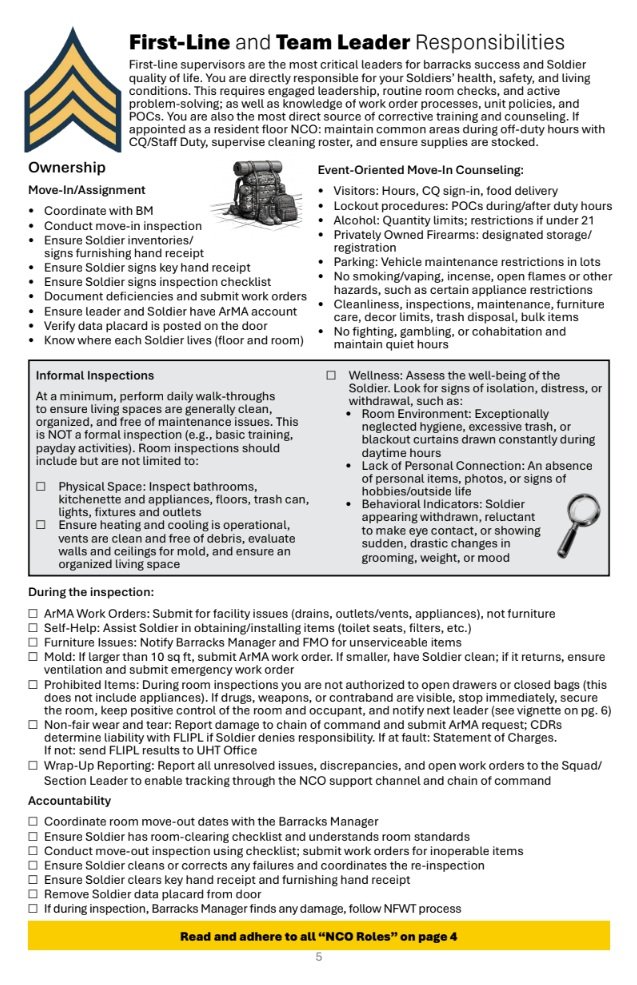
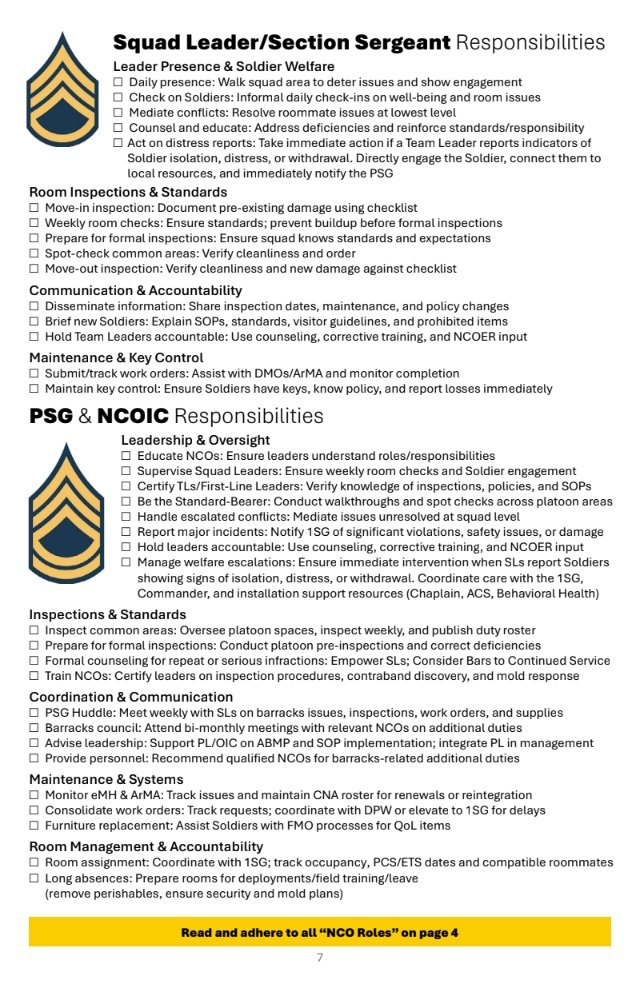 The list of responsibilities for team leaders, squad leaders, and platoon sergeants in the barracks. Army photos.
“Commanders are responsible for barracks welfare, discipline, and living conditions. NCOs enforce standards, maintain order, conduct inspections, ensure safety compliance, and train junior leaders,” the guide reads. “Active engagement, rather than complaints, prevents issues that degrade morale and readiness.”
The 20-page handbook includes a series of vignettes about possible scenarios soldiers might face, such as finding contraband in the barracks or how to prepare living spaces for a 30-day Joint Readiness Training Center rotation at Fort Polk, Louisiana.
Officers and noncommissioned officers in formations, at the battalion and company level, are “just really, really busy,” and without good systems in place to manage things like the barracks, issues and repairs can fall by the wayside, Command Sgt. Maj. Nema Mobarakzadeh with Army Western Hemisphere Command told reporters.
“And unfortunately, sometimes that ends up being barracks or components of barracks management,” Mobarakzadeh said. “And so we set out to create something to help keep them on track and share some tried-and-true tricks and tips at their level to be more efficient and to help them create some of those systems and processes.”
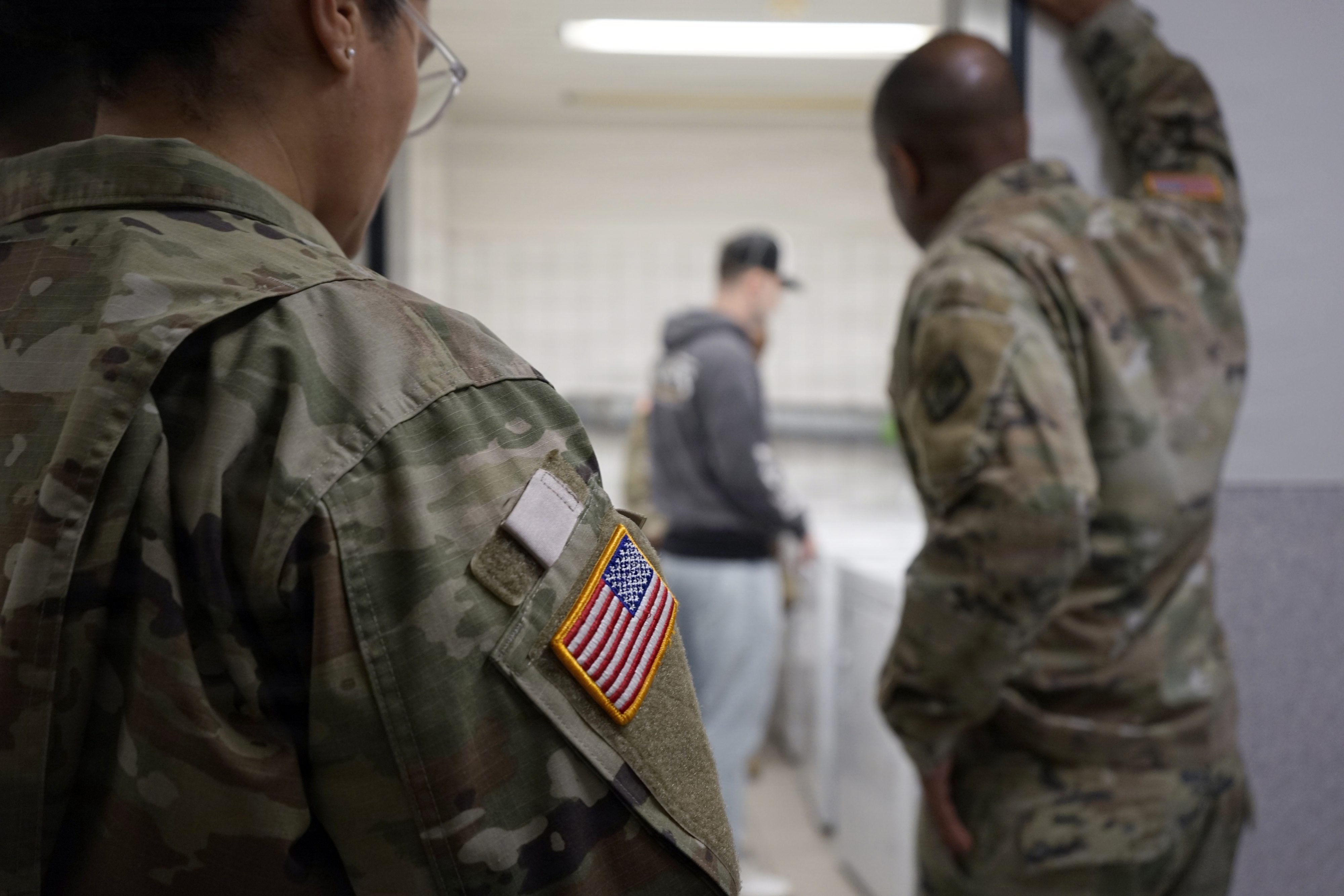 The service stressed that while the guidebook was a resource for enlisted leaders, it was not an addendum to policy. Army photo.
The idea, officials said, is to make these duties clear so all troops have an understanding of the proper chain of command for handling matters. The guidebook also gives steps for how to address common concerns, such as what to do when mold is found in the barracks. In that case, NCOs are directed to immediately inform fire-line leadership and the barracks manager, who have to contact the Directorate of Public Works via the Army Maintenance Application.
The Army previously set up the Army Barracks Management Program a few years ago. Officials said that the new guidebook is meant to complement the barracks management program, not replace it. That program manages buildings and inventory, while the new publication is meant to help NCOs look out for quality-of-life issues impacting their soldiers in the barracks.
Army officials told reporters that there isn’t a new set of information in the book, but instead it shares best practices that different formations have developed across the service.
Last month, the Government Accountability Office found that the cost of maintenance for barracks and other military buildings had risen to $285 billion, double what it was five years prior. That high price tag came alongside the watchdog’s notes of deferred maintenance, aging buildings and a lack of enough maintenance workers to meet demand.
Top Stories This Week
W. Jordan Gillis, the assistant secretary of the Army for installations, energy and environment, acknowledged the new guidance doesn’t fix back-end problems or boost Directorate of Public Works staff numbers. However, Gillis said that it can help soldiers better manage how they place and track work orders, and suggested that it would allow for greater accountability when problems aren’t resolved as they should be, “so a soldier doesn’t have to be frustrated and take that all upon themselves to track the work order.”
The new guidebook has been developed over recent months, with formations in the western hemisphere offering feedback and some soldiers testing out a pilot version of it. Army officials told reporters that the guidebook went through more than 50 iterations before its launch this week.
The Army’s new publication comes as the Department of Defense works to try and address longstanding issues with the barracks, where aging buildings across the armed forces have dealt with issues from lack of air conditioning to widespread mold.
The post Army publishes guidebook to help NCOs manage barracks appeared first on Task & Purpose.
Classification
Region
North America
Analytical Domain
Operational
Primary Category / Secondary Categories
Command & Control / Logistics
SALUTE Report
Size
Not applicable
Activity
Publication of a guidebook for barracks management
Location
Fort Polk · Louisiana
Unit
U.S. Army
Time
Wednesday morning
Equipment
-
Summary
The U.S. Army published a new guidebook on Wednesday morning to assist noncommissioned officers (NCOs) in managing barracks at Fort Polk, Louisiana. The guidebook outlines responsibilities for NCOs, including maintenance and cleanliness, and provides strategies for addressing common issues. It aims to enhance the quality of life for soldiers and is intended as a resource rather than a policy document.
Key Facts
- A new guidebook for barracks management was published by the Army.
- The guidebook aims to assist NCOs in managing living conditions and addressing emergencies.
- It includes checklists and responsibilities for squad leaders and platoon sergeants.
- The guidebook is not a policy document but a resource for NCOs.
- The Army Barracks Management Program is complemented by this new guidebook.