
JNIM strikes Dioura and Sévaré — over 100 Malian soldiers killed in the heart of the central theater
 Marie Dubois
JNIM strikes Dioura and Sévaré — over 100 Malian soldiers killed in the heart of the central theater
Dioura, Mopti region. On September 10, an attack on the Malian camp in this isolated city turned an outpost into an operational trap. Two sources cited by Reuters report 120 to 130 soldiers killed and over 100 military personnel taken hostage. The Malian army confirms an evacuation of the camp and a counter-operation lasting more than a week, but does not provide a toll. The Jama’at Nusrat al-Islam wal-Muslimin (JNIM), affiliated with al-Qaeda, claims 150 dead. These figures remain disputed. The geography, however, is not: Dioura is located on the edge of an area where Bamako no longer controls the roads, only fortified points.
A two-phase offensive
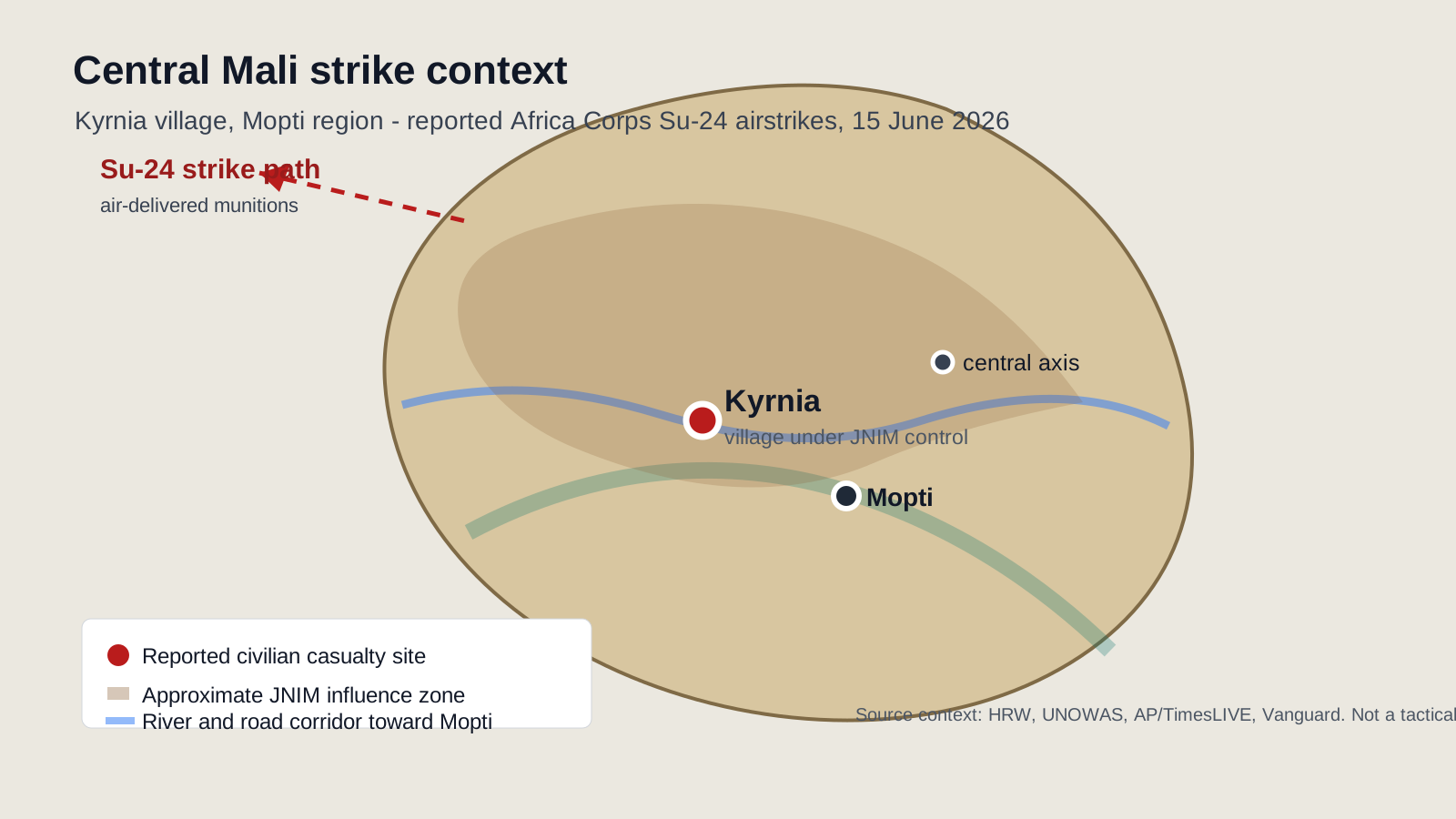
The same cycle extended to Sévaré, the military airport located a few kilometers from Mopti. After the assault on Dioura, JNIM claimed strikes against the airport's air defenses and announced 33 dead among pro-government forces in Sévaré and Konna. A resident cited by Reuters described six consecutive nights of bombardments and saw around forty injured at the local hospital. About 55 kilometers from Sévaré, residents of Konna reported that motorcycle fighters were encircling the camp.
These events should be read as a single sequence, not as three separate incidents. Dioura sets the reinforcements and disrupts the chain of command. Sévaré then targets aviation, drones, and reaction capability. Konna threatens the road axis that connects the airport to the central garrisons. For a group that possesses neither armored vehicles nor aviation, this is an effective way to create operational depth with motorcycles, mortars, and local intelligence.
The problem is not the number of bases
On the ground, the question is not whether the Malian army and the Russian Africa Corps can retake Dioura. They can probably retake a camp for a few hours or a few days. The question is whether they can resupply it, evacuate it, and defend it when the runways become impassable and every movement is observed.
An isolated position several dozen kilometers from a main garrison is not proof of territorial control. It becomes a burden if the units can only move out in heavy convoy, with predictable routes. JNIM does not need to hold Dioura permanently. It is enough for them to demonstrate that the state's presence there is intermittent and costly. The market, transporters, and village chiefs then adjust their behaviors even before the flag disappears.
“Significant losses have been inflicted on the attackers,” claims the Malian army. This version must be maintained, but it does not yet establish who controls the access around Dioura, Sévaré, and Konna.
The Africa Corps does not compensate for the loss of mobility
Russian fighters from the Africa Corps support Malian forces at these two sites. However, Reuters' report mentions that the Russians were no longer visible in Sévaré at the time the firing continued. This detail is not proof of a general withdrawal, and it would be unwise to draw a definitive strategic conclusion from it. It does, however, signal a classic limitation of expeditionary partnerships: instructors and foreign detachments can reinforce an assault, but they do not automatically create a network of intelligence, maintenance, and local presence.
Since the coordinated offensives in April, JNIM and the Azawad Liberation Front have shown that they can strike military centers, airfields, and political axes far from each other. The fall of Kidal and the death of the Malian Minister of Defense had already called into question the promise of a reconquest led by Bamako and Moscow. Dioura adds a harsher data point: even the central theater, where the army has the Sévaré airport, remains vulnerable to a war of attrition.
A quantitative progression that becomes a political problem
The regional figures published by ACLED and reported by The Guardian measure the change. Violent events involving jihadist groups in Mali, Burkina Faso, and Niger rose from 63 in 2016 to 2,845 in 2025. Over 2,100 had already been recorded in 2026 at the time of this analysis. The Sahel is therefore not only facing deadlier attacks: it is facing a density of incidents that exhausts forces and reduces their windows of maneuver.
This military pressure meets a diplomatic fracture. The Alliance of Sahel States has left ECOWAS, and Niger has withdrawn from the Multinational Joint Task Force of the Lake Chad Basin. The Africa Defense Forum emphasizes that the 1,608-kilometer Niger-Nigeria border remains officially a space of cooperation, but with less structured regional mechanisms. JNIM and the Islamic State in the Sahel are precisely exploiting this gap between political maps and the routes that are actually passable.
What Dioura signals for the future
The next risk is not necessarily a new spectacular conquest. It is the paralysis of reinforcements between Mopti, Sévaré, and secondary garrisons. If attacks on the airport continue, Malian drones and transport aircraft will have to operate under constraints, at night or from more distant bases. If Konna remains encircled, the road becomes a line of force consumption rather than an instrument of control.
On the ground, the priority should be to reopen safe and temporary corridors, improve alerts around the camps, and protect medical teams. Announcements of victory do not replace these tasks. JNIM has just reminded us that central Mali is not a rear area. As long as Bamako cannot move its soldiers without exposing each convoy to an ambush, the official map of Mali will remain larger than its actual theater of operations.
Sources
- Reuters, reported by Business Day, “More than 100 Malian soldiers killed in rebel attacks in September,” September 21, 2026.
- The Guardian, “Al-Qaida and IS-linked violence in Africa’s Sahel belt set to hit record levels this year,” September 16, 2026, ACLED data.
- Africa Defense Forum, “Diplomatic Divide Threatens Sahel Security,” September 2026.
JNIM attacked the Malian military camp in Dioura on September 10, 2026, resulting in 120-130 soldiers killed and over 100 taken hostage. Following this, JNIM conducted airstrikes on the military airport in Sévaré, claiming 33 pro-government forces killed. The situation reflects a coordinated offensive against Malian forces, highlighting vulnerabilities in their operational capabilities.
- Over 100 Malian soldiers killed in attacks by JNIM.
- 120-130 soldiers reported killed, with more than 100 taken hostage.
- JNIM claimed responsibility for the attacks on Dioura and Sévaré.
- Malian military confirmed evacuation and ongoing counter-operation.
- Significant military pressure on Malian forces in the region.