

Summary and Key Points: Phantom Works flew the Boeing YF-118G Bird of Prey, a stealth demonstrator, at Area 51 between 1992 and 1999. Tailless and UAP-like, Boeing built it with its own money and off-the-shelf parts. It flew 38 times at no more than 300 mph to test how little radar could see. The Pentagon declassified it in 2002, and it now hangs above the F-22 Raptor at the National Museum of the Air Force.
The Boeing YF-118G Bird of Prey Combined Out-of-the-Box Design With Off-the-Shelf Components
Between 1992 and 1999, Boeing’s secretive Phantom Works was at Area 51 in the Nevada desert working on a new project. It wasn’t built for speed or high-altitude flight, but for maximum stealth and efficient reproduction. Beneath its cutting-edge exterior, it also featured off-the-shelf tech and parts cannibalized from common civil aviation aircraft like the Beechcraft King Air.
To maximize stealth, the aircraft’s shape took form, looking more like a UAP than a traditional aircraft. It was also given the cover designation “YF-118G,” which was never used internally to identify the aircraft, but I will use it here for clarity.
The YF-118G: Oddest-Looking Aircraft You Might Never See
With a tailless, blended form, the YF-118G shed traditional horizontal or vertical tailplanes.
Instead, it relied on edge alignment between the fuselage and wing edges, which were parallel, deflecting radar waves away from its receiver rather than reflecting them back.
To help deflect radar waves, the control surfaces blended into the wing with no gaps. Radar waves may hit these surfaces, but they would return very little information about the aircraft’s shape or size.
To hide the jet engine’s compressor blades from radar waves directed at the front of the aircraft, the intake sat on top of the fuselage behind the cockpit. Instead of massive, complex, and expensive exotic metal alloys covering the Bird of Prey, they used carbon fiber composite sheets made in simple molds.
Because Boeing was spending its own money on this project (It inherited the program by acquiring McDonnell-Douglas in 1997), it resorted to some unusual cost-saving methods to keep costs down, especially since one of the project’s goals was to demonstrate low-cost prototyping to the government. The landing gear came from a Beechcraft King Air, and the ejection seat came from the AV-8B Harrier.
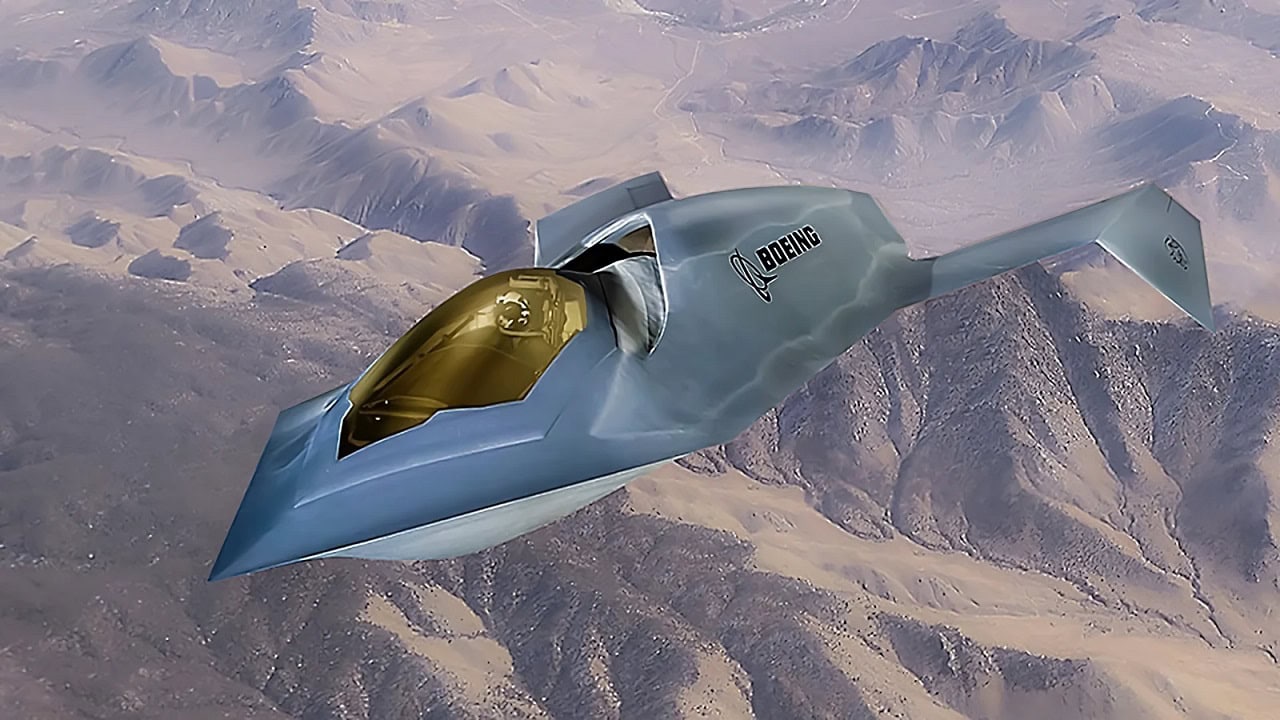
YF-118G. Image Credit: Creative Commons.
The result was an oddly shaped, tailless aircraft with oddly bent wings, looking like reverse-engineered alien spacecraft. I have no doubt that it was probably reported as a UAP by any civilians observing it flying near Area 51 in the 1990s.
In 1996, the YF-118G made its first flight with the single prototype that was built.
YF-118G Stats
Here are the basic stats on the Bird of Prey. Prepare to be unimpressed by its engine thrust, altitude ceiling, or top speed.
Crew: 1 pilot
Length: 46 ft 8 in (14.22 m)
Wingspan: 22 ft 8 in (6.91 m)
Height: 9 ft 3 in (2.82 m)
Max Takeoff Weight: 7,400 lb. (3,356 kg)
Powerplant: 1 × Pratt & Whitney Canada JT15D-5C turbofan engine (producing 3,190 lbs thrust)
Maximum Speed: 300 mph (260 knots / 482 km/h)
Service Ceiling: 20,000 ft (6,100 m)
As the specifications show, the Bird of Prey wasn’t exactly a fast, high-flying aircraft. It was made to be low-observable to radar.
No Aircraft Is Truly Invisible To Radar
Boeing flew the Bird of Prey 38 times, testing its profile against various air-search radars to see how much it could be seen on a radar screen. No stealth aircraft is truly invisible to radar, at least not yet. The best you can hope for is to reduce its radar signature to something so small that it gets lost in the background clutter most radar operators erase by reducing gain.
The YF-118G didn’t have to go high or fast to test its composite materials, low gap exposure, and jet intake profiles. It just had to fly around slowly while they pointed radar antennas at it.
After those flights, Boeing applied the lessons learned to other projects like the Boeing X-32 (Joint Strike Fighter demonstrator), the X-45A UCAV, and probably 5th- and 6th-generation designs as well.
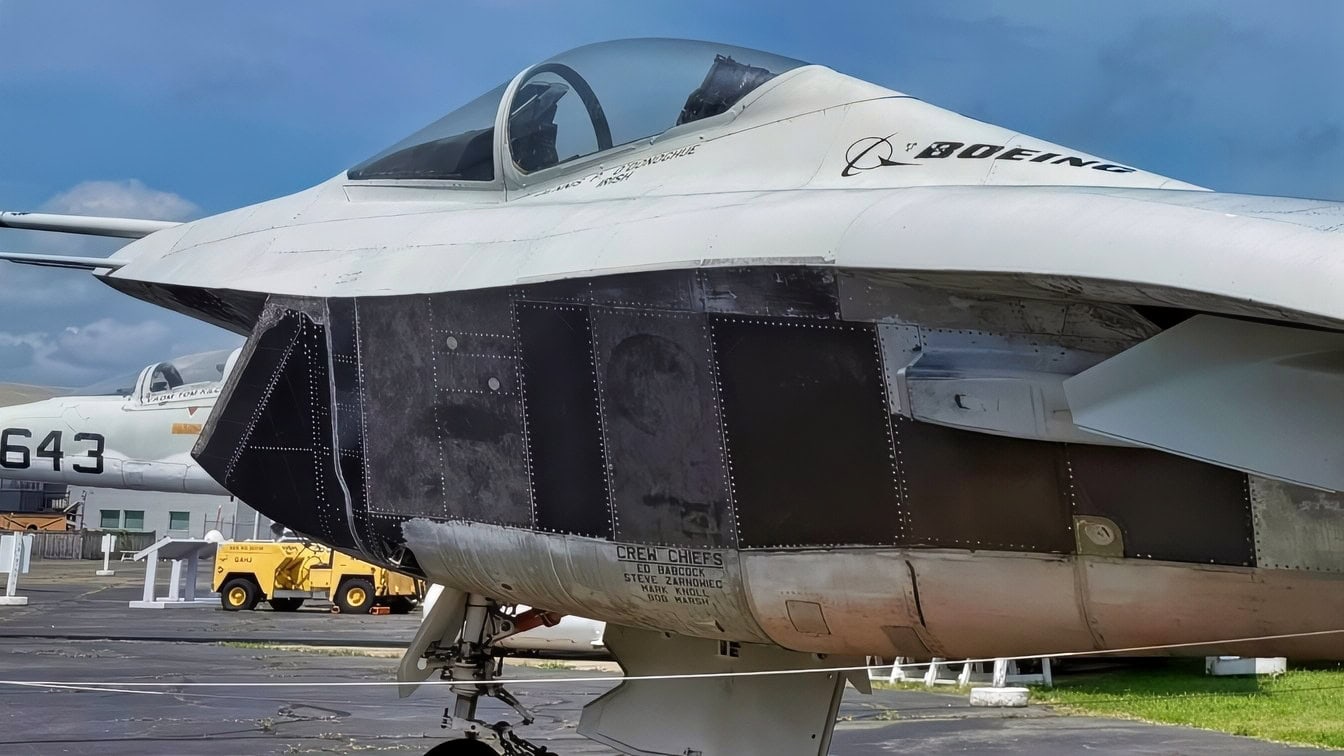
Boeing X-32B Fighter 19FortyFive Photo by Christian D. Orr
YF-118G Summed Up in 1 Word: History
I say probably because, rather than locking the YF-118G in the “Hangar of Deep Secrets That Must Never Be Revealed” just 3 years after the program concluded in 1999, the Pentagon declassified the project and revealed it to the public at Boeing’s St. Louis, Missouri, plant.
The rationale for the disclosure was that the technology, so secret in 1992 when the program started, had by 2002 already appeared in military and commercial aircraft.
It really couldn’t have been that big a secret to be in. Long gone are the days when the government wouldn’t even acknowledge Lockheed’s “Skunkworks.”
Today, Boeing’s Phantom Works has its own page on Boeing’s website, as does Lockheed’s Skunkworks.
Today, the YF-118G, Bird of Prey, hangs from the ceiling at the National Museum of the Air Force in Dayton, Ohio. Photos are below, and it sits right above the F-22 Raptor.
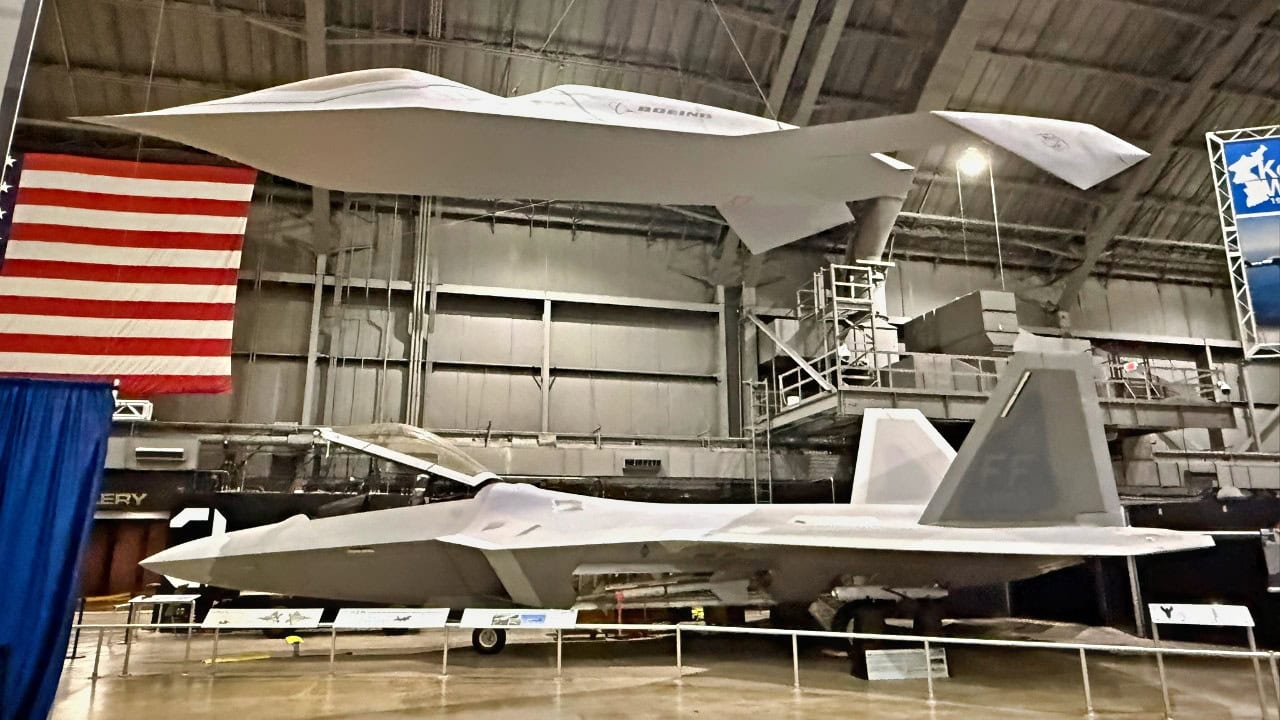
YF-118G. Image taken by Harry J. Kazianis for 19FortyFive.
About the Author: Sean Spoonts
Sean Spoonts is the former Editor-In-Chief of SOFREP.com. He is a military analyst, writer, and commentator whose work has appeared in Newsweek, CNS News, Ukrinform, and various military/veteran media networks and professional publications, including the Military Intelligence Professional Bulletin. He is a U.S. Navy veteran, having served as an Aviation Anti-Submarine Warfare Operator and Search and Rescue Helicopter Aircrewman.