
Bosaso becomes the new American bet in Somalia — AUSSOM wobbles after 500 million dollars in logistics
 Marie Dubois
Bosaso Becomes the New American Bet in Somalia — AUSSOM Wavers After $500 Million in Logistics
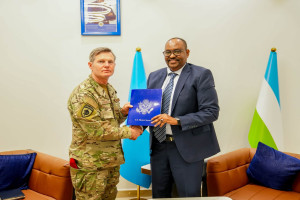
In Bosaso on Sunday, Said Abdullahi Deni received an American delegation led by Major General Claude K. Tudor Jr., commander of the Special Operations Command Africa. The meeting reportedly resulted in an agreement allowing the United States to expand its military installation in this port city of Puntland. This is not just a local announcement. It is a very clear signal of how Washington wants to maintain a military presence in Somalia while withdrawing from the multilateral mechanism that still supports part of the front against Al-Shabaab.
The timeline is brutal. On August 1, the leaders of the troop-contributing countries to the African Union Mission in Somalia, AUSSOM, requested an extension of UN support in Kampala for 18 to 24 months. Two days later, Mogadishu was simultaneously discussing defense and AUSSOM with Beijing, while Puntland announced an increase in American cooperation in Bosaso. On the map, this looks like three separate issues. On the ground, it is the same issue: who holds the lines when the common logistics disappear?
The Bosaso Base is Not a Detail
Bosaso commands maritime access to the Gulf of Aden and opens towards the Cal Miskaad mountains in the Bari region, where the Islamic State in Somalia retains fighters, caches, and escape routes. This theater does not have the political density of Mogadishu nor the visibility of the fighting against Al-Shabaab in the center of the country, but it has strong operational value: port, runway, logistical axis, proximity to maritime corridors between the Red Sea and the Indian Ocean.
According to Hiiraan Online, the agreement would allow for the expansion of the American base to support counter-terrorism operations and maritime security. American authorities have not yet publicly detailed the scope or timeline. This caution matters. In this kind of agreement, the difference between a small liaison capability, a drone platform, an intelligence center, and a support point for special forces changes the entire military scope.
From experience, a coastal base that serves both intelligence, strike, and evacuation is sometimes worth more than a visible but poorly supplied battalion inland. Puntland forces claim to have retaken areas held by the Islamic State with American support, notably through airstrikes, intelligence, equipment, and logistical support. This does not solve the Somali problem. But it gives Washington a foothold less dependent on the debates between Mogadishu, the African Union, and the Security Council.
AUSSOM Loses Its Logistical Oxygen
The real shock comes from the other side of the issue. The United States announced that it would end its support for the United Nations Support Office in Somalia, UNSOS, at the end of the year, and that it would oppose a continuation of UN logistical support for AUSSOM. Washington funds a critical part of this setup. Without fuel, rotations, food, medical evacuations, and spare parts, a stabilization mission quickly becomes a stationary garrison.
The figure cited by the think tank Balqiis gives the scale of the problem: UNSOS's operational costs reached about $500 million this year, three times the AUSSOM budget. Much of the debate about African missions focuses on troop numbers. This is misleading. The decisive question is the fuel truck, the evacuation helicopter, the ration arriving on time, and the ability to relieve a unit stuck 300 kilometers from its base.
Solomon Dersso of Amani Africa believes there is little viable possibility of maintaining the mission without a reversal of the American decision on UNSOS. A diplomat at the African Union quoted by AFP considers the American decision "irreversible."
African contributors are calling for an orderly, coordinated, and gradual exit. The formula is reasonable. It does not address the central question: with what money, what planes, and what chain of command? The European Union has already reduced its contribution this year. African capitals know that a mission can be politically extended in New York and practically paralyzed in Baidoa, Jowhar, or Beledweyne.
Beijing Enters the Conversation at the Right Time
The meeting of Somali Defense Minister Ahmed Moallin Fiqi with Chinese Ambassador Wang Yu on Monday in Mogadishu fits within this window of uncertainty. The two men discussed the campaign against Al-Shabaab, the strengthening of Somali forces, bilateral security cooperation, and the future of AUSSOM. Beijing does not replace a UN logistical architecture. This is not its usual mode of action. But China knows how to occupy the political spaces left by Western hesitations.
For Mogadishu, talking to Beijing while Washington withdraws its multilateral support and consolidates Bosaso is a way to diversify the cards. For Beijing, supporting Somali unity and territorial integrity has diplomatic value in a fractured Horn of Africa, especially when Somaliland, Puntland, Mogadishu, Ethiopia, and Gulf actors each advance their interests.
The difficulty is that Somalia is not a clean chessboard. Puntland deals directly with Washington. Mogadishu seeks to maintain control over sovereignty. The troop-contributing states of AUSSOM want to avoid finding themselves without means of extraction. Al-Shabaab observes the gaps between these levels. In counter-insurgency wars, jihadist groups rarely win by a single battle. They win when lines of responsibility become blurred.
The Operational Risk of the Next Two Seasons
- If UNSOS withdraws without a relay mechanism, AUSSOM will lose its mobility before officially losing its mandate.
- If Bosaso strengthens without coordination with Mogadishu, the American effort will become more effective locally but politically more fragmented.
- If Somali forces inherit too quickly from the African Union sectors, Al-Shabaab will seek isolated garrisons, not regional capitals.
The comparison with Kabul, mentioned by several analysts, is useful only if it remains sober. Mogadishu is not Kabul. Al-Shabaab is not the Taliban. But the mechanism of collapse may look similar: dependence on external logistics, incomplete security institutions, internal political rivalries, and withdrawal presented as gradual until the day it becomes physical.
The next indicator to watch is therefore not another statement from Kampala or New York. It is the actual movement of convoys, air rotations, medical evacuations, and fuel stocks in AUSSOM sectors. An army that no longer moves is already half defeated. If Al-Shabaab understands that the logistical window opens at the end of the year, the attacks will not start in January. They will start earlier, on the roads where no one wants to be the last to pass.
The U.S. is expanding its military base in Bosaso, Somalia, following a meeting with U.S. General Claude K. Tudor Jr. This expansion aims to enhance counter-terrorism operations while the U.S. ends its support for the UN logistics office for AUSSOM. Puntland forces, supported by U.S. airstrikes and intelligence, have regained territory from ISIS. The operational costs of the UN support office are significant, raising concerns about the future of AUSSOM's logistics capabilities.
- The U.S. is expanding its military base in Bosaso, Somalia.
- The U.S. will end support for the UN logistics office for AUSSOM by the end of the year.
- The Puntland forces have regained areas held by ISIS with U.S. support.
- The operational costs of UNSOS were approximately $500 million this year.
- China is engaging with Somalia regarding security cooperation.