

Summary and Key Points: From 2000 to 2018, the São Paulo (A12) served as the flagship of the Brazilian Navy. Originally built as a Clemenceau-class aircraft carrier for the French Navy, the carrier was acquired by Brazil in 2000 and commissioned. Despite the prestige of being one of the three nations to operate a CATOBAR carrier at the time, São Paulo suffered from numerous technical issues that kept her out of service for most of her service life in Brazil. The ship was originally planned to be scrapped at a shipyard in Turkey, but the Turks ultimately refused after discovering large quantities of asbestos in her hull. With her condition too poor to transit the open ocean, the ship was controversially sunk off the coast of the Atlantic.
How Brazil Acquired a French Aircraft Carrier
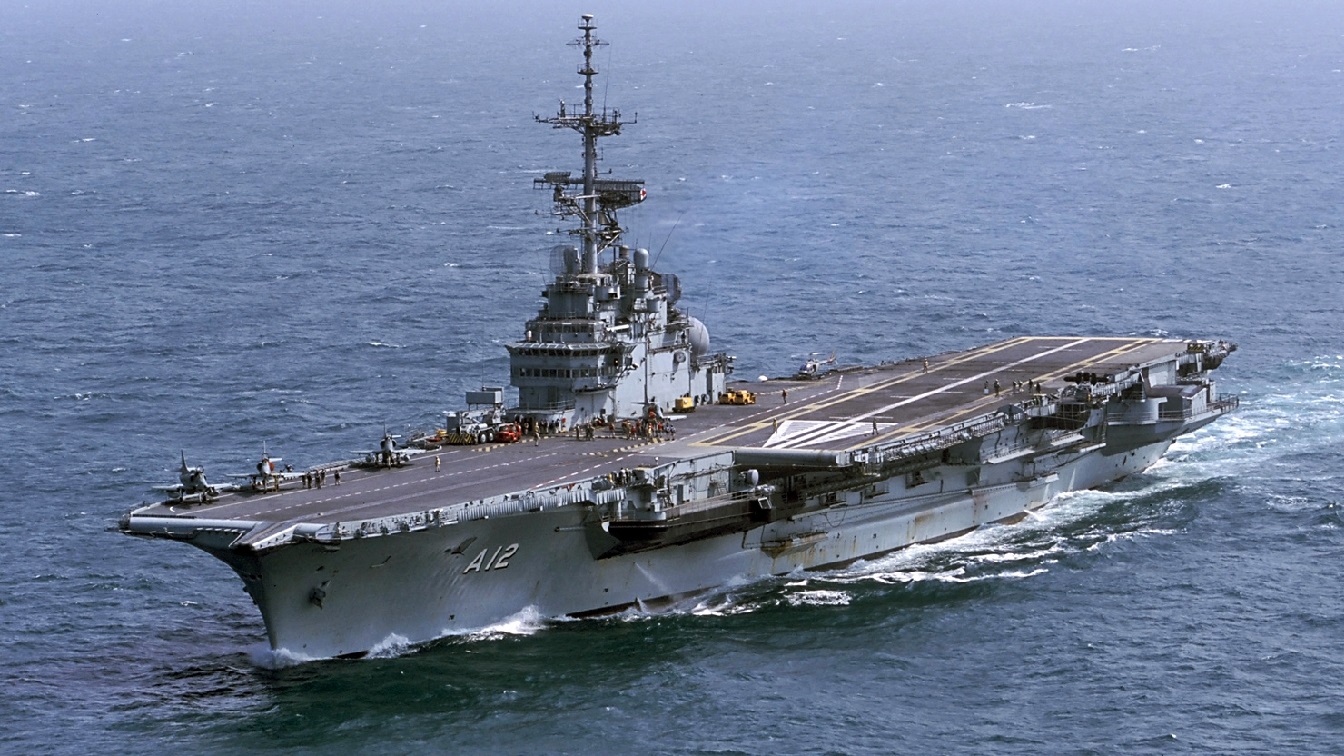
Sao Paulo at sea, seen from a Bell 206 Jet Ranger. Creative Commons.
São Paulo was originally built as a Clemenceau-class aircraft carrier, designated Foch. Foch was the second and final ship in the class, commissioned in 1963, several years after the lead ship, Clemenceau.
With a moderate displacement of 24,400 tons, these carriers are much smaller than their American counterparts and can carry a maximum of 40 aircraft.
As with most surface ships of the time, the Clemenceau-class carriers used asbestos for insulation.
At the time, the toxic effects of asbestos were unknown, so using the substance on surface ships was common practice.
The ships were also among the few carriers in the world to use steam-powered launch catapults, setting them apart from their non-American peers.
As the ships grew older, however, the French sought to replace the Clemenceau-class with the newer, more capable Charles de Gaulle-class aircraft carrier.
The lead ship, Clemenceau, was decommissioned in 1995 and scrapped in 2005.
Foch, on the other hand, was sold to the Brazilian Navy to replace the older WWII-era Mina Gerais.
The purchase included no aircraft. Instead, the carrier would house A-4KU Skyhawks and an assortment of helicopters.
Brazil purchased the ship from France in 2000 and pressed it into service that same year under the new name São Paulo.
For a time, this made Brazil one of three nations to operate a CATOBAR-equipped aircraft carrier.
An 18-Year Tenure With Only 206 Days At Sea
When I say that Brazil “operated” São Paulo, there is an important caveat to that statement. In fact, over her entire 18-year tenure with the Brazilian Navy, the carrier spent only 206 days at sea.
This is an abysmally low readiness rate. Even the problem-laden Admiral Kuznetsov spent more time at sea with the Russian Navy than São Paulo did. The carrier experienced a slew of mechanical issues.
In 2005, her steam system exploded, which killed one sailor and injured several more; two more later died of their injuries.
Consequently, the ship was put away for a five-year overhaul to replace her steam turbines and modernize the ship’s onboard systems.
In 2010, she completed her sea trials and was undergoing final inspections.
Originally planned to return to service in 2013, São Paulo experienced a second onboard fire, which killed one sailor and injured another.
This prompted further repairs and kept the carrier out of service even longer.
By 2017, the cost of repairing and maintaining the ship was growing too high, and the government began talks of decommissioning and dismantling it.
The question arose of what to do with the ship.
Some initial proposals by former crewmen and naval enthusiasts sought to turn the ship into a museum, much like her predecessor, Minas Gerais, but the government ultimately rejected them. Instead, the Brazilian government entered into talks with the Turkish government to sell the carrier for scraps.
In 2018, São Paulo was officially decommissioned.
The End of Brazil’s ‘Toxic Carrier’
The carrier left Rio de Janeiro in 2022, towed by a Dutch tugboat, and was scheduled to arrive in Turkey that same year.
However, before the carrier could pass Gibraltar and enter the Mediterranean Sea, the program hit a snag.
Turkey suddenly withdrew from the agreement after the Turkish Ministry of the Environment reported that the amount of asbestos in São Paulo was much higher than Brazilian authorities had originally estimated. Consequently, the deal was off, and the ship had to be taken back to Brazil.
The carrier then entered a sort of limbo, as no domestic ports would accept the asbestos-ridden vessel.
In 2023, as the ship’s condition deteriorated, São Paulo was no longer seaworthy.
The government therefore decided to scuttle the ship and be done with her once and for all.
This decision was immensely controversial, both at home and abroad, because of the toxic materials still on board.
The announcement drew harsh pushback from then-Minister of the Environment Marina Silva, who pointed out that the asbestos aboard the carrier was hazardous to the region’s marine environment and took the matter to court.
The courts, however, ruled in favor of the government’s decision. On February 3, 2023, the carrier was hauled 350 kilometers off the coast of Brazil and sunk by the Brazilian Navy.
About the Author: Isaac Seitz
Isaac Seitz, a Defense Columnist, graduated from Patrick Henry College’s Strategic Intelligence and National Security program. He has also studied Russian at Middlebury Language Schools and has worked as an intelligence Analyst in the private sector.