
China’s 49-Aircraft Taiwan Surge Tests Its Two-Carrier Pressure Model in 2026
 Marcus Chen
China’s 49-Aircraft Taiwan Surge Tests Its Two-Carrier Pressure Model in 2026
Forty-nine Chinese military aircraft, six naval vessels, and six official ships appeared around Taiwan in a single 24-hour period this week. Thirty-one aircraft crossed the median line or entered zones closer to Taiwan’s main island. TaiwanPlus reported that it was the largest daily aircraft total recorded by Taipei in 2026. The number matters, but the map matters more: Taiwan also tracked the Liaoning carrier group in the Philippine Sea and the Fujian in the South China Sea. Beijing was not rehearsing one blockade line. It was displaying a distributed pressure system.
That is the useful way to read the episode. A sortie count is a political signal; a dispersed naval and air pattern is an operational problem. The People’s Liberation Army is testing whether Taiwan, and the US-led network supporting it, can distinguish a temporary surge from the beginning of a sustained campaign.
The Numbers Show a Wider Operating Area
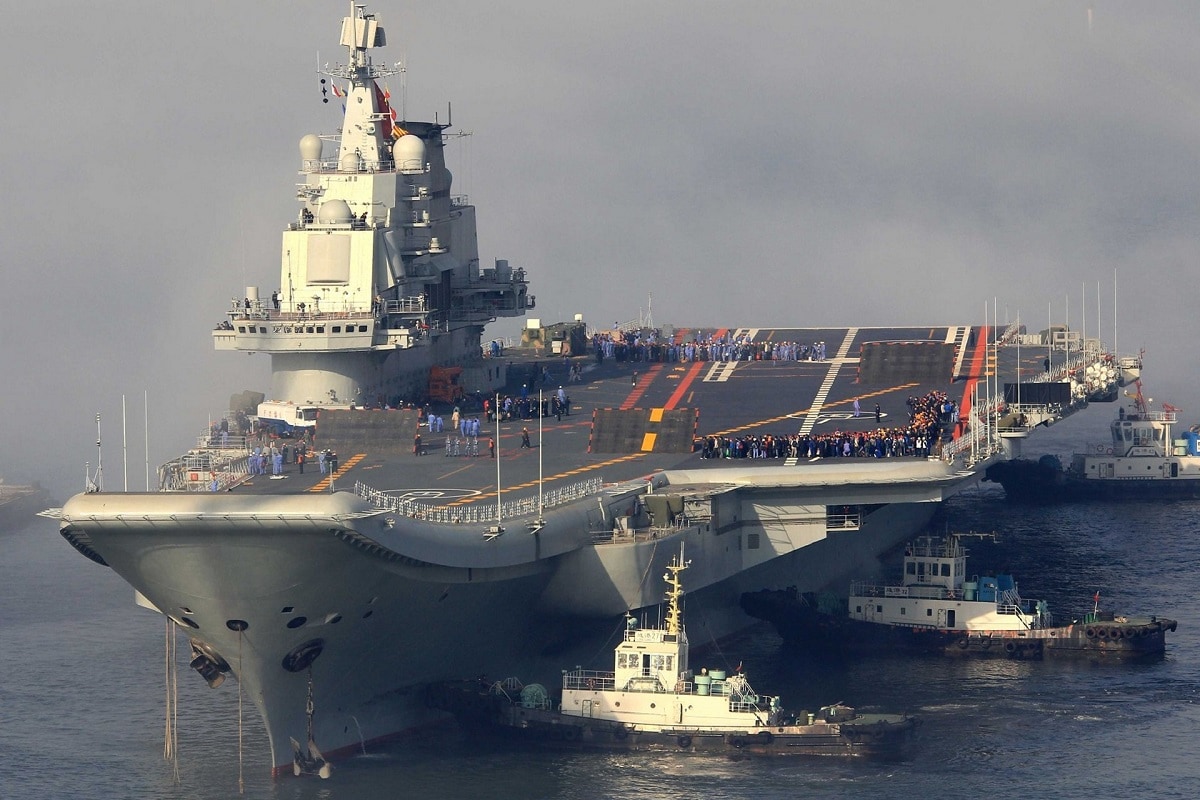
Taiwan News reported that Taiwan’s National Security Council secretary-general Joseph Wu described more than 100 Chinese navy and coast guard vessels operating across the Western Pacific as of November 3. The same report identified two simultaneous carrier deployments: Liaoning in the Philippine Sea and Fujian in the South China Sea. Taiwan’s defense ministry then reported the 49-aircraft day, followed by a lower but still significant count of 22 aircraft, seven PLA Navy vessels, and five official ships.
There are three separate signals here. First, the aircraft activity creates persistent demand for Taiwan’s combat air patrols, surface-to-air missile crews, and command networks. Second, the naval presence forces Taipei to watch more than the approaches immediately east and southwest of the island. Third, the coast guard and other official ships blur the line between military pressure and law-enforcement coercion. The combination consumes attention and readiness without requiring Beijing to cross the threshold of an announced exercise.
The carriers are especially important because they stretch the surveillance problem. Liaoning is a ski-jump carrier built around short-takeoff, arrested-recovery operations, while Fujian represents a newer catapult-equipped design intended to generate a more capable fixed-wing air wing. Neither carrier needs to approach Taiwan’s coast to create military value. Their presence complicates the location of Chinese fighters, maritime patrol aircraft, escorts, and support ships, and it forces planners to consider the Philippine Sea and the South China Sea as connected spaces.
This Is Pressure, Not Yet a Blockade
It would be a mistake to call the November activity a blockade rehearsal simply because it is large. A blockade requires sustained control of maritime approaches, a system for stopping or diverting shipping, and the logistics to maintain the force under pressure. The reported activity demonstrates reach and coordination; it does not prove that China can hold a quarantine line for weeks while absorbing losses and international intervention.
That distinction is not semantic. Taiwan’s immediate defense problem is not only whether it can defeat an invasion fleet. It is whether its aircraft, ships, coastal missile units, and command centers can remain functional while Chinese forces generate a new alert every day. A force that launches 49 aircraft once can create headlines. A force that can repeat the pattern for ten days creates a readiness crisis.
For the United States, the geography raises a parallel question. Carrier strike groups, submarines, long-range bombers, and distributed ground units would need to track two Chinese carrier groups while preserving enough combat power for the Taiwan Strait. The distance between the Strait, the Philippine Sea, and the South China Sea is not a footnote. It is fuel, tanker capacity, sortie time, and magazine depth.
The Weak Point Is Sustainment
Beijing’s advantage in gray-zone operations is the ability to choose the tempo. It can surge aircraft, then reduce activity before the cost becomes obvious. Taiwan must respond every time because failing to identify an aircraft or ship can be more dangerous than overreacting. That asymmetry is the core of the pressure model.
But the model has a ceiling. Aircraft require maintenance, pilots need rest, ships need replenishment, and carrier aviation is constrained by deck cycles and weather. Coast guard hulls can remain visible, but visibility is not sea control. The next question for analysts should therefore be less “How many aircraft crossed the median line?” and more “How many sorties and patrol days can the PLA sustain while keeping its forces dispersed across three maritime theaters?”
Public reporting cannot answer that question yet. TaiwanPlus provides the daily activity count, while Taiwan News adds the carrier and Western Pacific context. Neither source establishes that the two carrier groups were operating as one integrated force or that Beijing had begun a formal exercise. Those limits matter. The strongest assessment is also the narrower one: China is demonstrating the ability to create simultaneous military pressure around Taiwan and beyond it, not demonstrating that an invasion has begun.
What Taipei Should Measure Next
- Repetition: whether aircraft totals remain elevated for several consecutive days rather than spiking once.
- Composition: whether fighters are accompanied by bombers, tankers, electronic-warfare aircraft, and airborne early-warning platforms.
- Maritime geometry: whether the Liaoning and Fujian groups remain in separate theaters or begin coordinated movement toward Taiwan’s eastern approaches.
- Logistics: whether replenishment ships, shore-based aviation support, and ammunition activity indicate a campaign designed to last.
Taiwan should also avoid spending its most expensive readiness hours on every gray-zone contact. That is difficult politically, but a defense that burns through aircraft and crews before a crisis is a defense that has already lost part of the opening battle.
The Signal Is Operational Pressure
The 49-aircraft day is not proof that China has solved the Taiwan problem. It is proof that Beijing can make Taiwan solve the same problem repeatedly: detect, classify, scramble, track, and recover while Chinese ships operate farther afield. The two-carrier pattern adds distance to that calculation.
The coming test is endurance. If the PLA can turn this week’s surge into a repeatable rhythm, it will have created a coercive mechanism that sits below blockade and above routine patrols. If it cannot, the episode will remain an expensive demonstration. Either way, the lesson for Washington and Taipei is direct: count the sorties, but prepare for the replenishment schedule behind them. That is where pressure becomes power.
Sources: TaiwanPlus, “Chinese Military Sorties Around Taiwan Hit Single-Day High for 2026”; Taiwan News, “Taiwan says China deploys over 100 navy, coast guard vessels in Western Pacific”; Taiwan News, Taiwan defense ministry daily activity report; Taiwan News, subsequent Taiwan defense ministry activity report.
Chinese military aircraft and naval vessels conducted significant operations around Taiwan on November 3, 2026, with 49 aircraft and multiple naval ships reported. The PLA is testing Taiwan's military readiness and response capabilities through a surge in activity, involving simultaneous deployments of the Liaoning and Fujian carrier groups in the Philippine Sea and South China Sea. This operational pressure aims to challenge Taiwan's defense systems without crossing into a formal blockade.
- 49 Chinese military aircraft were reported in a single day, the highest for 2026.
- Two carrier groups, Liaoning and Fujian, were deployed simultaneously in different seas.
- Taiwan's defense ministry reported ongoing military activity and significant naval presence.
- The PLA is testing Taiwan's response capabilities with a surge in military operations.
- The activity is characterized as operational pressure rather than a blockade.