
China's Liaoning Carrier Turns 2026 Voyages Into a Pacific Operating Pattern
 Marcus Chen
China's Liaoning Carrier Turns 2026 Voyages Into a Pacific Operating Pattern
The Liaoning carrier group traveled into the western Pacific on October 14, launched and recovered aircraft south of Japan's Ishigaki Island, and was later assessed heading toward the South China Sea. That is not a one-off cruise. It is evidence that China's first carrier is becoming a repeatable instrument for training, signaling, and pressure along the first island chain.
The October Deployment Was a Measured Test
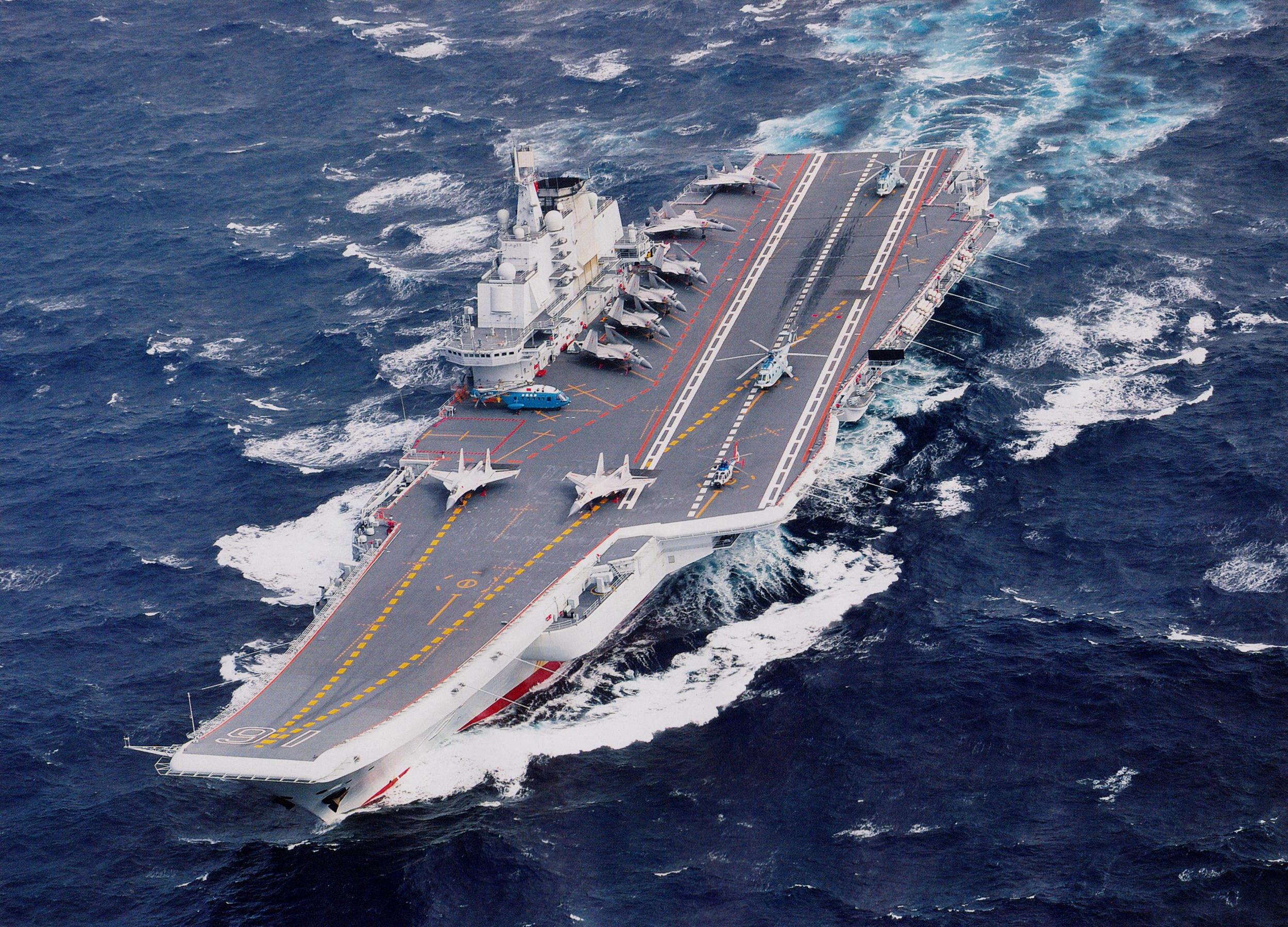
Defense News reported that the People's Liberation Army Navy sent the Liaoning into the western Pacific as part of an annual training plan. Japan's Joint Staff Office tracked the ship about 250 kilometers, or 155 miles, south of Ishigaki. The carrier conducted at least 10 takeoffs and landings on October 14, according to USNI News, while sailing with the cruisers Anshan and Wuxi and the destroyer Huainan.
The platform matters because of what it can practice, not because it is China's most capable carrier. Liaoning is approximately 305 meters long, with a flight deck up to 75 meters wide. Its ski-jump configuration makes it a short-takeoff-but-arrested-recovery carrier. That limits the launch weight of its J-15 fighters and prevents the fixed-wing airborne early-warning operations available to a catapult carrier. Fujian, China's newer electromagnetic-catapult carrier, is the more important long-term combat asset.
But a limitation is not the same thing as irrelevance. A carrier that launches and recovers aircraft in the Philippine Sea is generating deck crews, pilots, escorts, maintenance teams, and command procedures under real distance and weather conditions. Ten cycles in a day is not a wartime sortie rate, but it is a useful training datapoint. Repeated deployments create a baseline from which the PLAN can measure fuel consumption, aircraft availability, replenishment timing, and communications beyond shore-based cover.
China Is Building a Deployment Routine
The most important fact in the October movement is its recurrence. Defense News noted that Liaoning has made at least six distant deployments since entering service 14 years ago and that its voyages now look like an evolving pattern. The carrier is no longer simply a national technology demonstrator leaving port for headlines. It is becoming a training ship for a fleet that now includes Shandong and Fujian.
That distinction changes the military calculation. The United States and Japan do not need to assume that every Liaoning transit is preparation for an attack. They do need to assume that every transit adds competence. A carrier group that repeatedly operates near Taiwan, Japan, the Philippines, and the South China Sea can learn routes, sensor conditions, air-defense procedures, and the political reactions that follow each movement. This is the practical side of sea control: hours at sea accumulate into familiarity, and familiarity reduces friction during a crisis.
Chinese officials described the deployment as routine training and said it was not aimed at a specific country. That explanation can be sincere and still miss the point. A routine deployment near several disputed waters is itself a strategic message because it normalizes the presence of a Chinese carrier where neighboring militaries must monitor it.
The Carrier's Limits Still Matter
Liaoning should not be mistaken for a nuclear-powered U.S. carrier. The ship's STOBAR deck forces aircraft to trade fuel or weapons for launch performance. Its air wing lacks the organic fixed-wing radar coverage that gives a U.S. carrier strike group a wider and more resilient picture. A conventionally powered carrier also depends more heavily on replenishment when operating far from home ports.
Those constraints make Liaoning a poor standalone reaction force. A carrier's combat value is not measured by hull length alone. It depends on escorts, tankers, airborne early warning, submarines, electronic warfare, and the ability to sustain sortie generation after the first exchange of missiles. Public reporting on this deployment identified a small surface escort, but not the full undersea or logistics picture. That uncertainty is important: observers should not turn a visible carrier into an invisible fleet.
Still, the limitations are precisely why the ship is useful as a testbed. Analysts cited by Defense News assessed that Liaoning may be validating flight operations, sensors, and newer aircraft while passing lessons to Shandong. The older carrier can absorb the costs of experimentation while China's newer ships refine their own procedures. In operational terms, Liaoning is a floating schoolhouse that also happens to carry a political signal.
Keen Sword Made the Timing Meaningful
The deployment began days before the U.S.-Japan Keen Sword 27 exercise opened on October 19. USNI News reported that the Theodore Roosevelt Carrier Strike Group was operating in the Philippine Sea with Japanese, Australian, Canadian, and French warships. That exercise placed a large multinational formation in the same broad maritime space where China was demonstrating its own carrier operations.
Beijing did not need to disrupt Keen Sword to influence it. Monitoring the exercise, forcing Japan to track aircraft activity, and keeping regional commanders focused on a moving carrier group all consume attention. The same is true in reverse: the Roosevelt group gives the United States and its partners a chance to rehearse carrier operations, distributed escorts, and coalition command arrangements under observation by China.
This is competition below the threshold of combat. No missile has to be fired for the operational burden to increase. Japan must allocate aircraft and ships to surveillance. The Philippines must watch the southern approaches. Taiwan must consider whether a western Pacific carrier movement could connect to a larger exercise or blockade scenario. China gains information about the response while presenting the activity as normal training.
The Math Favors Repetition
One Liaoning cannot dominate the Pacific. It cannot replace land-based aircraft, submarines, or missile forces, and its ski-jump deck imposes real tactical limits. But a carrier that deploys repeatedly while Shandong and Fujian mature is doing something more consequential than making a symbolic port call. It is creating an operating habit across the waters where a Taiwan contingency would unfold.
The U.S. and its allies should judge the deployment by the training cycle it supports, not by whether Liaoning could defeat a U.S. carrier alone. Ten launches today, a longer patrol tomorrow, and a more complex escort formation next year produce a learning curve. That is the gap between a navy that owns carriers and a navy that can routinely use them.
China's 2026 carrier activity does not prove that the PLAN has achieved American-style carrier warfare. It does show that the distance problem is being worked methodically. The Liaoning is no longer just China's first carrier. It is becoming the fleet's repeatable Pacific operating pattern.
Sources
The Liaoning carrier group conducted training exercises in the western Pacific on October 14, 2026, including multiple aircraft takeoffs and landings south of Ishigaki Island. This deployment is part of a routine training plan for the People's Liberation Army Navy, marking at least the sixth distant deployment of the Liaoning since its service began. The operation coincided with the U.S.-Japan Keen Sword 27 exercise, highlighting the strategic significance of the carrier's presence in the region.
- The Liaoning carrier group traveled into the western Pacific on October 14, 2026.
- The carrier conducted at least 10 takeoffs and landings south of Japan's Ishigaki Island.
- This deployment is part of an annual training plan for the People's Liberation Army Navy.
- The Liaoning has made at least six distant deployments since entering service.
- The deployment coincided with the U.S.-Japan Keen Sword 27 exercise.