
Russia's 153 Shahed Drones Expose NATO's 2026 Air-Defense Problem
 Alexandra Reeves
Russia's 153 Shahed Drones Expose NATO's 2026 Air-Defense Problem
Russia is not trying to win the air war with one exquisite missile. It is trying to make every Ukrainian night expensive, exhausting and politically corrosive. The overnight attack reported on October 25, when Russia launched 153 Shahed-type drones alongside Banderol cruise missiles, is the latest demonstration of that logic.
The Ukrainian Air Force said 92 of the drones were jet-powered. The same wave accompanied attacks reported around Vinnytsia and elsewhere. That combination matters more than the raw total. Moscow is mixing slow, inexpensive one-way attack drones with faster variants and cruise missiles, forcing defenders to identify, prioritise and engage several different threats at once. This is not a single weapons story. It is an air-defence workload problem.
The weapon is cheap; the defensive decision is not
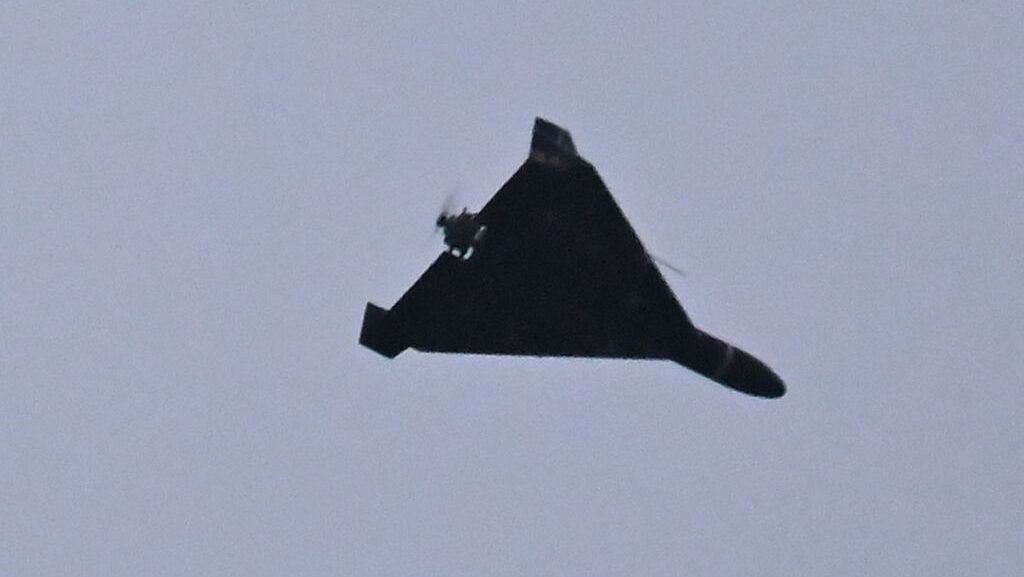
The Shahed-136, known in Russian service as the Geran-2, is a large loitering munition rather than a conventional aircraft. Open-source assessments generally place its range in the thousands of kilometres, with a modest subsonic speed and a warhead of roughly 40–50 kilograms. Its airframe is simple. Its strategic value comes from production volume, navigation updates and the ability to force a defender to spend scarce interceptors.
That cost exchange is the point. Ukraine can use mobile guns, electronic warfare, man-portable missiles and higher-end surface-to-air systems against different parts of the raid. But every choice has a price. A radar-guided interceptor used against a drone costing a fraction of the missile may be tactically necessary while still being economically punishing. A gun team that saves a missile may reveal its position. An electronic-warfare unit that defeats one route does not guarantee the next route will be vulnerable.
The 92 jet-powered drones reported by Ukraine suggest another layer of adaptation. Even without assuming that every aircraft reached its target, the presence of faster platforms compresses warning time and complicates the defender's task. Russia does not need every drone to penetrate. It needs enough uncertainty to keep Ukrainian crews on alert and enough leakage to damage power, transport and industrial infrastructure.
Why the Black Sea connection matters
Reuters reported on October 25 that Russia's Defence Ministry claimed its drones had struck a cargo vessel bound for the Black Sea port of Chornomorsk, as well as Ukrainian logistics hubs. The claim is Russian and should be treated as such until independently verified. But the reported target set fits a broader pattern: the air campaign is aimed at the system that sustains Ukraine, not merely at front-line trenches.
Ports, rail links, depots and energy facilities are dual-use targets. They support military operations, but they also support an economy already operating under wartime pressure. Strikes against them create delays that may not appear on a battlefield map. A damaged warehouse can be replaced; a disrupted schedule across several ports and railheads is harder to absorb.
That is why the drone wave should be read alongside the wider Russian campaign. ZeroFox's October geopolitical assessment described an escalation in Russian hybrid activity against defence and dual-use logistics infrastructure in Eastern Europe. It also argued that Ukrainian long-range strikes against Russian economic sectors were encouraging Moscow to apply asymmetric pressure against Ukraine's partners. The pattern is familiar: attack the opponent's capacity to keep fighting, then attack the political confidence of those supplying it.
NATO's uncomfortable lesson
NATO has spent the war learning that air defence is not a single shield. It is a layered network that depends on sensors, command-and-control, ammunition stocks, power resilience and trained crews. The alliance can field Patriot and other high-end systems, but it cannot cover every transformer, rail junction and port with premium interceptors. Nor can it assume that a static map of threats will survive a campaign in which Russia changes seeker packages, flight routes and drone mixes.
For Europe, the lesson is not simply to buy more Patriots. It is to build a much larger middle layer: inexpensive interceptors, mobile anti-aircraft guns, passive sensors, electronic-warfare suites and counter-drone aircraft. The Ukraine war has made the requirement obvious, but NATO procurement still tends to reward exquisite systems that arrive slowly. A 153-drone raid is a reminder that quantity is not the opposite of quality when quantity is what overloads the network.
There is also a political vulnerability. European governments can promise long-term support for Ukraine, but voters notice when the price of defence rises while the threat is described as abstract. Russia's method is designed to make every successful interception invisible and every failure politically loud. That is how a military problem becomes an alliance problem.
What to watch next
- Whether Russia increases the proportion of jet-powered drones in mixed raids.
- Whether Banderol missiles appear repeatedly alongside Shahed-type systems, indicating a more standardised saturation package.
- Whether attacks on Chornomorsk and other logistics nodes produce sustained disruption or only episodic damage.
- Whether NATO members accelerate procurement of lower-cost interceptors and layered counter-drone systems.
The central finding is straightforward: Russia's latest drone wave was not impressive because 153 is a large number. It was important because the raid combined volume, speed and different munition types against a defence system that must ration every response. Ukraine will keep adapting, and its air defenders have repeatedly shown that adaptation can be faster than outside observers expect. But the alliance cannot outsource this lesson to Ukrainian crews forever.
The uncomfortable forecast is that Europe will continue buying the wrong kind of air defence until a drone raid reaches a NATO logistics hub. The next test is not whether Ukraine can survive another night. It is whether NATO can make saturation attacks uneconomical before they arrive at the alliance's own doorstep.
Sources
- The Kyiv Independent, October 25, 2026, reporting Ukrainian Air Force figures on the 153-drone attack.
- Reuters, October 25, 2026, on Russia's claim regarding a cargo vessel and Ukrainian logistics hubs.
- ZeroFox Intelligence, October 2026 geopolitical report, on Russian hybrid pressure against European logistics.
On October 25, 2026, Russian Armed Forces launched 153 Shahed-type drones and Banderol cruise missiles targeting Ukrainian logistics and infrastructure, including strikes reported near Vinnytsia and Chornomorsk. The operation aimed to disrupt Ukraine's supply chains and create economic pressure, highlighting the challenges faced by Ukrainian air defenses against mixed drone and missile threats. NATO is recognizing the need for a more layered air defense strategy.
- Russia launched 153 Shahed-type drones and cruise missiles on October 25, 2026.
- 92 of the drones were jet-powered, complicating Ukrainian air defense efforts.
- The attacks targeted logistics hubs and infrastructure, not just military positions.
- The operation aims to create economic and political pressure on Ukraine.
- NATO is learning that air defense requires a layered approach to counter diverse threats.