
China's WZ-7 Makes the South China Sea a 2026 Sensor Grid
 Marcus Chen
China's WZ-7 Makes the South China Sea a 2026 Sensor Grid
The Southern Theater Command put a WZ-7 high-altitude unmanned reconnaissance aircraft into a joint air-and-sea exercise around Huangyan Island on September 28. The aircraft operated with a KJ-500 airborne early-warning platform and surface ships identified as the Yulin, Tianmen, and Qinghai Lake. That lineup matters more than the drone's appearance by itself: China is practicing the sensor-to-shooter chain that turns a contested reef into a managed battlespace.
The Event Was About the Network
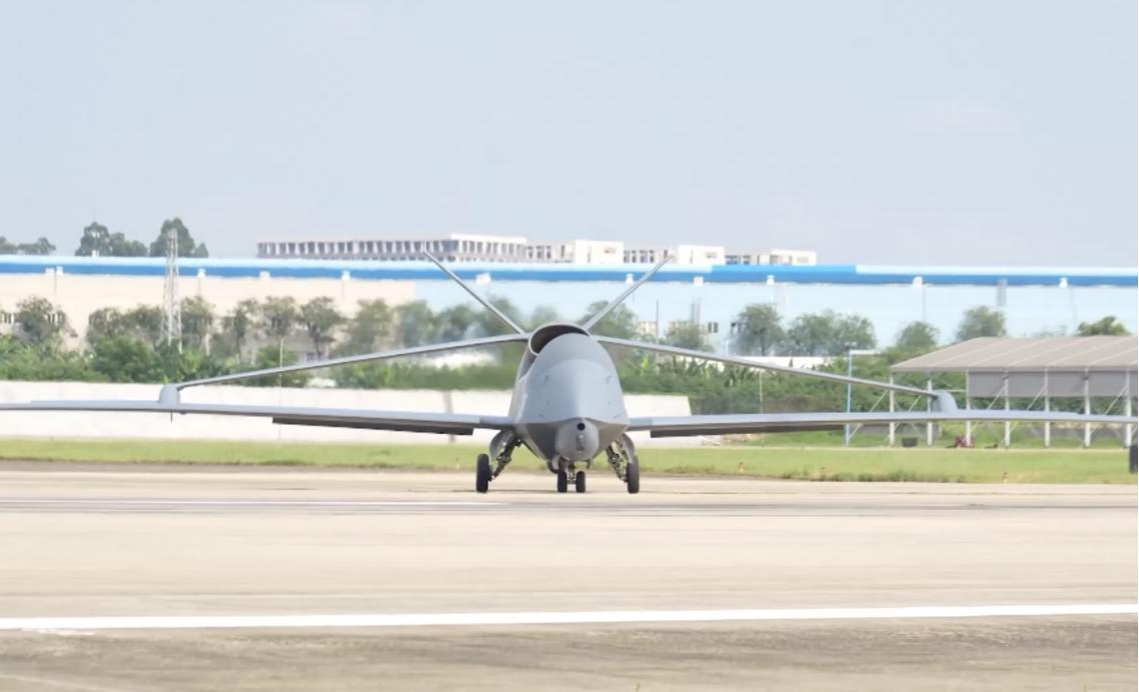
The official account, carried by Huanqiu and reviewed by HiWars, describes reconnaissance, early warning, rapid maneuver, and joint search-and-rescue scenarios. Beijing's own military commentary emphasized a sequence: the WZ-7 searches outside the formation's immediate defense zone, data links send contacts rearward, the KJ-500 fuses the picture, and ships or aircraft receive an operational task.
That is a useful distinction. A drone flying over the South China Sea is surveillance. A drone feeding an airborne command node that can cue ships is an operational architecture. It compresses the time between finding a Philippine vessel, classifying it, and placing a patrol or missile unit in the right sector. No single platform has to do everything.
Why the WZ-7 Fits the Mission
Chinese military commentators describe the WZ-7 as a high-altitude, long-endurance reconnaissance aircraft with a maximum operating altitude of roughly 19,000 to 20,000 meters. Its joined-wing design provides structural stiffness for a large airframe and supports long-range navigation, satellite communications, and autonomous flight. Electro-optical sensors can support day-and-night observation; an aperture radar would add coverage in cloud and poor weather, although the exact fit of individual aircraft is not publicly confirmed.
Altitude buys geometry. At approximately 20 kilometers, the platform can see far beyond the horizon that constrains a frigate's organic radar. It can maintain a wide-area track while remaining cheaper to operate than a fighter and less politically escalatory than sending a manned combat aircraft into every encounter. Endurance is the point: a fighter can arrive faster, but it cannot loiter over the same maritime picture for the same cost.
The limitation is equally clear. A WZ-7 is not a stealth aircraft, and its data links, control stations, and supporting command aircraft are targets in a serious conflict. Its value therefore depends on redundancy and escort. Pairing it with the KJ-500 and multiple surface ships is an attempt to build that redundancy before a crisis, not after the first missile launch.
Huangyan Island Is a Useful Test Range
Huangyan Island, known internationally as Scarborough Shoal, sits roughly 220 kilometers from the Philippine island of Luzon. Its location makes it a natural observation post for movements in the northern South China Sea and a politically loaded place to demonstrate presence. The exercise's military-police framing also matters. A coast guard or maritime law-enforcement vessel can approach first, while naval and air assets provide the surveillance and escalation ladder behind it.
For Manila, the problem is not that one WZ-7 suddenly makes the shoal impossible to approach. The problem is persistent uncertainty. A Philippine patrol must assume that its route, speed, and supporting ships may be visible to a high-altitude sensor, then passed to an airborne command system and nearby surface forces. That makes routine presence operations more expensive and increases the risk that a maneuver intended as signaling is interpreted as preparation for a larger action.
For Washington, the lesson is about targeting and timing. The United States and its allies can bring more capable aircraft and submarines into the theater, but they must first find the relevant Chinese units and survive the same surveillance web. The WZ-7 does not close the South China Sea; it improves China's ability to decide where and when to concentrate force.
The 2026 Military Question Is Persistence
Washington often debates exquisite platforms: the next fighter, the next long-range missile, the next unmanned surface vessel. The Huangyan exercise highlights a less glamorous requirement. Whoever can keep sensors airborne, connected, and replaceable for weeks will often control the tempo before either side fires.
The Pentagon's annual China military assessment has repeatedly described the People's Liberation Army's push toward integrated joint operations, while the WZ-7's public record shows why high-altitude unmanned systems are attractive for that mission. The aircraft offers reach and persistence; the KJ-500 offers command-and-control; ships provide presence and potential effects. Together they create a kill chain that can be exercised below the threshold of war.
That chain is not invulnerable. Jamming, cyber attacks, decoys, fighter patrols, and attacks on command nodes can break it. But breaking a network is harder than destroying a single drone, especially when the network is trained around a geographic feature Beijing already treats as a standing operating area.
What to Watch Next
- Whether WZ-7 sorties around Huangyan Island become routine rather than episodic.
- Whether Chinese exercises add coast guard and maritime militia tracks to the same data picture.
- Whether KJ-500 crews demonstrate control of fighters or anti-ship weapons, not merely surveillance.
- Whether the Philippines and the United States respond with distributed sensors and cheaper counter-reconnaissance tools.
The WZ-7's debut is not a miracle weapon. It is something more consequential: a repeatable way to make the South China Sea transparent to Chinese commanders and opaque to everyone else. The contest is moving from who can send a ship to who can maintain the better picture. That is the gap Manila and Washington now have to close.
Sources
China's Southern Theater Command conducted a joint air-and-sea exercise on September 28, 2023, around Huangyan Island, utilizing a WZ-7 high-altitude reconnaissance drone and a KJ-500 airborne early-warning platform. This exercise focused on enhancing the sensor-to-shooter chain, allowing for improved surveillance and operational tasking in the South China Sea. The presence of these assets increases the operational complexity for Philippine patrols in the area.
- China conducted a joint air-and-sea exercise involving the WZ-7 drone and KJ-500 platform.
- The exercise took place around Huangyan Island on September 28, 2023.
- The WZ-7 is designed for high-altitude reconnaissance and can operate at altitudes of 19,000 to 20,000 meters.
- The exercise aimed to enhance China's sensor-to-shooter capabilities in the South China Sea.
- The presence of the WZ-7 increases uncertainty for Philippine patrols in the region.