
Creotech of Poland aims at quadrupling its satellite production capacity in the coming years
Creotech Instruments (Creotech), Poland’s largest integrator and manufacturer of satellites, satellite systems, and subsystems, is witnessing a dramatic increase in the satellite demand and aims at quadrupling its production capacity in the coming years, while continuing to keep under strict control its supply chain to avid incurring in export issues
Multidomain added space and cyber to the three typical domain, land, sea, and air. Poland presence in the space sector is increasing the largest satellite integrator in the country being Creotech. Visiting MSPO as part of a study tour on the Polish Defence Industry organised by Polska Agencja Inwestycji i Handlu (PAIH), the Polish Investment and Trade Agency [1], EDR On-Line met Jakub Bochiński, the Vice President of the company Management Board.
One of the main concerns of the company is increasing its production capacity. “We are currently capable to build up to 10 satellites per year, but we need to increase our capacity to manufacture over 40 satellites per year. The typical question from our customers is ‘how many can you deliver in orbit, and how quickly’,” Bochiński told EDR On-Line. The company aims at boosting its capacity in the next three and half years. “We already did an investment round which attracted half a billion Polish Zlotys [115 million Euro], and there was a lot of interest from investors,” he added most of them coming from Poland and Europe. EDR On-Line understood that potentially the operation could have attracted a higher amount of financing, but the Creotech management did not wanted to sell the whole company.
 click on image to enlarge
Creotech is currently building a new factory in the vicinity of Warsaw that will allow large scale manufacturing and plans to roll-out the first satellite from that facility in 2029. In fact, the number of 40 satellites is conservative. “Should we produce a single design at large scale, numbers may double,” we were told.
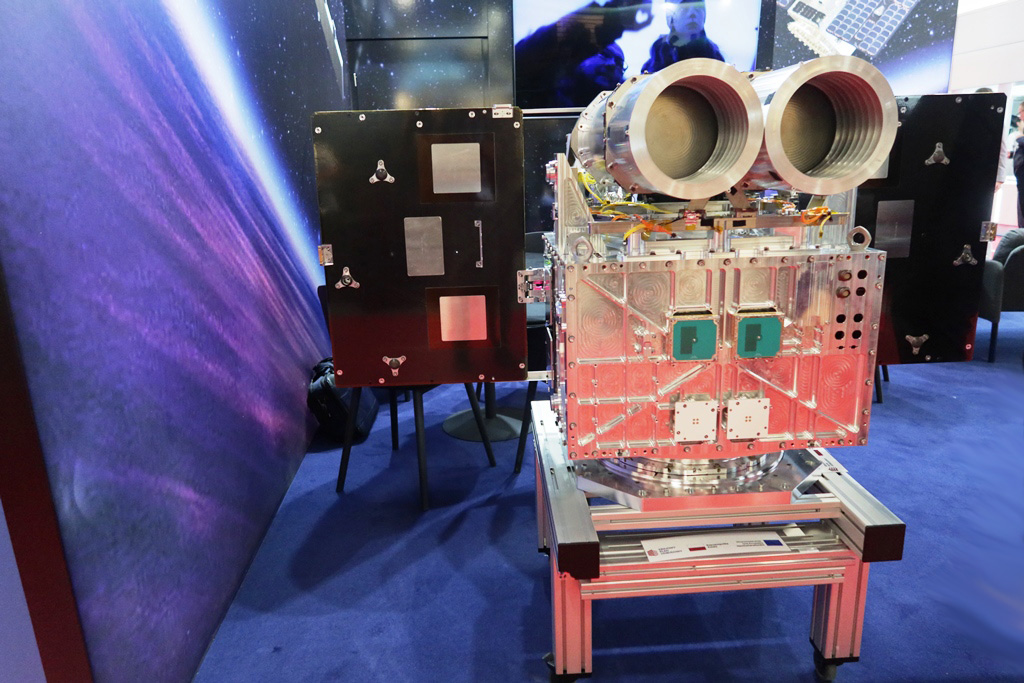
Among the most recent successes of Creotech we find the contract worth 556.7 million PLN (128 million Euro) for the MikroGlob programme. Signed with the Polish Armament Agency, on behalf of the Polish Ministry of Defence, on December 20, 2024, it includes the delivery of four earth observation microsatellites with optical sensors operating in the visible and near-infrared spectrum. These are based on the HyperSat platform developed by Creotech and will provide a space reconnaissance capability to the Polish Armed Forces. The first PIRX-1 satellite was launched on July 7, 2026, from Vandenberg Space Force Base in California on board SpaceX Transporter-17 mission.
This brings the discussion on European launch capabilities. In late 2023 the European Space Agency’s (ESA) launched the European Launcher Challenge initiative, which aimed at expanding European launch service supply to allow European satellites to be launched from European rockets. Funding was approved two years later; first contracts being signed in August 2026. Creotech follows closely the development of European launch capabilities and is currently in discussions with every single European rocket launcher company. Sovereignty is not the only issue, EDR On-Line understood, cost for launching over the pound being one order of magnitude higher.
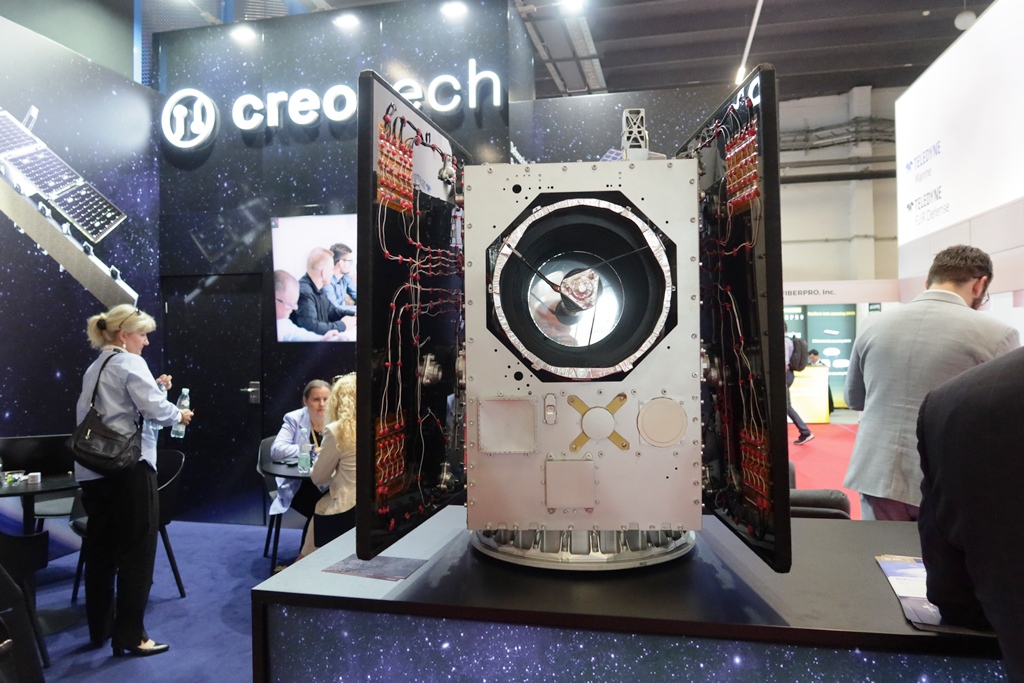
Sovereignty is even a more important issue when talking of the supply chain. Poland wants to avoid unilateral restrictions on export from other countries, Creotech is very careful in selecting its subcontractors, which are mostly Polish and European, checking that their subsystems do not contain any component coming from nations such as China, Russia, South Africa, and a few other. Satellites currently built by Creotech have 97% of their value coming from Europe, the remaining 3% coming from countries such as South Korea and Switzerland, with very few ITAR-free components provided by US companies. This means that only 18 components over several tens of thousands come from extra-EU countries, these being in principle replaceable, although for some of them this should mean waiting at least one and a half year, EDR On-Line understood.
 click on image to enlarge
“In the past a satellite built for ESA by a European consortium had a Chinese component on board, and China imposed a restriction on its export. ESA immediately switched gears and one week later what used to be fine was not fine anymore,” EDR On-Line was told.
As said Creotech is fully involved in the MikroGlob programme. “The constellation consists of four high-resolution optical satellites. Two more should be join it later this year, and there is a potential for increase,” Jakub Bochiński explained. The company is also involved in the Camila programme, for which in April 2025 received a 225 million PLN (52 million Euro); it is developed in cooperation with ESA and aims at strengthening Poland’s national Earth observation capabilities and increase its independence in accessing geospatial data. Camila was commissioned by the Polish Ministry of Development and Technology and is therefore a fully civilian programme.
Poland, and therefore Creotech, is involved in many European programmes, one of them being IRIS2 (Infrastructure for Resilience, Interconnectivity and Security by Satellite) to which it contributes with 700 million Euro. It will support several of governmental applications in the domains of surveillance, crisis management and connection and protection of key infrastructures.
Chreotech maintains close links with many European players in the satellite community, in France, Germany, Italy, Spain, Sweden, Finland, Denmark and other. Currently the company main customer is Poland, with a split of 60/40 between military and civil, although the VP of the Management Board expects these numbers to switch in the next couple of years; that said, Creotech looks with interest at the wider European market. One of the main clients is the ESA; Poland will contribute to the ESA budget with 550 million Euro for the next three years, hence the company expects an increase in orders from the European space entity in the near future.
Image and photos courtesy Creotech and P. Valpolini
[1] PAIH is the first point of contact for exporters and investors operating in dozens of markets globally. It provides free consulting to grow and promote Polish businesses. Among its missions, PAIH supports Polish companies in promoting their brands on export markets.
Content preview only. Full article available at source. View Full Article
Creotech Instruments plans to quadruple its satellite production capacity from 10 to over 40 satellites per year by 2029 in Warsaw, Poland. The company has secured a significant contract for the MikroGlob program, which includes the delivery of four earth observation microsatellites. Creotech is also building a new factory to support this expansion and is closely involved with the European Space Agency.
- Creotech aims to increase satellite production from 10 to over 40 per year by 2029.
- The company has secured a contract worth 556.7 million PLN for the MikroGlob program.
- Creotech is building a new factory near Warsaw for large-scale manufacturing.
- 97% of components used in satellites are sourced from Europe.
- Poland will contribute 550 million Euro to the ESA budget over the next three years.