
Defense Minister Resigns in Discontent Over Military Funding Plan, Accusing Prime Minister of Failing to Allocate Sufficient Funds and Claiming Inability to Counter External Threats
[Global Times Special Correspondent in the UK Wang Mingwei, Global Times Special Correspondent Zhen Xin] According to reports from Reuters, the BBC, and other media, due to dissatisfaction with the funding plan for the defense investment program, UK Defense Secretary John Healey announced his resignation on the 11th local time. He publicly accused Prime Minister Keir Starmer of failing to allocate the necessary funds in full, which would prevent the UK from defending against increasingly severe external security threats. On the same day, the Minister of State for Armed Forces Affairs, James Heappey, also announced his resignation.
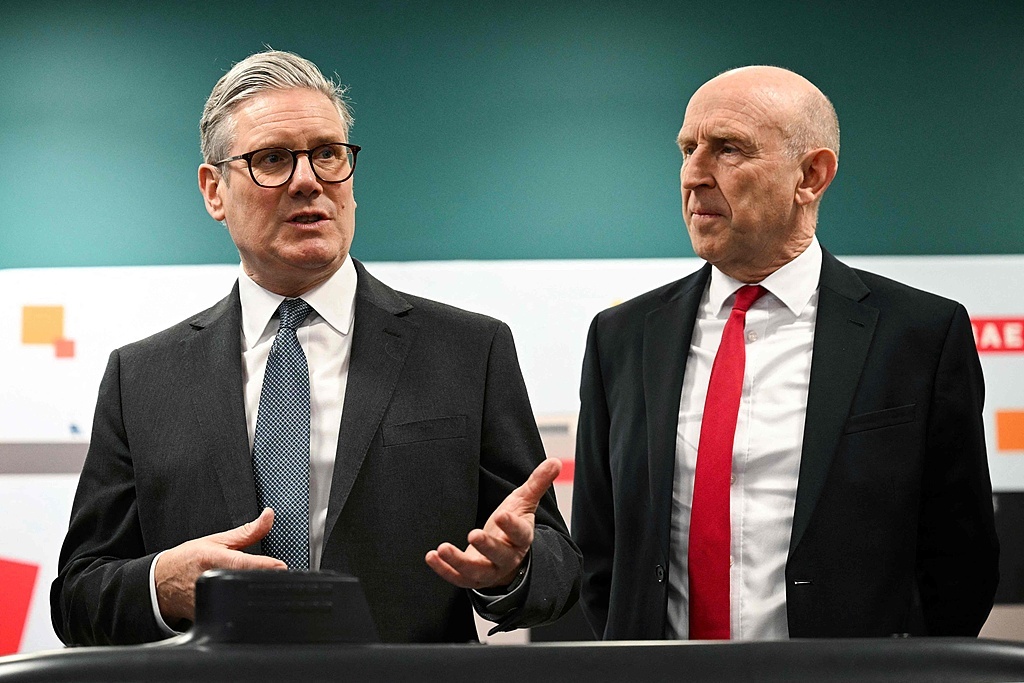
Resignation letter to Starmer
In a resignation letter posted on social media on the 11th, Healey stated that considering the further increase in UK defense needs and commitments to allies, by 2030, UK defense spending needs to account for 3% of GDP.
Healey indicated that the defense investment program funding plan he received previously only allocated 2.68% of GDP to defense spending by 2030, which could not meet the UK's defense needs. He also stated that he could not accept an investment plan that could not provide the necessary resources for the British Armed Forces, and therefore had to choose to resign as Defense Secretary, but would continue to support the Labour government. Former Conservative Party Security Minister Tom Tugendhat told the BBC that Healey's resignation letter was "the most devastating indictment."
Starmer immediately replied, expressing regret over Healey's resignation and appointed Dan Jarvis as the new Defense Secretary. The UK government website shows that after the Labour government took office in July 2024, Jarvis served as Minister of State for the Home Office and also took on the role of Minister of State for the Cabinet Office from September 2025. On the 12th, Starmer met with Jarvis.
On the same day, the Minister of State for Armed Forces Affairs, Heappey, along with two of Healey's parliamentary assistants, also submitted their resignations. Heappey similarly wrote to Starmer, accusing the current government's proposed defense investment plan of being "neither transformative nor adequately funded," making it difficult to respond to increasingly severe security threats and the rapidly changing nature of modern warfare.
In his resignation letter, Heappey stated that the Ukraine crisis shows that modern warfare is rapidly evolving, while the UK is still procuring equipment suitable for past warfare models. "Platforms worth billions of pounds could be defeated by systems worth thousands of pounds." He also criticized the overall decision-making efficiency of the UK government, stating that government departments are "at odds with each other rather than working together to solve problems."
The defense investment plan was originally scheduled for release in the fall of 2025, but has been repeatedly delayed due to disputes between the UK Ministry of Defense and the Treasury over funding scale, allocation cycles, and sources of funding. UK media reported that the plan has a funding gap of £28 billion (approximately 9 RMB per pound).
Defense spending promises unfulfilled
On the 11th, Reuters reported that the Starmer government had previously promised to introduce the largest and most sustained increase in defense spending since the Cold War, planning to raise military spending to 3% of UK GDP during the next parliamentary term, which means adding billions of pounds in defense funding each year. However, Healey stated that the proposed military spending increase by Starmer falls far short of the requirements: it must address the security pressures posed by Russia and strengthen the military deployment of the British Armed Forces in the Arctic and the Middle East, with a significant existing funding gap. Meanwhile, the UK economy is currently stagnant, with government debt levels and overall tax burdens at decades-high levels, making it difficult for the government to squeeze out additional fiscal funds to expand military spending.
Former Commander of the UK Joint Forces Command, General Richard Barrons, who participated in drafting the 2025 Defense Review report, which was supposed to serve as the basis for the defense investment plan, expressed outrage in an interview with Reuters over the government's failure to fulfill defense investment commitments: "The government clearly knows the various risks facing the UK and repeatedly emphasizes the importance of defense, yet has failed to provide actual funding that matches its statements."
Starmer may soon step down
The Guardian reported on the 11th that although there has been a months-long dispute between the UK government and opposition over defense spending, Healey's resignation still caught Downing Street by surprise. Healey had served in the Labour governments of former Prime Ministers Blair and Brown and was generally well-regarded among colleagues and within the Ministry of Defense. His departure further undermines Starmer's governing foundation, and in the coming months, his leadership within the party may face challenges.
Reports indicate that amid this political turmoil, international security threats continue to escalate, and Starmer is now struggling to restore his image and maintain the label of "stable and reliable governance." In just a few days, Starmer is set to travel to France for a G7 leaders' meeting, and a NATO summit is also approaching. Starmer needs to explain to the outside world why his country's Defense Secretary believes he is not doing enough in terms of national security.
Last month, Health Secretary Steve Barclay from Starmer's cabinet resigned, criticizing the Prime Minister for lacking long-term planning; Greater Manchester Mayor Andy Burnham is also preparing to challenge Starmer for the Prime Minister's position. The Guardian stated that many Labour MPs believe Starmer's time as Prime Minister is running out. A cabinet minister admitted to The Guardian: "The series of resignations only solidifies the outcome of Starmer stepping down."
UK Defense Minister John Healey resigned on November 11, 2023, citing inadequate defense funding to address external security threats. He criticized Prime Minister Starmer for failing to allocate sufficient resources, with the defense spending plan projected at only 2.68% of GDP by 2030. This resignation, along with that of other officials, underscores growing concerns about the UK's military readiness and defense strategy amid escalating security challenges.
- UK Defense Minister John Healey resigned on November 11, 2023.
- Healey criticized Prime Minister Starmer for inadequate defense funding.
- The defense spending plan is projected to be only 2.68% of GDP by 2030, below the required 3%.
- The resignation reflects broader dissatisfaction with the government's defense strategy amid rising security threats.
- The UK government faces criticism for not meeting defense spending commitments.