
Summary and Key Points: The deployment of F-22 Raptors, F-35As, and U-2 “Dragon Lady” spy planes to the Gulf marks a return to the “Desert Storm” doctrine of air superiority.
-Following the success of June 2025’s Operation Midnight Hammer—where B-2 Spirits successfully neutralized nuclear sites at Fordow and Natanz—this new buildup emphasizes a “systems approach” to warfare.
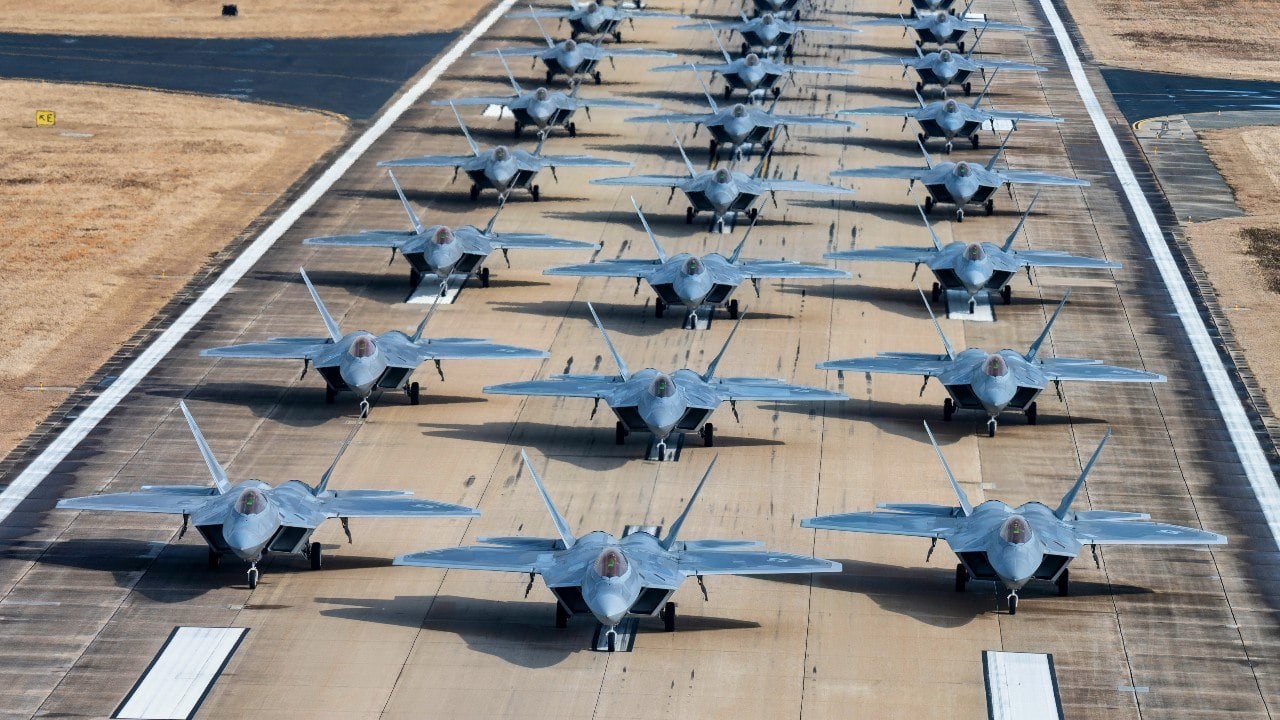
Aircraft from the 1st Fighter Wing conducted an Elephant Walk at Langley Air Force Base, Virginia, Jan. 31, 2025, showcasing the wing’s readiness and operational agility. This demonstration highlighted the wing’s capability to mobilize forces rapidly in high-stress scenarios. The wing’s fleet includes F-22 Raptors and T-38 Talons. As Air Combat Command’s lead wing, the 1 FW maintains unparalleled combat readiness to ensure national defense at a moment’s notice. (U.S. Air Force photo by Tech Sgt. Matthew Coleman-Foster)
-By utilizing high-altitude signals intelligence from the U-2 and the stealth dominance of the Raptor, the U.S. aims to bypass the “occupation trap.”
-This shift represents a broader strategic pivot to apply air-centric dominance across the Middle East and the Indo-Pacific.
1991 vs. 2026: How the U.S. Air Power Is Relearning the Decisive Lessons of Desert Storm
“The last time F-22s from Langley were spotted arriving at RAF Lakenheath was in the lead-up to Operation Midnight Hammer in June 2025, in which seven B-2 Spirit bombers struck two Iranian nuclear sites at Fordow and Natanz while an additional site at Isfahan was struck with Tomahawk cruise missiles,” reads an article from Air and Space Forces.
The article illustrates a buildup of air power taking place in the Gulf right now that rivals that seen in 1991 before the launch of Operation Desert Storm. On the surface it appears as though history could repeat itself.
The list of air power assets building up in the region is a lineup of all the post-Cold War advancements that make American and allied air power such a formidable force.
For tactical aircraft, there are reports of dozens of fighter jets deployed. These include F-22 Raptors, F-35A Lightning IIs, F-16 Fighting Falcons, and F-15E Strike Eagles.
There is also a commensurate deployment of strategic platforms, which include the E-3 Sentry Airborne Warning and Control System (AWCS). According to other reports, even U-2 spy planes are being brought to support a potential attack on Iran.
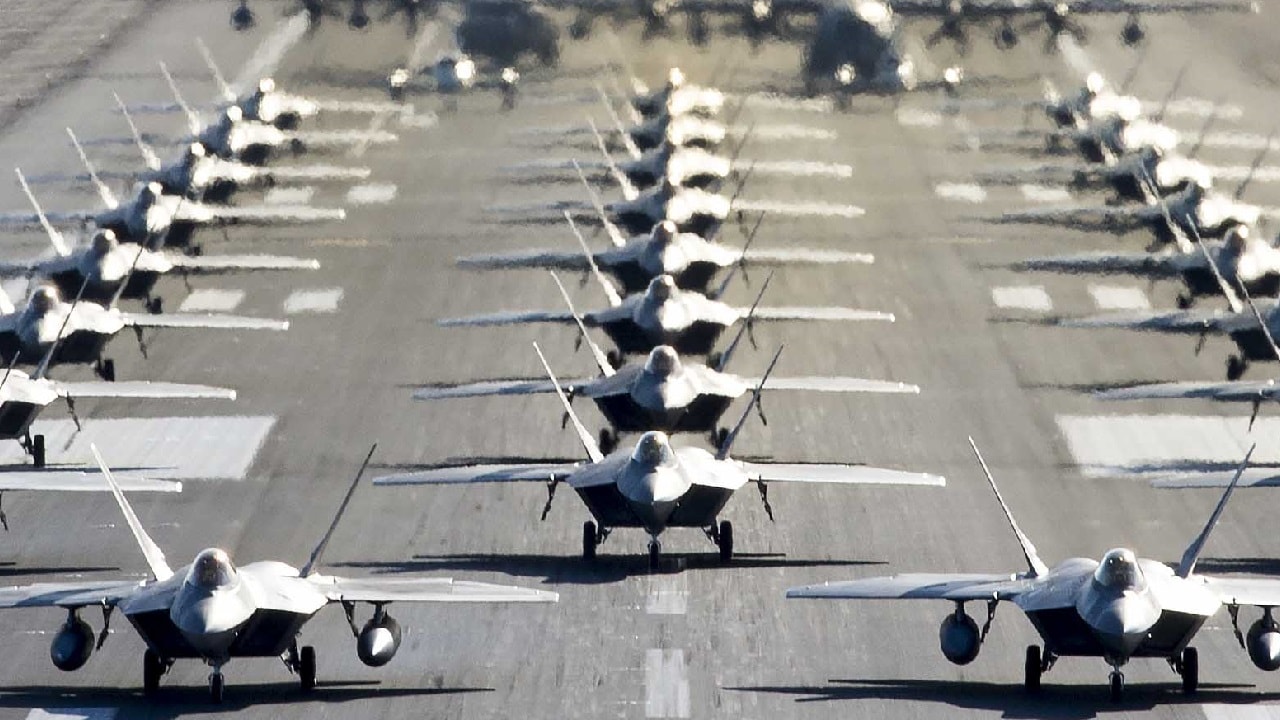
U.S. Air Force F-22 Raptors, E-3 Sentrys, C-17 Globemaster IIIs, C-130J Herculeses and C-12F Hurons participate in a close formation taxi known as an elephant walk at Joint Base Elmendorf-Richardson, Alaska, May 5, 2020. This event displayed the ability of the 3rd Wing, 176th Wing and the 477th Fighter Group to maintain constant readiness throughout COVID-19 by Total Force Integration between active-duty, Guard and Reserve units to continue defending the U.S. homeland and ensuring a free and open Indo-Pacific. (U.S. Air Force photo by Senior Airman Jonathan Valdes Montijo)
Eyes in the Sky
Speculation about the use of the U-2 “Dragon Lady” began when one of the aircraft departed from the aircraft’s regular forward operating base at RAF Fairford, United Kingdom, on February 17. Those aircraft are not recent arrivals, however; the U-2s rotate through the RAF base on a regular basis.
Two of the U-2s are usually at Fairford, from where they fly missions toward Eastern and Northern Europe.
Although there has been no official comment, the assumption is that these aircraft are engaged in missions supporting U.S. intelligence and targeting data collection used by the Ukrainian military.
There have been reports of U-2s flying “unknown missions” of this type ever since the Russia-Ukraine War began in 2022.
This aircraft can fly at altitudes of 70,000 feet or greater. While doing so, it provides continuous digital downloads of imagery, a tremendous upgrade from the days when the aircraft was using older-generation film cameras.
U-2s today are also equipped with an extensive set of signals intelligence and electronic emissions sensor systems on board. Ukraine has proven to be a “treasure trove” of electronic intelligence opportunities to assess Russian air defense, radar, and electronic warfare systems, said one of the former intelligence officials who spoke to NSJ about the use of the U-2s.
The Wrong Paradigm Shift
Writing in Forbes magazine, retired Air Force Lieutenant General David Deptula, currently the dean of the Mitchell Institute for Aerospace Power Studies, hearkens back to the use of America’s air-power technology during Operation Desert Storm.
The value of that operation, he asserts, “lies in understanding why it succeeded so decisively—and why the United States subsequently moved away from the very principles that made that success possible.”

U-2 Spy Plane. Image Credit: Lockheed Martin.
“It is time for a reset,” he says, “for what is at stake in the current security environment demands America and its allies succeed.” He describes the 1991 campaign as a “carefully conceived and executed campaign that exploited the inherent advantages of aerospace power through an effects-based, systems approach to warfare.”
The question today is how the U.S. military lost its way and forgot many of the lessons learned in that celebrated air campaign against Iraq.
Deptula’s position is that “in the decades following Desert Storm—particularly after 9/11—the United States largely abandoned this way of war.”
“Instead, it embraced a fundamentally different conflict model centered on prolonged, ground-centric campaigns of occupation, counterinsurgency, and nation-building. Leaders focused on restraining power more than adopting strategies that were focused on winning.”
Should there be a massive air campaign against Tehran, what happens after could be as vital as the air strikes themselves. After the 1991 Gulf War the Chinese military “learned what we have now forgotten,” and the United States has failed to comprehend how dangerous that is.
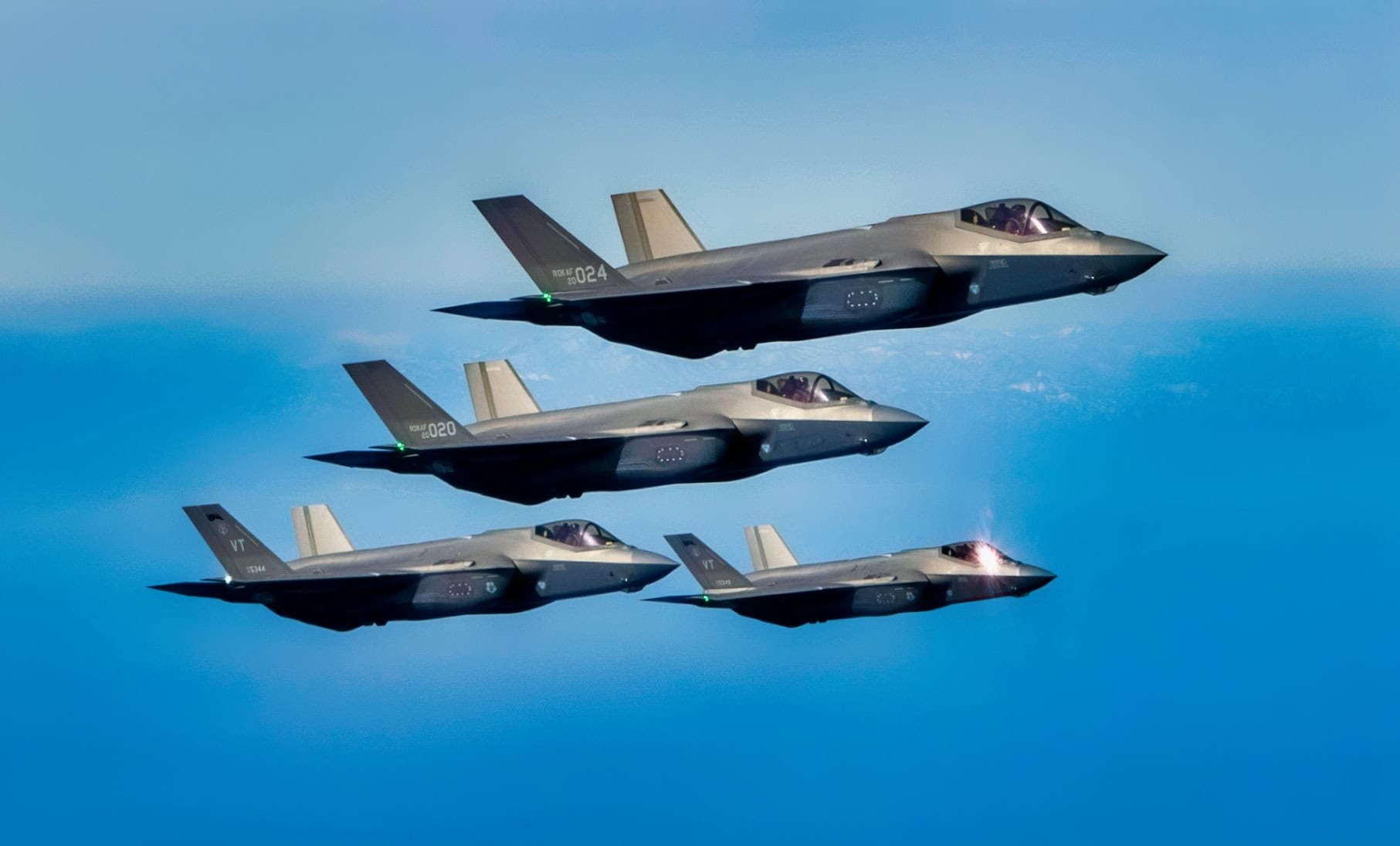
Two U.S. Air Force F-35A Lighting IIs fly in formation with two ROKAF F-35As during Freedom Shield 25, a defense-oriented exercise featuring live, virtual, and field-based training, March 13, 2025. The aircraft participated in dynamic targeting and aerial refueling training, validating the capability of ROK and U.S. Air Forces, to find, fix, and defeat a range of threats. (Photo courtesy of Republic of Korea Air Force)
If Iran proves to be another example of how U.S. air power can overwhelm an adversary, then it needs to be more than a one-off exercise, say Deptula and others. It should become the new paradigm that is applied to how wars will be fought, not just in the Middle East, but also across the vast expanse of Asia.
About the Author: Reuben F. Johnson
Reuben F. Johnson has thirty-six years of experience analyzing and reporting on foreign weapons systems, defense technologies, and international arms export policy. Johnson is the Director of Research at the Casimir Pulaski Foundation. He is also a survivor of the Russian invasion of Ukraine in February 2022. He worked for years in the American defense industry as a foreign technology analyst and later as a consultant for the U.S. Department of Defense, the Departments of the Navy and Air Force, and the governments of the United Kingdom and Australia. In 2022-2023, he won two awards in a row for his defense reporting. He holds a bachelor’s degree from DePauw University and a master’s degree from Miami University in Ohio, specializing in Soviet and Russian studies. He lives in Warsaw.