
Germany's Four Eurofighters Turn Latvia's Election Into a NATO Test
 Alexandra Reeves
Germany's Four Eurofighters Turn Latvia's Election Into a NATO Test
Four German Eurofighter Typhoons are being sent to Latvia for a week around the country's October 3 parliamentary election. On paper, that sounds like a small air-policing detachment. In practice, it is a revealing admission: in the Baltic states, protecting a democratic vote now requires fighter aircraft, ground crews and a NATO command network built for war.
Defense News reported on September 17 that Berlin will deploy the jets, several dozen soldiers and technicians to Lielvārde Air Base in central Latvia. Latvian authorities requested allied help after a year of repeated drone incursions near the eastern flank. Some drones were assessed as Ukrainian aircraft that strayed while attacking targets in Russia; others remain unidentified. The distinction matters less than the operational fact. An object crossing the border creates a decision problem before anyone knows whose flag it carries.
A short mission with a very long shadow
NATO normally covers the Baltic skies through four-month rotations. Latvia, Estonia and Lithuania do not operate their own fighter fleets, so allied aircraft based at Šiauliai in Lithuania and Ämari in Estonia provide the backbone of the mission. Lielvārde became capable of hosting NATO air-policing aircraft in 2024, but it is not usually a permanent fighter base.
That makes the German deployment different from routine reinforcement. It is a one-week, election-focused mission nested inside NATO's enhanced Air Policing North. The alliance is not claiming that Russian aircraft are about to attack Latvia. It is acknowledging that a crowded, nervous airspace can become strategically dangerous through misidentification, accident or deliberate probing.
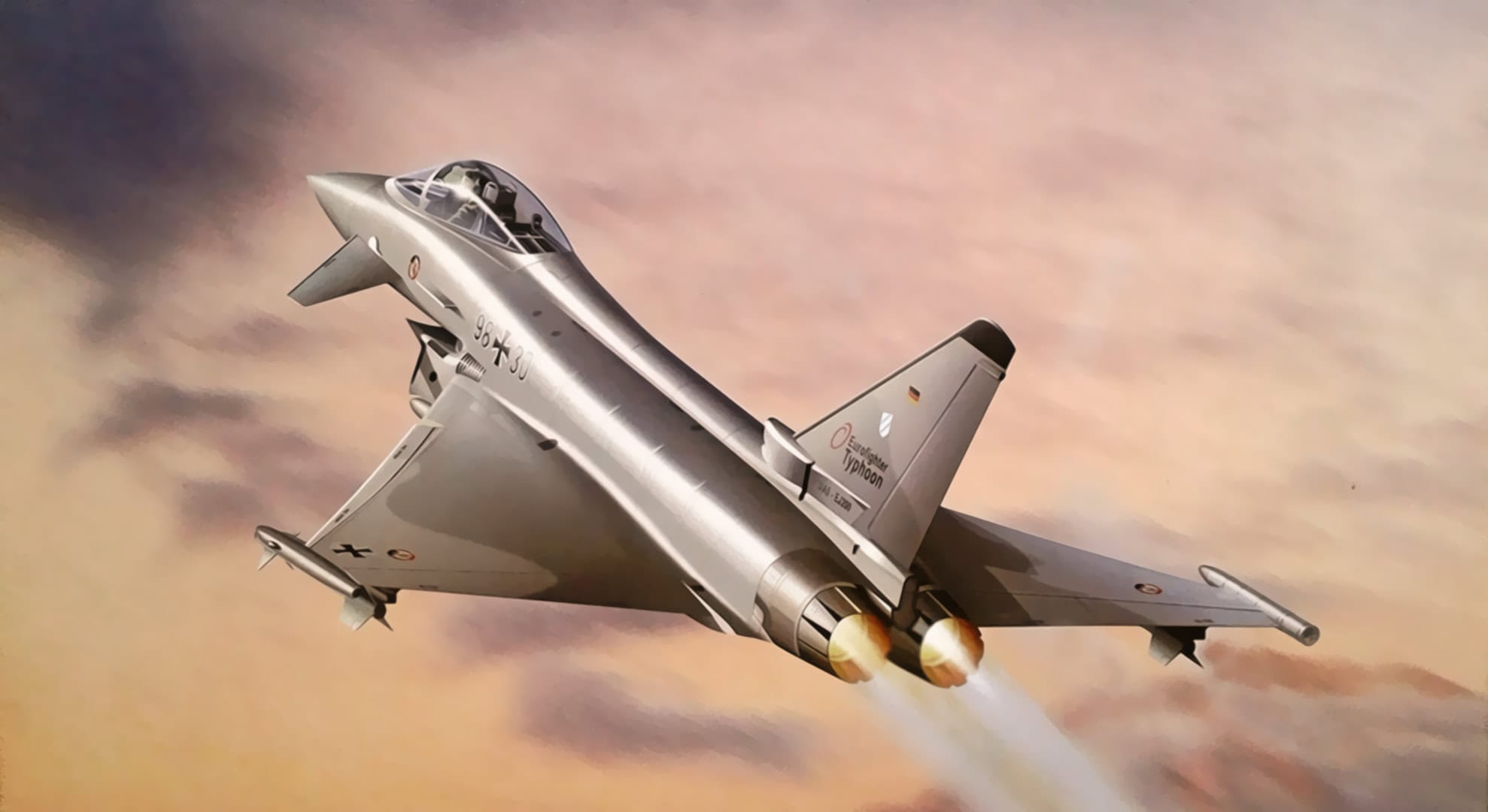
The equipment is familiar but still formidable. The Eurofighter Typhoon is a twin-engine, multirole fighter designed for rapid interception, air defence and precision strike. Its speed, sensors and beyond-visual-range weapons give Latvia something its own armed forces cannot provide: an immediate airborne response backed by NATO rules of engagement and a permanent command structure.
Why drones changed the political meaning of air policing
NATO describes Air Policing as a 24/7/365 mission inside its Integrated Air and Missile Defence System. The alliance says its command network monitors as many as 30,000 air movements across European NATO airspace each day. That system was built around aircraft, not the cheap and ambiguous drones now crossing borders.
In September, Italian NATO jets in neighbouring Lithuania shot down a suspected Russian-made drone after it entered Lithuanian airspace from Belarus, according to Defense News. It was reportedly the first such shoot-down in Lithuanian airspace. That incident changes the political threshold. Intercepts are no longer theoretical demonstrations of sovereignty; they are becoming a visible part of daily alliance management.
Small drones are difficult precisely because they are small, numerous and politically deniable. A fast jet can intercept one, but using a Eurofighter to deal with a low-cost unmanned aircraft is an expensive answer. A surface-to-air missile may be more appropriate, but that raises its own questions about radar coverage, identification and collateral risk. Latvia's election mission therefore exposes a gap between NATO's high-end air-power architecture and the low-end threats most likely to create a crisis.
Germany is sending reassurance, not just aircraft
Berlin's contribution matters beyond the four airframes. Germany is one of Europe's largest military powers, yet its defence credibility has often been judged by what it can sustain rather than what it can announce. Sending a small package to a specific allied request is a modest but useful test of responsiveness: can Germany move aircraft, personnel, maintenance equipment and command links quickly enough to support a vulnerable ally?
It also sends a message to Moscow and Minsk without crossing into theatrical escalation. A fighter deployment around an election is defensive, temporary and easy to explain. At the same time, it forces any hostile planner to account for an additional NATO sensor and weapons node at Lielvārde. Deterrence often works through inconvenience. The point is not that four jets can stop a campaign; it is that an opponent cannot assume the Baltic air picture is uncontested.
Latvia's request is equally important. Asking allies to protect election airspace is not evidence of weakness. It is evidence that the Baltic governments understand the modern threat correctly. Russia does not need to launch a conventional attack to pressure Latvia. A few unexplained drones, a border incident, a disinformation campaign and a tense election night could generate the uncertainty an adversary wants.
The uncomfortable NATO lesson
The mission exposes a contradiction in Europe's current defence debate. European governments are buying more fighter aircraft and discussing larger defence budgets, but the immediate problem is not simply the number of jets. It is the layered system beneath them: persistent surveillance, counter-drone sensors, electronic warfare, short-range air defence, secure communications and clear political authority to act.
Four Eurofighters can reassure voters for a week. They cannot create a national counter-drone network, and they cannot substitute for a Baltic air-defence architecture that can absorb repeated incursions without exhausting its most expensive assets. If every suspicious drone demands a fighter scramble, NATO will spend its premium capability on the cheapest instrument in the threat inventory.
That is why the next question is not whether Germany should have sent the jets. It should have. The question is what happens after October 3. NATO needs to turn temporary election protection into a standing plan for ambiguous air threats, with Latvia able to detect, classify and defeat drones before a Eurofighter has to leave the runway.
Germany's four Typhoons are a sensible signal of allied solidarity. They are also a warning. When fighter aircraft become election security equipment, the Baltic air-policing mission has moved from routine reassurance into domestic resilience. NATO can keep rotating jets around the problem, or it can build the cheaper, denser defences that the next crisis will actually require.
Sources
- Defense News, “Germany sending fighter jets to Latvia to protect election from drone incidents,” September 17, 2026.
- NATO, “NATO Air Policing,” official mission overview.
Germany deployed four Eurofighter Typhoons to Lielvārde, Latvia, for air policing during the parliamentary elections on October 3, 2026. This mission includes several dozen soldiers and technicians and responds to Latvia's request for assistance due to drone incursions. The deployment highlights NATO's commitment to air defense in the Baltic region and the evolving nature of security threats.
- Germany deployed four Eurofighter Typhoons to Latvia for a week around the October 3 parliamentary election.
- The deployment includes several dozen soldiers and technicians to Lielvārde Air Base.
- Latvia requested allied help due to repeated drone incursions near its eastern flank.
- The Eurofighter Typhoon is designed for rapid interception and air defense.
- This deployment is part of NATO's enhanced Air Policing North mission.