
Iraqi Pool Attack Tests UAE Defenses 2026 and Israeli Iron Dome Network
 Ahmed Al-Rashid
Drone Attack on Barakah from Iraq Tests UAE Defenses 2026 and Israeli Iron Dome Network
On May 19, 2026, the UAE Ministry of Defense stated that the drones targeting the Barakah nuclear power plant all came from Iraqi territory. This short sentence is more significant than the extent of the damage itself. There were no injuries and no radiation leak, but hitting a generator at the perimeter of a nuclear facility is enough for us to understand that the battle is no longer just between a launch platform and an intercepting missile, but between a state that wants to protect its economic model and an adversary that uses the political distance between Tehran, Baghdad, and the militias as part of its weaponry.
From a military perspective, the attack on Barakah is not just a fleeting incident in the Iran war. It is a test of a multi-layered defense system operated by the UAE under daily pressure since the war began on February 28. The cheap drone does not need to destroy the reactor to achieve its purpose. It is enough to force Abu Dhabi to activate the alarm, close the airspace around a sensitive facility, and demonstrate that the energy, tourism, and financial networks in the Gulf can be touched from an unexpected distance.
The Iraqi Significance in the Course of the Attack
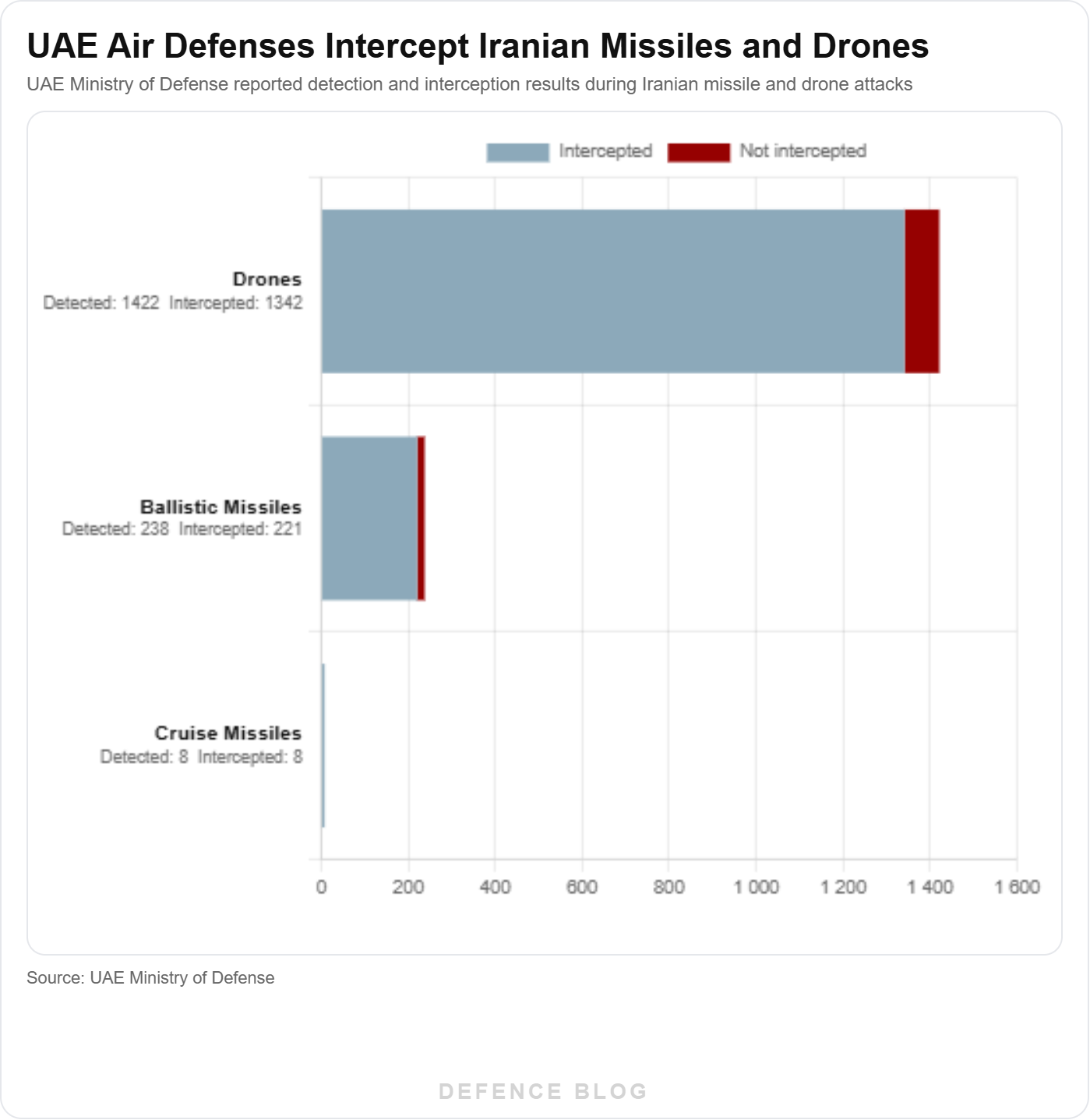
If the Emirati narrative is correct that all the drones came from Iraq, then the issue goes beyond intercepting targets over the Gulf. Iran or its allies want to expand the threat map so that the UAE no longer looks only at the opposite Iranian coast. The Iraqi route opens a northwestern angle and places Abu Dhabi in a delicate political dilemma, as it cannot deal with Baghdad as it does with Tehran. Iraq is a brotherly state, with a government that tries to appear sovereign, and within it are armed groups that can provide Tehran with plausible deniability.
The Iraqi government's statement condemning the attacks on the UAE is important, but it does not solve the problem. In such cases, the real question is not who condemned, but who has the power to prevent recurrence. Any military officer who has served in the region knows that the gap between the government's decision and the ability of the agencies to control the militias is the space in which drones operate. Therefore, the attack on Barakah pressures Baghdad as much as it pressures Abu Dhabi.
UAE Defense Layers Between Missiles and Jamming
The UAE has built over the past years an air defense system based on several layers, from Patriot and THAAD to M-SAM II, along with radars and command, control, and jamming systems. The new aspect of this war is that the non-missile layer is no longer experimental or promotional. The head of EDGE spoke in May about using Emirati systems like SKYSHIELD and NAVCONTROL to counter drones, which rely on high-power jamming and disrupting navigation via GNSS instead of launching an expensive missile at a cheap target.
This is a practical point that should not be underestimated. It is a mistake to measure air defense solely by the number of intercepting missiles. In the current war, if the defender is forced to use a million-dollar missile against a drone costing tens of thousands, the adversary wins part of the battle even if the drone is shot down. The UAE understands this more than others because it is a country with dense infrastructure, ports, airports, data centers, and energy facilities relatively close to threat paths. Therefore, the ability to jam locally from the first moment is not an industrial luxury, but a necessity of reverse attrition.
Iron Dome on Gulf Soil

The most politically sensitive element is Israel's entry into the Emirati defense structure in an open or semi-open manner. Reports from Axios and then Janes stated that Israel sent Iron Dome batteries and personnel to operate them in the UAE during the war, marking the first use of the system in this manner outside of Israel and the United States. Technically, Iron Dome is not the complete solution against all Gulf threats; it was originally designed for short-range missiles, shells, and drones within a specific Israeli environment. However, its value in the UAE is not just technical.
Its value lies in the fact that Tel Aviv has become a direct security supplier to a Gulf state while it is under Iranian attack. This is not a form of traditional diplomatic normalization. This is operational cooperation in wartime. Hence its sensitivity. Arab public opinion does not view any Israeli military presence in the Gulf as a cold engineering matter, especially in light of the war in Gaza and Lebanon. But from Abu Dhabi's perspective, a missile falling over the airport or port does not wait for political consensus to be reached.
Barakah as a Symbol, Not Just a Target
The choice of the Barakah plant's perimeter has significance. The facility is not just a power station; it is a symbol of the UAE's transition from a state reliant on oil, gas, and services to a state presenting itself as having an organized civilian nuclear program and a center for technology and energy in the region. Targeting it, even with a single drone, sends a message to investors, tourists, and insurance companies before it sends one to the Ministry of Defense.
Here, the old Gulf problem that I always return to in such files emerges. Purchasing systems is not enough. True capability is a triangle of equipment, training, and institutions. The UAE is better than most of its neighbors at linking these elements, but it is not immune to the pressures of geography. The more valuable the assets it wants to protect, the wider and more expensive the defense network becomes, and the adversary can choose symbolic points instead of classic military targets.
Iran and Militia Calculations
If the Iraqi route is intentional, it is an attempt to force the UAE to distribute its attention between the Gulf, Iraq, Yemen, and perhaps the Red Sea. Tehran does not need to announce its responsibility to gain politically. It is enough for everyone to understand that the network linked to it can open a low-cost front whenever it wishes. This pattern suits Iran because it has extensive experience in turning unregulated borders into pressure tools.
However, there is a risk for Iran itself. Targeting a civilian nuclear facility in a Gulf state, even without a radiation leak, creates a stronger international justification for expanding defensive cooperation against it. Many Arab capitals may not like seeing Iron Dome in the Gulf, but they may accept a reality they theoretically rejected if they feel that their vital facilities have become part of the militias' target bank. And as the old military saying goes, fire does not ask for the identity of the firefighter.
What the Incident Reveals About the Gulf
The Barakah incident reveals that Gulf security after the Iran war is no longer based on a single American umbrella or on the purchase of individual Western systems. We are facing a new mix, with Patriot and THAAD, local Emirati jamming, Israeli Iron Dome, and perhaps later short-range lasers and Chinese or European systems as needed. This mix is practical, but it raises a difficult institutional question: who manages the unified air picture, and who decides the priority between protecting the airport, the port, the power station, and the military base?
In my estimation, the UAE has tactically succeeded in minimizing damage, but it has entered a more complex strategic phase. Each new defense layer reduces risk and creates new dependencies. Relying on Israel improves protection but increases political costs. Relying on local technology provides flexibility but requires long testing under fire. Relying on the United States remains necessary, but it is no longer sufficient. This is the paradox of the Gulf today. The more advanced the defense becomes, the more urgent the question of sovereignty becomes.
Sources
- Associated Press, May 19, 2026 report on the path of the drones towards the Barakah plant.
- Breaking Defense, EDGE interview about SKYSHIELD and NAVCONTROL in May 2026.
- Janes, May 13, 2026 report on the deployment of Iron Dome in the UAE.
- Axios, April 26, 2026 report on Israel sending the Iron Dome system and operating crews to the UAE.
On May 19, 2026, drones targeted the Barakah nuclear power plant in the UAE, reportedly launched from Iraq. The UAE's Ministry of Defense confirmed the attack, which did not result in casualties or radiation leaks, but tested the country's air defense capabilities, including the Iron Dome system. This incident underscores the ongoing military tensions in the region and the strategic implications for UAE-Iran relations.
- Drones targeting Barakah nuclear power plant originated from Iraq.
- No casualties or radiation leaks reported.
- The attack tests the UAE's multi-layered defense system.
- Israel's Iron Dome was deployed in the UAE during the conflict.
- The incident highlights the geopolitical tensions involving Iran and its allies.