
Marine Corps tests new robot boat to hunt underwater mines
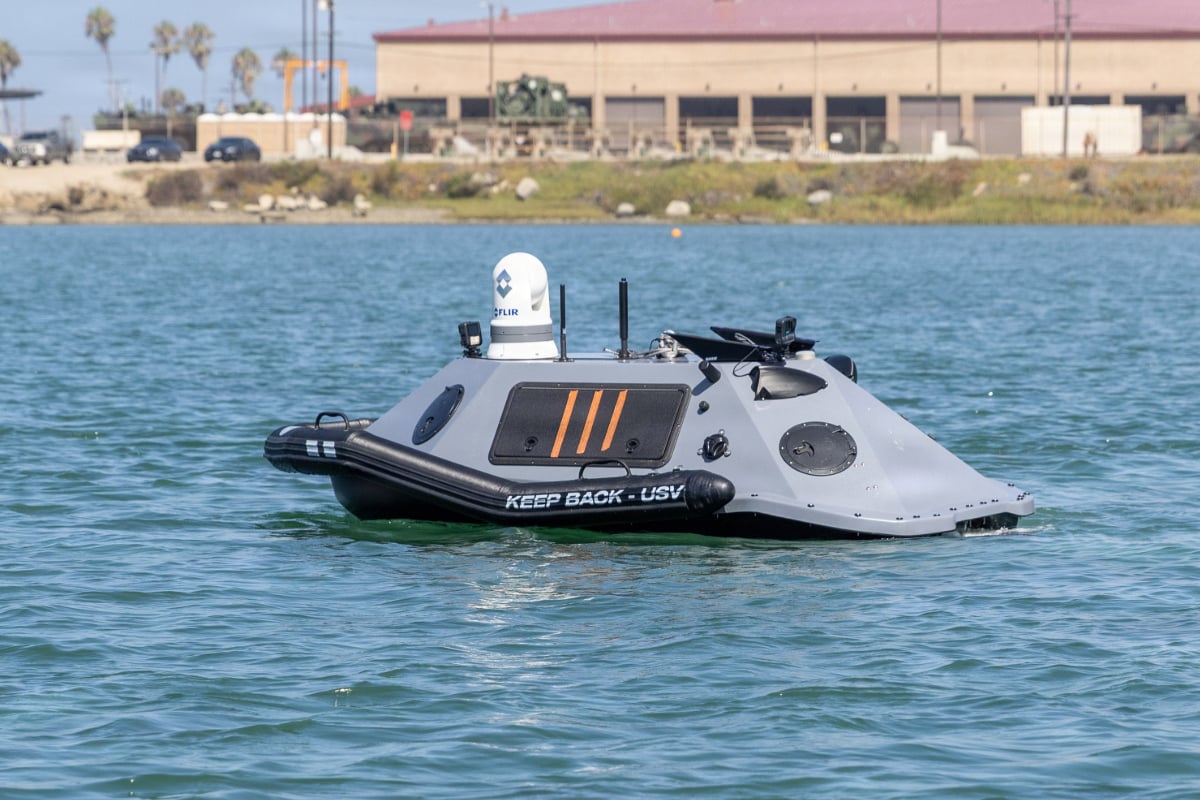
Marine Corps explosive ordnance disposal teams tested a new unmanned boat at Camp Pendleton in late August, part of an effort to clear mines and other explosive hazards from coastal waters without putting divers directly in harm’s way. The Explosive Hazard Defeat Team, working under Program Manager Combat Support Systems, ran the Unmanned Surface Vessel through two weeks of trials off the Southern California coast.
The boat is a commercial unmanned surface vessel fitted with sonar, forward-looking infrared cameras, and both line-of-sight and acoustic communications gear. It can drive itself along programmed routes.
It is the fourth piece of a five-part system the Marine Corps calls Littoral Explosive Ordnance Neutralization, or LEON. The full system also includes a remotely operated vehicle, diver equipment, an unmanned underwater vehicle, and an amphibious unmanned ground vehicle, each meant to extend how far Marine explosive ordnance disposal technicians can operate from a hazard before they have to approach it directly.
“The USV is a key part of the LEON System of Systems (SOS). While it provides a search capability, it will primarily enable the other LEON systems to conduct operations below the surface, locating and identifying potential hazards, then relaying that information to the surface for real time updates. The LEON SOS will enable maneuver by identifying safe routes for transit within the littorals,” said Capt. Timothy Guinan, project officer, Explosive Hazard Defeat Team.
The boat’s main job is to scan for hazards and serve as a communications relay, called a Mobile Gateway Buoy, linking the underwater and shallow-water parts of the LEON system to command elements on shore or afloat. It can run missions for up to 14 hours at a stretch, according to Guinan, covering large stretches of coastline with little more than a small crew monitoring it from a distance.
“Unmanned systems allow operations to continue without fatigue. These systems can be launched and left to conduct a mission for upwards of 14 hours covering large areas of the littorals, while it requires minimal manpower to monitor the system,” Guinan said.
Marines from 7th Engineer Support Battalion’s explosive ordnance disposal company took part in the testing, known formally as a Field User Evaluation. That gave fleet Marines, rather than engineers alone, a chance to run the system through waypoint navigation, target deployment, and location verification before offering feedback to the program office.
The teams started in calm water, learning the controls and setting up mock mine targets, then moved into a wider-area search through varying sea conditions off the Pacific coast.
“The events were very successful. Everyone was communicating well. The platform itself was running well, had long endurance and gave us good results to refine and further develop the capability,” said Chief Warrant Officer 2 Alfredo Andrade, officer in charge, Explosive Ordnance Disposal Company, 7th Engineer Support Battalion.
Andrade said the push toward unmanned maritime systems reflects a broader goal within the EOD community: reducing how often Marines have to physically approach a suspected explosive hazard, and cutting the strain that repeated deployments put on a limited pool of trained technicians.
“Some of the conflicts that we are engaged in take a toll on the force, and surging in new forces is costly. It turns into a logistical problem. To preserve the safety and the health of the forces…the USV and the [LEON] program exist to ensure that we have readily available combat power,” Andrade said.
The Marine Corps expects to begin fielding the USV to explosive ordnance disposal companies in fiscal year 2027, with the rest of the LEON family of systems set to follow over the two years after that.
Content preview only. Full article available at source. View Full Article
The Marine Corps tested a new unmanned surface vessel (USV) at Camp Pendleton in late August 2023 as part of the Littoral Explosive Ordnance Neutralization (LEON) system. The USV, equipped with sonar and communication gear, can operate autonomously for up to 14 hours, aiding in mine detection and serving as a communications relay. Marines from the 7th Engineer Support Battalion participated in the testing, which was deemed successful, with plans to field the USV by fiscal year 2027.
- Marine Corps tested a new unmanned surface vessel at Camp Pendleton.
- The USV is part of the Littoral Explosive Ordnance Neutralization (LEON) system.
- The vessel can operate for up to 14 hours and covers large areas with minimal manpower.
- Testing involved Marines from the 7th Engineer Support Battalion.
- The USV is expected to be fielded by fiscal year 2027.