
Mine Removal Mission in Hormuz with Participation of 38 Countries Reveals Gulf Maritime Gap in 2026
 Ahmed Al-Rashid
The Mine Clearance Mission in Hormuz with Participation from 38 Countries Reveals the Gulf's Maritime Vulnerability in 2026
On June 16, 2026, the issue in the Strait of Hormuz is no longer about declaring it open or closed, but the more difficult question: who has the practical ability to get an oil tanker or gas ship through a two-mile-wide shipping channel without it becoming a hostage to a mine, a fast boat, or a political decision in Tehran? The Associated Press reported from the G7 summit in Évian that France and Britain are pushing for a defensive maritime mission to clear mines and escort ships, following the announcement of a preliminary agreement between the United States and Iran. The striking figure is not the name of the mission but its scope: French-British planning involving countries from the Gulf, Asia, and Europe, with a previous meeting that included 38 nations.
This is not a technical footnote to a political agreement. From a military perspective, mine clearance is the real test of any talk about freedom of navigation. A politician can declare the strait open in a minute, while a mine sweeper commander needs days or weeks to inform the captain and the insurance company that the passage is safe enough. In the Gulf, we have long learned that deterrence is not measured solely by the number of intercept missiles, but by a state's ability to restore economic life after the first strike.
The Strait Open on Paper is Not a Safe Passage at Sea
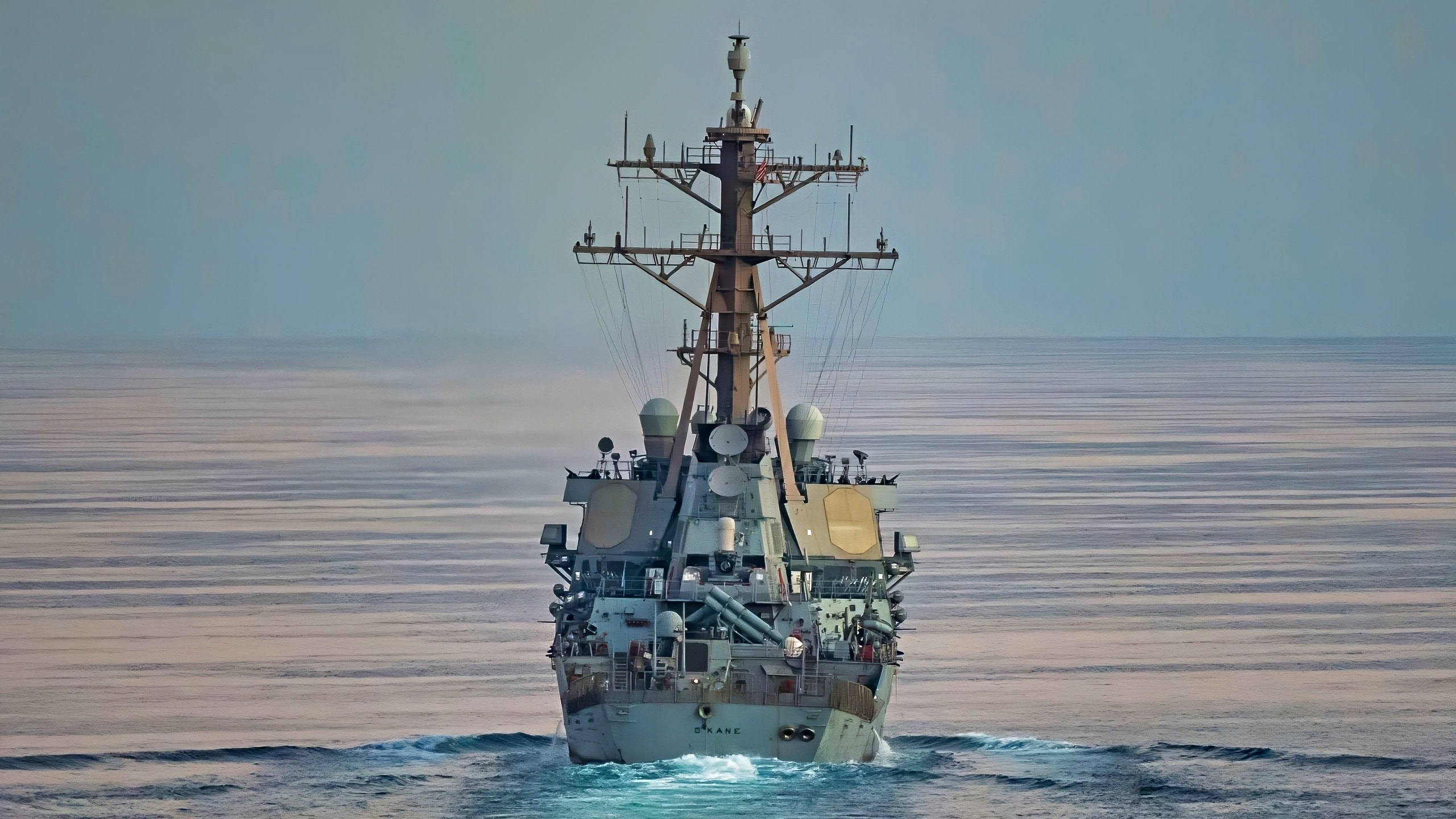
According to the Associated Press, Western allies are discussing an independent and defensive mission aimed at reassuring ship crews and insurance companies, not opening a new front with Iran. France has the aircraft carrier Charles de Gaulle in the region, and Macron stated that French aircraft could begin surveillance missions quickly, followed by frigates within 48 hours, and then the carrier within two or three days. Britain offers the expertise of the Royal Navy in mine clearance operations, and France and Britain are relying on their experience in the Red Sea, where Western frigates defended commercial ships against Houthi attacks.
However, the experience in the Red Sea itself carries a warning. A frigate may shoot down a missile or drone, but it cannot eliminate the cost of risk for shipping companies. In Hormuz, the danger is more complex because a mine does not issue a political statement before it explodes. Mines can be bottom-laid, tethered, or triggered by sound, movement, and light. This type of threat does not require complete Iranian naval superiority; it only needs enough doubt to make an insurance company raise its rates and a captain delay sailing.
A Gulf Rich in Missiles but Poor in Passage Engineering
A report from the UK House of Commons Library published in June places the numbers in stark terms: the strait at its narrowest point is 29 nautical miles wide, but the practical shipping channels consist of only two passages each two miles wide. About 20 percent of global oil trade and 27 percent of traded oil passes through it, and Qatar and the UAE heavily rely on this route for liquefied natural gas exports. The report also noted a significant decline in shipping traffic, with estimates suggesting that full flows may not return before 2027, even if an agreement is reached quickly.
Here, the old Gulf gap appears in a maritime guise. Gulf countries have purchased Patriot and THAAD systems, F-15 and Rafale aircraft, and Eurofighters, which is necessary. However, they have not built a collective capability to the same extent for mine clearance, port protection, emergency maritime traffic management, and linking military decisions with those of energy and insurance companies. From a purely military perspective, defending an oil facility begins before the missile falls and ends after the tanker returns to its route. Many Gulf capitals have mastered the first part, but they still call on external assistance for the second part.
Iran Has Lost Part of Its Power but Retained the Disruption Card
The US-Iran agreement, as described by The Guardian, grants a 60-day truce and opens the door to discussions on the nuclear program, sanctions, and frozen assets. However, it does not resolve the issue of ballistic missiles, the network of regional allies, or the definition of sovereignty over the strait. The National reported that European leaders want to reopen Hormuz without fees, and there is a rejection of Tehran's attempts to impose transit fees or new management of the passage. This point is not only legal; it is both military and economic at the same time.
Iran does not need to completely close the strait to gain a bargaining chip. It is enough to say that it is capable of closing it tomorrow, or that some mines have not yet been located, or that ships from certain countries need approval. Thus, the strait becomes like a pressure valve in the hands of a state worn down by war but that has not lost its tools of disruption. Practically, any Gulf defense system that does not have an independent answer to mines, boats, and maritime drones will continue to negotiate under the shadow of those tools.
Why the Role of Oman, Bahrain, and Qatar Matters More than Military Images
Macron's reference to Oman's approval for an international mission to pass through its territorial waters is very important. Half of the Hormuz puzzle lies not only in Tehran but also in Muscat. Oman has the calm geography that allows the passage to be international without turning into declared maritime occupation. Bahrain hosts Western naval facilities, and Qatar has a direct interest because gas exports cannot wait indefinitely. Nevertheless, Gulf capitals appear in this mission as beneficiaries and hosts rather than leaders.
This does not mean they should compete with France and Britain in aircraft carriers. What is needed is simpler yet more difficult: regional leadership for port operations, a permanent Gulf center for mine information, joint maritime survey units, and real exercises with energy companies, not just with guests. Anyone who has served in the region knows that an exercise that does not include the civilian owners of ships and insurance remains half an exercise. Modern warfare on passages does not separate radar from commercial contracts.
The Lesson the Gulf Does Not Want to Hear
The mission of the 38 countries may help reduce the risk and may be necessary in the early days after the agreement. However, it simultaneously reveals that the Gulf, despite its wealth and years of defense spending, still relies on others for a fundamental sovereign function: ensuring that its exports can leave its ports in times of crisis. This is not a matter of political dignity, but a matter of readiness. The military adage says that an unsecured road negates the value of the power at its end. And if Gulf oil and gas need a French, British, and American decision, along with Omani approval and Iranian hesitation to reach the market, it means that Gulf deterrence is still lacking at the most vital point.
Sources: Associated Press on the mine clearance and escort mission in Hormuz, The National on Macron's proposal and Oman's approval, The Guardian on the framework of the US-Iran agreement, and the UK House of Commons Library report on reopening the Strait of Hormuz and trade and energy figures.
An international coalition led by France and Britain initiated a mine clearance operation in the Strait of Hormuz on June 16, 2026, involving 38 countries. This operation aims to secure maritime routes for oil and gas tankers amid rising tensions and threats from Iran. The coalition seeks to ensure safe passage through a critical area that handles a significant portion of global oil trade.
- 38 countries are participating in a mine clearance operation in the Strait of Hormuz.
- The operation aims to ensure safe passage for oil and gas tankers.
- France and Britain are leading the initiative with support from Gulf and Asian nations.
- The region is critical for global oil trade, with 20% of oil passing through the Strait.
- Iran's influence and potential threats complicate the security situation.