
NSA Stirling Gives AUKUS a 2027 Base, Not Enough Submarines
 Marcus Chen
NSA Stirling Gives AUKUS a 2027 Base, Not Enough Submarines
One British and up to four American nuclear-powered attack submarines rotating through Western Australia sounds like a serious AUKUS milestone. It is. It is also not the same thing as Australia having a submarine force that can survive first contact with a China contingency.
The U.S. Navy has now established Naval Support Activity Stirling near Perth and re-established Submarine Squadron 3 at HMAS Stirling, according to USNI News and the U.S. Navy. Submarine Rotational Force-West, or SRF-West, is expected to become operational in 2027, with U.S. personnel beginning rotations later in 2026. Australia says it is investing up to $8 billion into the base expansion and creating roughly 3,000 direct jobs around the effort.
The Base Is Real Progress
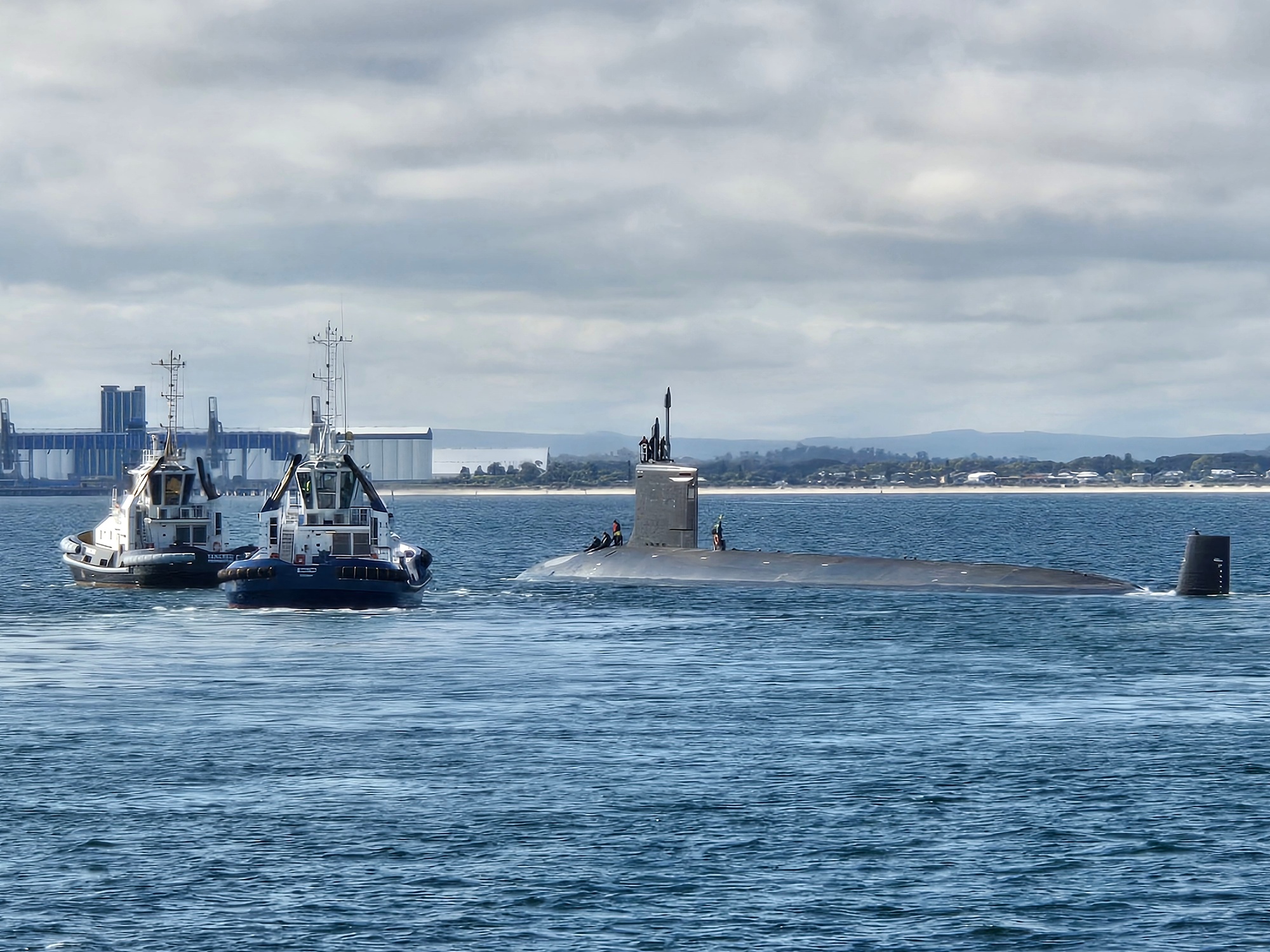
This matters because submarines are not aircraft. You cannot surge them by flying crews forward and parking them on a ramp. A Virginia-class SSN needs nuclear-qualified maintenance, weapons handling, secure communications, pier services, trained divers, spare parts, radiation safety procedures, and a port culture that understands what a boat needs when it comes alongside after weeks underwater.
That is why the new command structure is more important than the ribbon-cutting suggests. NSA Stirling is supposed to provide the ordinary but essential support for U.S. sailors, contractors, civilians, and families. CSS-3 is meant to provide the operational and logistics backbone for U.S. and U.K. submarines rotating through the base. Pearl Harbor Naval Shipyard is also expected to stand up a maintenance and logistics detachment in Western Australia in mid-2026.
Anyone who has served on a destroyer knows the unglamorous truth: readiness lives in the maintenance schedule. A forward base without intermediate maintenance is a hotel. A forward base with qualified maintainers, divers, parts, and authority to fix things becomes combat power.
The Numbers Still Do Not Close
The problem is that AUKUS has always had two separate equations. The first is basing. The second is boat availability. NSA Stirling helps with the first. It does not solve the second.
The planned SRF-West model is one Royal Navy SSN and as many as four U.S. Navy SSNs operating rotationally from Perth. That is not a small presence. From HMAS Stirling, a submarine can move into the eastern Indian Ocean, the South China Sea approaches, or the waters south of Indonesia without beginning every patrol from Hawaii, Guam, or the U.S. West Coast. In a Taiwan or South China Sea crisis, shaving transit time matters.
But a rotating force is still a rotating force. Four U.S. boats assigned to support the concept does not mean four boats continuously on station. Some will be in transit, some in maintenance, some working up, and some unavailable because submarines are machines operated hard in salt water. If Washington promises allies a four-boat political signal and then counts it as four boats of persistent wartime capacity, it is doing theater math.
The harder number is production. CSIS recently noted that the United States is producing about 1.2 Virginia-class submarines per year against a target rate of two, while arguing that the China problem really requires moving toward three per year. A single Virginia-class boat costs roughly $4.5 billion and carries a crew of about 132. AUKUS then asks this same stressed force to sell Australia three in-service Block IV Virginia-class submarines in the 2030s before Australia receives five SSN-AUKUS boats later.
That is the bottleneck. You cannot base your way out of a shipbuilding deficit.
Maintenance Is The First Test
There are encouraging signs. USNI reported that about 20 Australian civilian maintainers and 25 Royal Australian Navy divers and fleet support personnel have completed training at Pearl Harbor, with more than 230 Australians still under instruction in Hawaii. The recent HMS Anson maintenance period at HMAS Stirling also gave Australia a useful rehearsal, with 17 Australian businesses supporting the work and more than 2,500 person-hours of Australian industry labor involved.
That is exactly the kind of slow institutional learning AUKUS needs. It is also evidence that Australia is still early in the climb. Nuclear submarine maintenance is not a technology transfer seminar. It is a workforce habit built over years, usually by making mistakes under supervision until the mistakes become rare. The United States and Britain can lend procedures and people, but Australia has to create the muscle memory.
The most useful part of SRF-West may therefore be less about deterrent signaling and more about apprenticeship. If Australian workers can repeatedly maintain American and British SSNs without slowing the boats down, AUKUS becomes more credible. If every maintenance period requires extraordinary U.S. and U.K. support, then Australia is hosting allied submarines, not building the base of a sovereign SSN force.
China Will Read Capacity, Not Ceremony
Beijing will not ignore NSA Stirling. A submarine hub in Western Australia complicates Chinese planning because it places allied undersea power on a flank that is difficult for the People’s Liberation Army Navy to monitor continuously. Chinese anti-submarine warfare remains a relative weakness, especially across the vast distances between the South China Sea, Indonesian straits, and eastern Indian Ocean.
That geography is why attack submarines are still among the most valuable assets in a China fight. They can threaten amphibious ships, escorts, logistics vessels, and submarines while operating under a level of concealment surface forces cannot match. CSIS wargaming has repeatedly shown U.S. submarines doing disproportionate damage to Chinese invasion fleets. That is the case for AUKUS in one sentence.
But China will also read the gap between announcements and capacity. If the U.S. industrial base remains stuck near 1.2 Virginia-class boats per year, every forward-deployed SSN becomes a scarce asset pulled between U.S. war plans, Australian reassurance, maintenance demands, and future transfer commitments. Scarcity invites harder choices than communiques admit.
NSA Stirling is necessary. It gives AUKUS a pier, a command structure, a training pipeline, and a place to turn allied submarines around closer to the fight. That is real progress.
It still leaves the central question untouched: how many submarines can the alliance actually keep ready, west of the first island chain, when the shooting starts? Until that answer is measured in available hulls rather than scheduled milestones, AUKUS remains a basing success waiting on a shipbuilding miracle.
The U.S. Navy established Naval Support Activity Stirling in Western Australia, set to support U.S. and U.K. submarines by 2027. Australia is investing $8 billion in the base expansion and training personnel in Hawaii. However, the current production rate of Virginia-class submarines is insufficient to meet future demands, raising concerns about the operational capacity of the AUKUS alliance.
- NSA Stirling will support U.S. and U.K. submarines by 2027.
- Australia is investing $8 billion in base expansion.
- Training of Australian personnel is ongoing in Hawaii.
- The U.S. is producing 1.2 Virginia-class submarines per year, below the target of 2.
- AUKUS aims for Australia to receive submarines in the 2030s.