
On September 17, 19 PLA Military Aircraft Crossed the Taiwan Strait Median Line, High-Frequency Operations Test Taiwan's Early Warning System
 S.W
S.WOn September 17, 19 PLA Aircraft Crossed the Taiwan Strait Median Line, High-Frequency Operations Test Taiwan's Early Warning System
On September 17, Taiwan's authorities reported that in the past 24 hours, 19 PLA aircraft, 8 naval vessels, and 2 civilian ships were active around the island of Taiwan, with 17 aircraft crossing the so-called median line of the Taiwan Strait, covering areas to the north, southwest, and east. The number itself does not constitute a large-scale exercise, but the 90% crossing rate is quite informative: the PLA is transforming cross-median line actions from occasional displays into a repeatable daily task.
The Rhythm of Actions Behind the Numbers
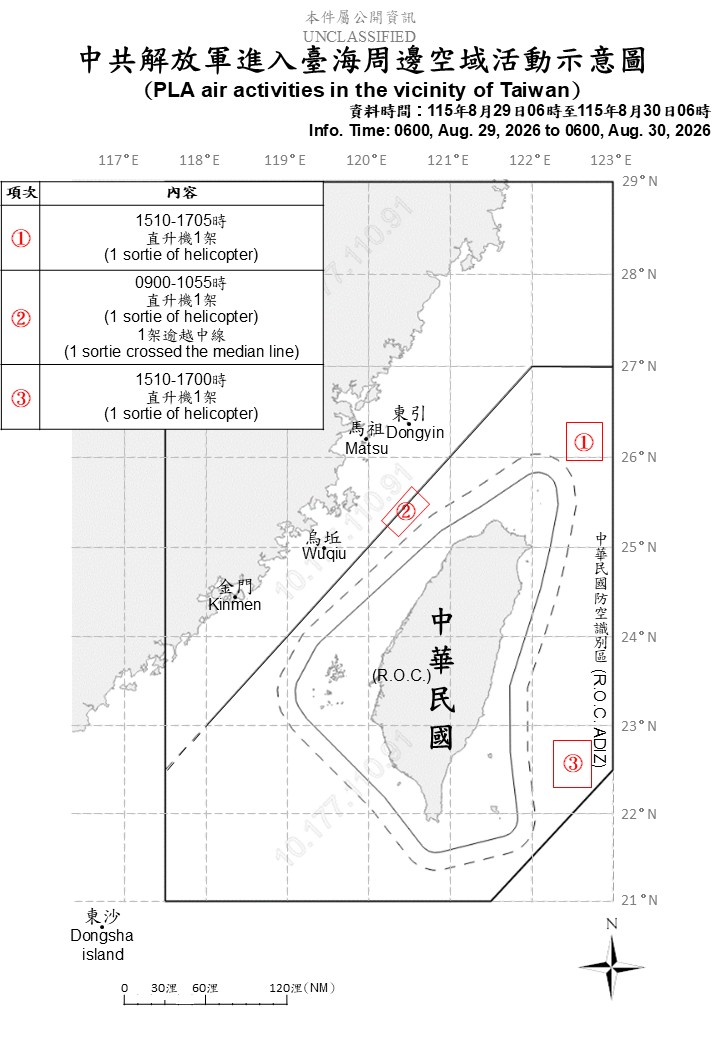
According to Taiwan news citing data from the defense department, since September, Taiwan has recorded 127 instances of Chinese military aircraft activity and 163 instances of naval activity. This statistic is not merely a ranking of "sorties," but rather a daily detection record published by Taiwan. In other words, it is more suitable for observing the density of actions and changes in direction, and should not be directly equated with how much combat power the PLA has deployed.
The independent tracking website PLA Tracker reported on September 17 a total of 19 sorties, 17 crossings of the median line, and 10 naval vessels, rating the aerial activity that day as above recent normal levels. However, the comprehensive index of the website is self-calculated and cannot replace military intelligence assessments. Public information does not provide complete details on aircraft types, flight paths, payloads, and mission purposes; whether it includes J-16s, early warning aircraft, or drones remains to be confirmed.
From "Crossing the Line" to System Consumption
The median line of the Taiwan Strait is not a boundary in the international legal sense, and crossing it does not automatically trigger armed conflict. Its real value lies in training and consumption. The PLA Air Force can approach from multiple directions—north, southwest, and east—forcing Taiwan to continuously mobilize fighter jets, shore-based radar, naval vessels, and air defense missile systems. If actions remain below the threshold of conflict, the PLA gains practical experience for pilots and command chains, while Taiwan bears the costs of alert sorties, fuel, maintenance, and personnel fatigue.
This is why it is not sufficient to focus solely on "whether there are 19 or 9 aircraft today." For Taiwan, the most challenging aspect is not a one-time breakthrough, but whether the early warning system can maintain reliability under sustained moderate pressure for several weeks. Detecting a target is just the first step; target identification, force allocation, engagement authorization, and post-action review determine whether such gray zone actions can translate into real military advantages.
Another Line of Recent Maritime Cooperation
On September 14, the Chinese Ministry of Defense disclosed that the "Maritime Cooperation-2026" joint exercise with Singapore has been completed, covering subjects such as communication drills, live-fire exercises, maritime resupply, joint search and rescue, and casualty evacuation. While this is not the same task as the activities around the Taiwan Strait, when viewed together, it reveals two directions of PLA training: one line is high-frequency combat readiness patrols around Taiwan, and the other line is offshore coordination, resupply, and interactions with multiple navies. The former practices pressure application, while the latter practices sustained presence.
The author believes that the data from September 17 resembles a "system test" rather than a signal of imminent conflict. The real change that needs to be monitored is whether military aircraft activities, naval vessels, coast guard, and unmanned platforms begin to operate in a fixed sequence, and whether this coordination gradually compresses Taiwan's response time. Current public information is still insufficient to prove that a mature blockade formation has been established, but if there are continuous instances of simultaneous actions by multi-directional air forces, naval forces, and electronic reconnaissance forces in the future, the risk assessment for the Taiwan Strait must be elevated by one level.
Sources and Judgment Boundaries
- Taiwan News, September 17, 2026, data on military aircraft and naval activities released by Taiwan.
- PLA Tracker, September 17, 2026, trend analysis of public data; its index is an unofficial metric.
- Guangming Daily citing Xinhua News Agency, September 14, 2026, information from the Ministry of Defense's regular press conference and the "Maritime Cooperation-2026" exercise.
The unanswered question remains: Is the PLA maintaining high-frequency gray zone pressure, or has it begun to calibrate its forces and rhythm for the next round of larger-scale joint operations?
On September 17, 19 Chinese military aircraft crossed the Taiwan Strait median line, testing Taiwan's early warning system. This action is part of a broader pattern, with Taiwan recording 127 instances of Chinese military activity in September. The PLA's increased frequency of operations suggests a shift towards routine incursions, raising concerns about Taiwan's response capabilities.
- 19 Chinese military aircraft crossed the Taiwan Strait median line on September 17.
- Taiwan recorded 127 instances of Chinese military aircraft activity in September.
- The PLA is increasing the frequency of operations across the median line, indicating a shift to routine actions.