
Pentagon wants satellites to use the atmosphere to change orbits
The Pentagon’s research and development arm, the Defense Advanced Research Projects Agency (DARPA), is preparing a program called Anzio to develop technology that would let spacecraft use Earth’s upper atmosphere, rather than rocket fuel, to make large changes to their orbits. DARPA’s Tactical Technology Office announced the effort on Nov. 9 in a notice on the federal government’s contracting website, inviting companies to an industry day in Arlington, Virginia, on Dec. 16 and 17.
The agency says Anzio aims to develop “innovative aero-assist technologies for spacecraft, which will enable large, rapid, and precise orbit transfers while significantly reducing propellant requirements.” DARPA has not disclosed a budget, schedule or number of planned awards, and the notice says a formal program solicitation will follow the industry day.
DARPA lists four technology areas of interest: thermal protection systems, control systems and algorithms, atmospheric sensing, and lightweight aeroshells. It has ruled out work on communications, power management, spacecraft buses, payloads, propulsion systems and existing orbital transfer vehicles, which leaves the program focused on the hardware and software a spacecraft needs to survive and steer through the atmosphere and come back out in a different orbit.
Aero-assist covers several techniques that trade propellant for atmospheric drag or lift. In aerobraking, a spacecraft dips into the thin upper atmosphere on repeated passes, slowly lowering its orbit. Aerocapture uses a single, deeper pass to shed enough speed to enter orbit, and aerodynamic plane changes use lift generated inside the atmosphere to alter the orbit’s inclination. DARPA’s notice does not say which of these Anzio will pursue, but its emphasis on “rapid” transfers and on aeroshells, thermal protection and control algorithms points beyond the slow, multi-week aerobraking used on past missions.
Propellant is the main limit on how much a satellite can move once it is in orbit. Changing the inclination of a spacecraft in low Earth orbit by just one degree requires a velocity change of roughly 135 meters per second (440 feet per second), and larger plane changes can consume more fuel than many satellites carry for their entire lives. Using the atmosphere to do part of that work could let a spacecraft reposition more often, or carry less propellant for the same mission.
NASA first proved aerobraking at another planet more than three decades ago. Beginning on May 25, 1993, the Magellan spacecraft repeatedly skimmed the upper atmosphere of Venus for more than 75 days, lowering its closest approach to about 140 km (87 miles) and turning a 3-hour, 15-minute elliptical orbit into a nearly circular 94-minute orbit. NASA’s Jet Propulsion Laboratory called Magellan “the first orbiting planetary spacecraft to use atmospheric drag, or aerobraking, to change the orbit.” Later Mars orbiters used the same technique to save fuel after arrival.
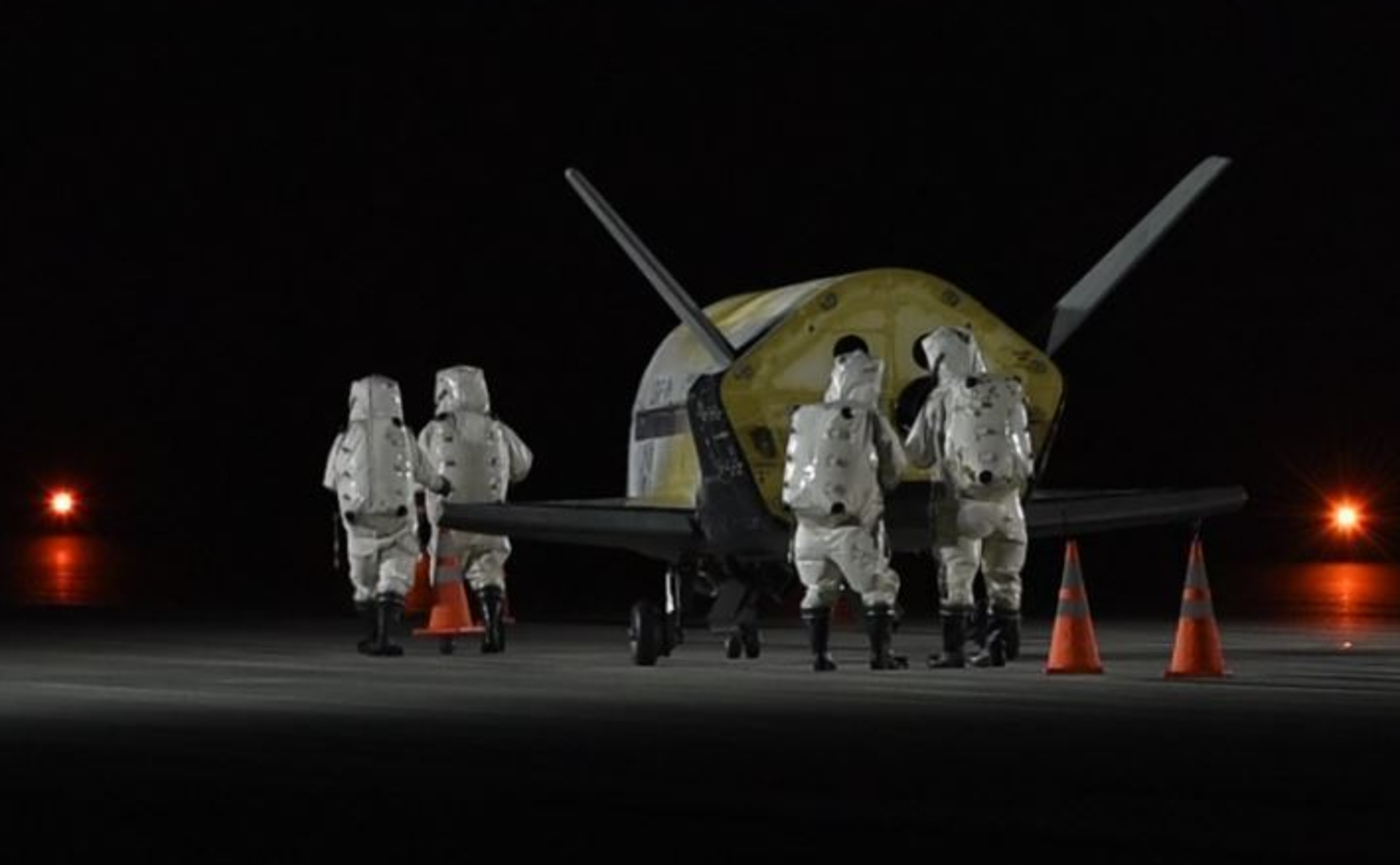
The U.S. military has since tested aerobraking around Earth. The U.S. Space Force’s X-37B spaceplane, which launched on its seventh mission into a highly elliptical orbit on a SpaceX Falcon Heavy, used atmospheric drag over multiple passes to change orbits with minimal fuel before it landed at Vandenberg Space Force Base, California, on March 7, 2025, after more than 434 days in space. X-37B program director Lt. Col. Blaine Stewart described the “novel aerobraking maneuver” as one of the mission’s main achievements.
The X-37B is a winged vehicle built to withstand reentry heating, and the Space Force has not said how long its aerobraking campaign took. DARPA’s interest in lightweight aeroshells and thermal protection suggests Anzio is aimed at giving similar capability to spacecraft that are not designed as spaceplanes, though the notice does not say what kinds of satellites the technology would serve or which military customers would use it.
The program will be handled under tight security. The industry day is classified at the Controlled Unclassified Information level and will include information restricted under the International Traffic in Arms Regulations, so attendance is limited to U.S. citizens and permanent residents representing U.S. companies, with no more than two people per company and no phones or electronic devices allowed in the room. The draft solicitation will also contain controlled information, and proposers must meet Cybersecurity Maturity Model Certification Level 2, which covers the 110 security requirements in NIST Special Publication 800-171.
Content preview only. Full article available at source. View Full Article
DARPA announced the Anzio program to develop technology allowing spacecraft to utilize Earth's atmosphere for orbit changes, reducing reliance on rocket fuel. The initiative, revealed on November 9, includes an industry day in Arlington, Virginia, on December 16-17. The program focuses on innovative aero-assist technologies, emphasizing thermal protection systems and lightweight aeroshells.
- DARPA is initiating the Anzio program to develop aero-assist technologies for spacecraft.
- The program aims to reduce propellant requirements for orbit changes.
- An industry day is scheduled for December 16-17 in Arlington, Virginia.
- The program will focus on thermal protection systems, control systems, and lightweight aeroshells.
- The initiative is classified and has strict attendance requirements.