
PLA Army KVD002 Drone Fires Live Ammunition at Unmanned Boat, Ground-Based Reconnaissance and Strike Integrated System Fires at Sea for the First Time
 Li Minghui
PLA Army KVD002 Drone Conducts Live Fire Against Unmanned Boat, Ground-Based UAVs Fire at Sea for the First Time
On August 6, in a training area off the southeastern coast, 13 KVD002 reconnaissance-strike integrated drones took off simultaneously. After the coastal defense forces detected a high-speed unmanned boat, they carried out a live-fire strike. This scene is from the CCTV documentary "Winning" Episode 2 "Transforming 'Land'," and was interpreted in a USNI News article on August 10, which believes this is the first public demonstration by the PLA Army of using armed drones to strike unmanned surface vessels (USVs).
What is KVD002?
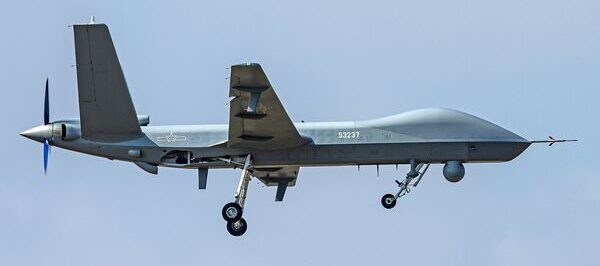
The KVD002 is the Army's first large medium-altitude long-endurance reconnaissance-strike integrated drone system, upgraded from the export version of the Rainbow-4B. It will enter combat units in 2026 and has been deployed in the Eastern, Western, and Southern Theater Commands, with at least 13 units stationed at a base in the south. It has a maximum takeoff weight of 1.33 tons, a payload of 350 kilograms, an endurance of over 30 hours, a range of about 3,500 kilometers, and a service ceiling of 9,000 meters, which is 2,000 meters higher than the export version. A key step was the replacement of the imported Austrian ROTAX 914F gasoline engine (85 kW) with the domestic DB416 heavy oil piston engine (120 kW), eliminating reliance on imports and solving the short takeoff and landing issues in high-altitude areas.
In simple terms, the KVD002 extends the strike radius of Army group armies from dozens of kilometers to over a thousand kilometers. It can carry AR-1 air-to-ground missiles (range 8-10 kilometers), FT-5 precision-guided bombs, loitering munitions, and electronic warfare pods, with four hardpoints under its wings.
What Makes Striking Unmanned Boats Difficult?
Interestingly, the most noteworthy aspect of this exercise was not the hit, but the "near miss." The target unmanned boat made high-speed maneuvers, and under the interference of sea spray, the onboard AI struggled to maintain a lock on the target. Ultimately, the operator switched to manual mode and corrected the 1% error that the machine could not calculate with human eyes, achieving a hit. This indicates that the Army has integrated the manual/automatic switching of human-machine collaboration into its combat processes, while also acknowledging that the automatic identification algorithms for small targets at sea still have shortcomings in complex sea conditions.
Where Did the Exercise Scenario Come From?
Foreign media analysis suggests that this scenario was not designed out of thin air. In June, the American unmanned boat company Seasats' "Light Fish" unmanned boat had a close encounter with a Chinese 052D destroyer in the Philippines' exclusive economic zone; on July 12, the U.S. Central Command used three Saronic "Pirate" unmanned boats to attack an Iranian repair facility. The infiltration of unmanned boats near the coast is precisely the most troublesome threat for the Army's coastal defense system—difficult to detect with radar and high interception costs. Using long-endurance reconnaissance-strike integrated drones to cover nearshore areas is the most cost-effective solution.
Boundaries Are Disappearing
A commentary in the CCTV documentary states: A missile has broken through the "wall" between the Army and the Navy.
In the past, maritime matters were the Navy's responsibility, and Army artillery could not reach the open sea. However, drones have transformed the battlefield into one with "no boundaries in the sky"—when the Army's drones fire at sea, who holds the command authority? According to old rules, the Navy should be notified, but by the time Navy aircraft arrive, the high-speed unmanned boat has already escaped. This exercise effectively answers that the Army has begun to assume the role of nearshore anti-unmanned boat operations, transforming the joint combat chain from "detect-report-wait" to "detect-handle on the spot."
From a production capacity perspective, the Rainbow-4 family has been exported to multiple countries, and the Army's drone brigade is expanding. The KVD002, with its "mid-tier platform + mature munitions" combination, is taking a different route from the U.S.—while the U.S. is developing expensive anti-unmanned boat weapons, the PLA has chosen to use low-cost, mass-deployable reconnaissance-strike drones to cover threats, resulting in a completely asymmetric cost structure.
However, I have a question: The KVD002 has a maximum speed of only 180 kilometers per hour. In the face of high-speed unmanned boats exceeding 30 knots, a long loiter time does not necessarily mean it can catch up. The exercise target was clearly a low-speed demonstration target. The real issue is not whether it can hit the demonstration boat, but whether the engagement channels for 13 KVD002s are sufficient to handle a "hellish scene" of swarming unmanned boats attacking. The documentary did not provide an answer.
On August 6, 13 KVD002 drones from the People's Liberation Army conducted live-fire exercises against a high-speed unmanned surface vessel in a training area off the Southeast Coast. This event marks the first public demonstration of the PLA's capability to engage naval targets with armed drones. The exercise revealed challenges in automatic target tracking under complex conditions, prompting manual intervention for successful engagement.
- 13 KVD002 drones were deployed in a live-fire exercise against a high-speed unmanned vessel.
- This marks the PLA's first public demonstration of using armed drones against unmanned surface vessels.
- The KVD002 drone has a maximum takeoff weight of 1.33 tons and a range of approximately 3500 kilometers.
- The exercise highlighted challenges in automatic target recognition in complex sea conditions.
- The PLA is adapting its operational procedures to include immediate responses to threats from unmanned vessels.