

Summary and Key Points: The Zumwalt-class destroyer was supposed to be a 32-ship fleet that would park off hostile coastlines and pound targets ashore with a pair of 155mm guns. Cost overruns cut the class to three ships, and the guns’ custom shells proved too expensive to use. Now the Navy is giving the stealthy hulls a second life as its first sea-based hypersonic strike platform. The catch is magazine depth: with a dozen missiles per ship, the Zumwalts could be spent in the opening days of a war with China.
The Great Zumwalt-Class Problem
The U.S. Navy’s Zumwalt-class destroyers are being transformed from an awkward shore bombardment experiment — an expensive and embarrassing venture — into the service’s first sea-based hypersonic strike platform.
Thanks to Conventional Prompt Strike (CPS), the ship has a potent new munition on the horizon, one that offers a very long-range conventional strike capability against well-protected, heavily defended targets.
The Great Challenge
When the Zumwalt-class was first conceived in the 1990s and early 2000s, it was intended to be much larger than today’s diminutive three-ship class.
They were also meant not to fire hypersonic missiles at distant targets, but rather to support disembarked troops ashore, dominating littoral waters with a pair of 155mm naval artillery pieces.
But that plan sank as the class ran into major cost overruns. The Advanced Gun System, which was designed to lob shells at land targets, proved too expensive to use in practice and contributed to the U.S. Navy’s decision to cancel the program.
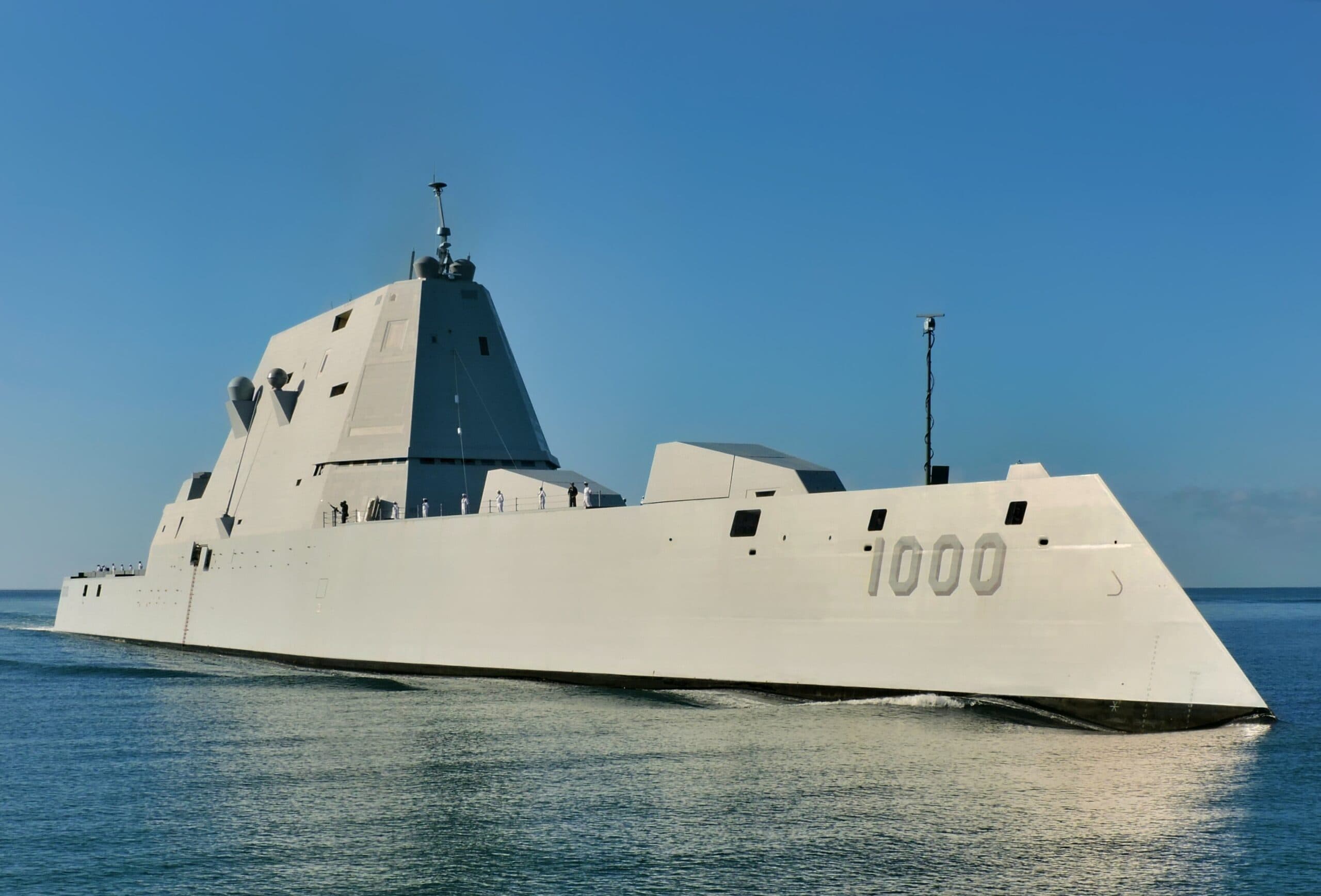
Zumwalt-Class Destroyer U.S. Navy. Image Credit: Creative Commons.
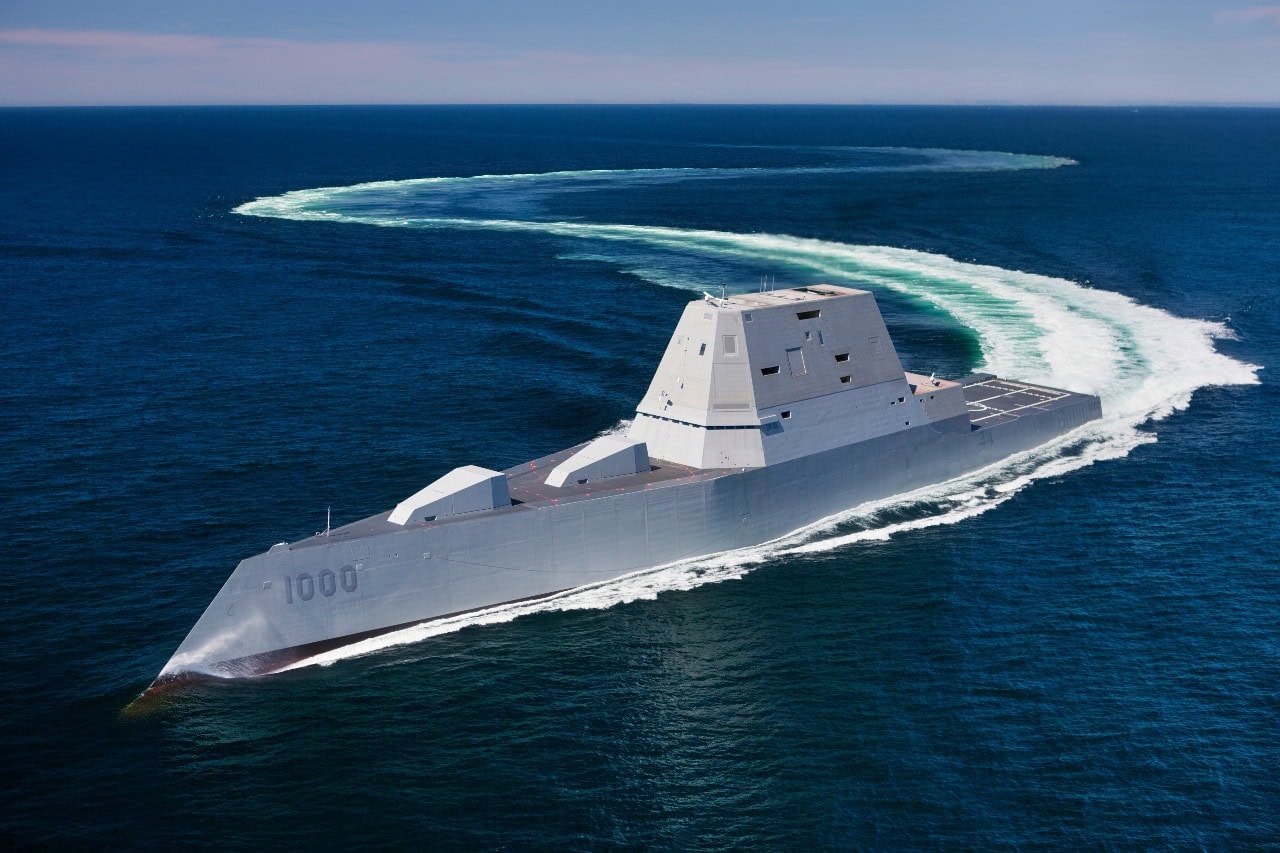
Zumwalt-Class Destroyer U.S. Navy.
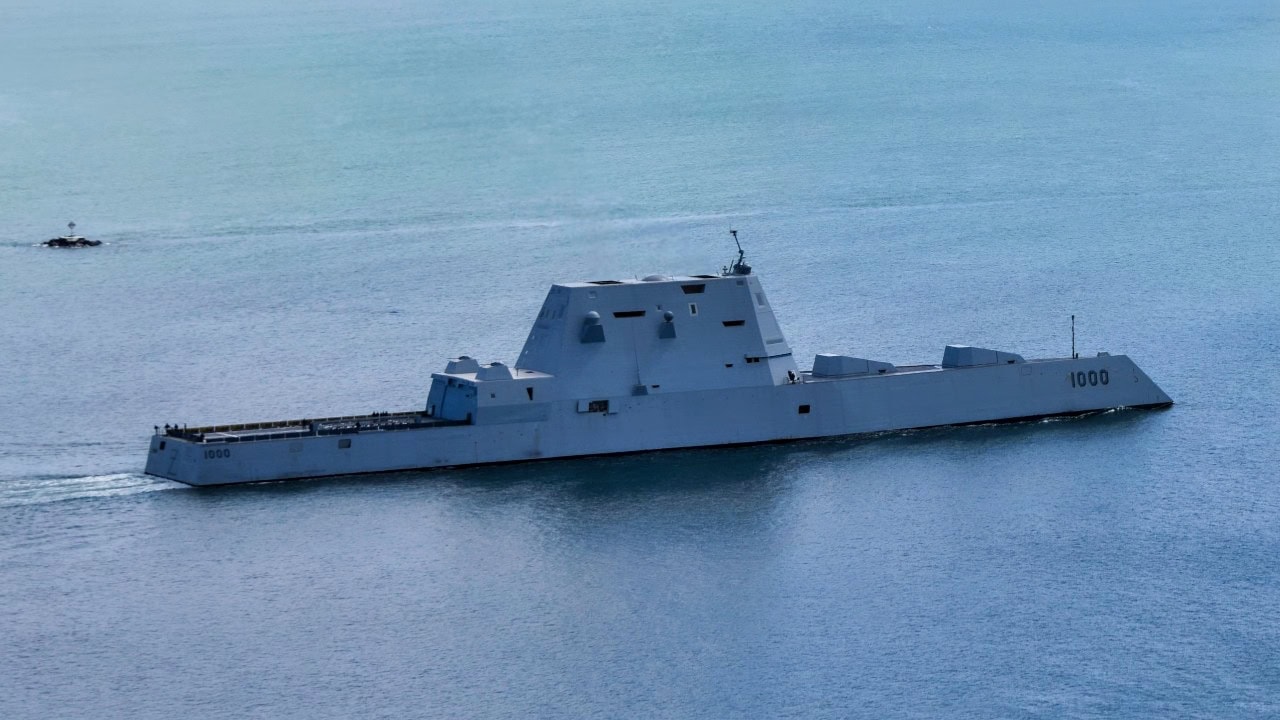
The Guided-missile destroyer USS Zumwalt (DDG 1000) departs San Diego as part of an operational underway. The milestone demonstrates the U.S. Navy’s commitment to advancing the lethality of its surface combatants by integrating cutting-edge technologies in Zumwalt’s combat systems, weapons, and engineering plants. (U.S. Navy photo by Mass Communication Specialist 2nd Class Natalie M. Byers)
Although the 155mm ammunition it fired was the same diameter as NATO-standard 155mm ammunition, it could not fire that artillery ammunition; instead, it required purpose-made shells that cost around $1 million each.
Because of massive cost overruns, the class was limited to three ships from the initially projected 32, and its role was eventually reassessed.
Today, the Zumwalt-class remains in service, though its role within the U.S. Navy has evolved dramatically into that of a stealthy naval strike platform.
Conventional Prompt Strike
Conventional Prompt Strike is a conventionally armed boost-glide hypersonic weapon intended to offer a rapid strike option against high-value, heavily defended targets or those with only small windows of opportunity.
The U.S. Navy plans to field Conventional Prompt Strike first on its three Zumwalt-class destroyers, then on Virginia-class submarines.
In tandem, the U.S. Army’s Dark Eagle, a land-based system, uses the same Common Hypersonic Glide Body, which ties both programs together.
Conventional Prompt Strike is therefore not a bespoke missile intended solely for destroyers, but a munition flexible enough to be operationally relevant to both the Army and the Navy.
The Zumwalt-class’ Transformation
On the Zumwalt-class, Conventional Prompt Strike alters its strategic implications. Once built to toss artillery shells close to shore, it could instead threaten targets hundreds or thousands of kilometers away and from outside the reach of adversary air defenses.
For the U.S. Navy, that gives the surface fleet a genuinely difficult-to-intercept kinetic option—and from a stealth hull designed from the outset to be hard to track.
That presents a concern for China.
The fear is not just Conventional Prompt Strike itself, but that missile’s ability to strike high-value targets at a moment’s notice, undetected from the Zumwalt-class launch platform.
One of the most significant limiting factors, however, to the Conventional Prompt Strike-Zumwalt-class teaming is scale.
Even when all three Zumwalt-class ships are outfitted with Conventional Prompt Strike, the total inventory of available Conventional Prompt Strike missiles will be modest — only a dozen missiles per ship.
While that is enough to complicate Chinese planning, it is not enough magazine depth to sustain long campaigns or overwhelm a major target set on its own.
There are also practical constraints.
The program has faced test delays, the Conventional Prompt Strike missiles are expensive, and the U.S. Navy has yet to establish how well Conventional Prompt Strike performs in a contest environment.
It also remains to be seen how quickly the U.S. can produce Conventional Prompt Strike missiles.
Rather than threatening Beijing with a massed hypersonic missile arsenal, the Conventional Prompt Strike and Zumwalt-class combination offers the U.S. Navy a small, hard-to-locate capability to strike a variety of targets with very little warning.
But in the early stages of a potential conflict, the rapid expenditure of Conventional Prompt Strike missiles could leave the Zumwalt-class with limited further utility.
MORE – Iran Used Mines to Attack the US Navy
MORE – The M250 – A Green Beret Gives Us His Take
About the Author: Caleb Larson
Caleb Larson is an American multiformat journalist based in Berlin, Germany. His work covers the intersection of conflict and society, focusing on American foreign policy and European security. He has reported from Germany, Russia, and the United States. Most recently, he covered the war in Ukraine, reporting extensively on the war’s shifting battle lines from Donbas and writing on the war’s civilian and humanitarian toll. Previously, he worked as a Defense Reporter for POLITICO Europe. You can follow his latest work on X.