
Resolute Dragon 26 Begins in the Southwestern Islands, Reassessing Japan-U.S. Island Defense
 Tanaka Takashi
Resolute Dragon 26 Begins Operations in the Southwestern Islands, Reassessing Japan-U.S. Island Defense
When names like Hibushidai, Amami, Miyako, Ishigaki, and Yonaguni line up in a training plan, the first thing to consider as a member of the Japan Maritime Self-Defense Force is the distance on the map. The Japan Ground Self-Defense Force will conduct a live training exercise called "Resolute Dragon 26" with the U.S. Marine Corps from June 20 to 30. According to the announcement from the Ground Staff Office, the purpose is to practice the coordination procedures for joint operations while following each country's command structure, thereby enhancing joint response capabilities.
The Training Area Extends from Kyushu to Yonaguni
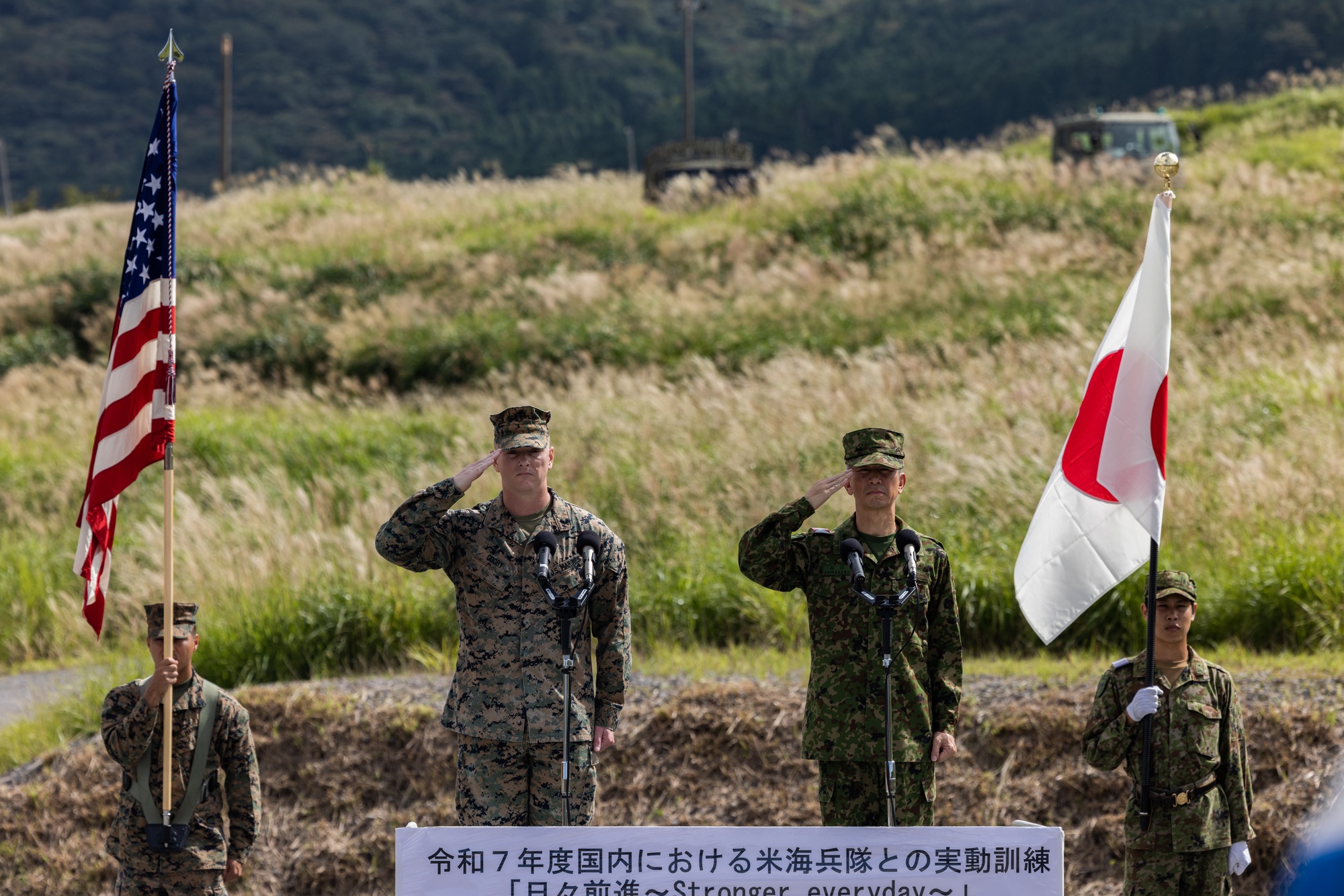
The notable feature of this exercise is not merely the number of participating units. Locations such as Hibushidai in Oita, Metabaru in Saga, Kengun in Kumamoto, Amami and Tokunoshima in Kagoshima, Miyako Airport and Ishigaki Airport in Okinawa, Ishigaki Port, and Yonaguni Airport are all listed. This training treats the southwestern islands as a line rather than isolated points, and in the author's view, it significantly tests the ability to maintain logistics across the strait.
On the Ground Self-Defense Force side, the Western Army Command will be the core, with the 8th Division, 15th Brigade, Ground Staff Office, various regional commands, Supply Headquarters, and the Air School participating. It is also important to note the inclusion of the Japan Self-Defense Force Maritime Transport Group as a joint unit and the Air Self-Defense Force Air Support Group as a support unit. While island defense takes the form of land combat, it is, in reality, a comprehensive operation that simultaneously manages ports, airports, transport aircraft, and transport vessels.
Significance of the 12th Marine Coastal Regiment and the 3rd Multi-Domain Task Force
The U.S. side will deploy the 3rd Marine Expeditionary Force, the 3rd Marine Expeditionary Brigade, the 3rd Marine Division, the 12th Marine Coastal Regiment, the 1st Marine Aircraft Wing, and the 3rd Marine Expeditionary Force Information Group. Additionally, the U.S. Army's 3rd Multi-Domain Task Force, the 7th Fleet, and the 18th Air Wing will also be involved. DVIDS describes Resolute Dragon as training to enhance command and control, multi-domain maneuver, and firepower effects in a distributed environment. In other words, the focus is not on "the Marines are coming," but rather on how quickly sensors, firepower, transport, and air support can be integrated.
This is different from the defense of Hokkaido during the Cold War. In Hokkaido, the front lines could be considered relatively continuous. In the southwestern islands, each island is a small base, and they are separated by the sea. For those protecting the SLOC (Sea Lines of Communication), a one-day delay in supply directly translates to a one-day shortage in firepower.
Concurrent Valiant Shield Casts a Shadow
From June 22 to July 1, a U.S.-led multinational exercise called "Valiant Shield 2026," announced by the Joint Staff Office, will also begin. This will take place in Japan, surrounding air and sea areas, Hawaii, and Guam, and will be conducted as a multinational exercise from 2024 onwards. USNI News reported that RD26 and Valiant Shield overlap in late June, and that the U.S. Army's Typhon medium-range missile system will be deployed to Japan.
According to Stars and Stripes, the 3rd Multi-Domain Task Force will deploy Typhon to the Japan Maritime Self-Defense Force Kanoya Air Base, and HIMARS will also be stationed at the same base. Typhon is a ground-based launch system capable of firing SM-6 and Tomahawk missiles, and live-fire exercises are not planned. However, if it is placed in the context of anti-ship warfare training in the waters around Kanoya and Amami, this is not merely a demonstration. It confirms the design philosophy of multilayered denial of enemy fleet approaches.
Strengthening Deterrence and Political Friction Progress in the Same Direction
The Ministry of Defense's explanation focuses on strengthening deterrence and response capabilities. There is nothing unnatural about this explanation. Considering the Chinese Navy's expansion into the western Pacific, military activities around Taiwan, and North Korea's missile capabilities, it is reasonable for Japan and the U.S. to train in dispersed firepower and joint command from Kyushu to the southwestern islands.
However, being reasonable and being readily accepted by the local community are two different issues. In Okinawa, Miyako, Ishigaki, and Yonaguni, parts of the training are explained as disaster relief and logistics support, but to the residents, it may appear as an expansion of military use of airports and ports. This cannot be filled solely by government public relations.
Evaluation by Takashi Tanaka
The essence of RD26 lies not only in "training to fight" in the southwestern islands but also in "training to transport without interruption." While the presence of Typhon is prominent, the more understated issues are port handling, air transport, the dispersion of supply depots, and information sharing between Japan and U.S. command centers. Firepower attracts political attention. However, what ultimately supports island defense is the often-invisible logistics and decision-making speed.
What concerns me more than the enemy's capabilities is our ability to explain ourselves. As the Japan-U.S. alliance enhances its effectiveness in the southwestern islands, political friction in peacetime will also increase. For deterrence to be successful, we must extend not only the range of missile capabilities but also the range of explanations to the local community.
Major Reference Materials
- Ground Staff Office "Overview of Live Training Exercise Resolute Dragon 26 with the U.S. Marine Corps for FY 2026" May 22, 2026
- Joint Staff Office "Participation in Valiant Shield 2026" May 22, 2026
- USNI News "Japan Announces 2 Major Western Pacific Exercises with U.S." May 25, 2026
- Stars and Stripes "US Army sending Typhon missile systems to southern Japan for upcoming drills" June 16, 2026
- DVIDS Resolute Dragon feature page
Japan Self-Defense Forces and U.S. Marine Corps are conducting the joint military exercise 'Resolute Dragon 26' from June 20 to June 30, 2026, across the southwestern islands of Japan. The exercise focuses on enhancing island defense capabilities and logistics, involving multiple units and equipment such as the Typhon missile system and HIMARS. Training locations include Nishinoomote, Amami, Miyako, Ishigaki, and Yonaguni.
- The exercise 'Resolute Dragon 26' is scheduled from June 20 to June 30, 2026.
- It involves numerous units from the Japan Self-Defense Forces and U.S. Marine Corps.
- The training areas include various locations in the southwestern islands of Japan.
- The exercise aims to enhance joint operational capabilities and logistics.
- The Typhon missile system and HIMARS will be deployed during the exercise.