
Romania's 2 Billion Euro SPYDER Purchase 2026 Highlights NATO's Eastern Air Defense Dilemma
 Dr. Klaus Weber
Romania's 2-Billion-Euro SPYDER Purchase in 2026 Highlights NATO's Eastern Air Defense Dilemma
3.049 billion lei for the first contract, around 2.038 billion euros for the entire framework program, and up to three years until the delivery of the first two VSHORAD systems: Romania's decision for Rafael SPYDER is not a footnote in the defense industry. It is a sober test case of how quickly a NATO frontline state can close its lower air defense layer when Russian drones strike along the Danube and European suppliers are politically desirable but not automatically available operationally.
According to Defense News and Defence Industry Europe, the Romanian Ministry of Defense has signed the first contract under a framework agreement concluded with Rafael Advanced Defense Systems in July 2025. The total value is approximately 2.038 billion euros excluding VAT. The package includes integrated SHORAD/VSHORAD systems, additional short-range and very short-range systems, ammunition, training, simulation, logistical support, and industrial cooperation in Romania. Rafael describes the program as the largest contract in the company's history.
A Procurement Decision Driven by Operational Pressure
The temptation is great to classify this purchase as further evidence of the rearmament along NATO's eastern flank. That would be too simplistic. Romania is not buying SPYDER because it lacks strategic rhetoric, but because it lacks tactical density. The experience of the Ukraine war has shown that the most dangerous airspace does not only begin at 20,000 feet. It often lies between treetop height and medium altitude, where Shahed drones, cruise missiles, guided munitions, and occasionally misdirected or crashing systems test the political boundaries of an alliance.
In recent months, Romania has repeatedly reported Russian drone activity near its border with Ukraine. Particularly the region around Tulcea, Sulina, Galați, and the Danube ports illustrates the problem: A NATO member cannot plan Patriot missiles for every small, slow-moving target and still credibly claim to have a sustainable air defense architecture. Patriot remains indispensable for ballistic threats and larger aerial targets. But Patriot is too expensive, too scarce, and operationally too valuable to serve as a one-size-fits-all tool against every drone.
SPYDER Fills a Real Gap
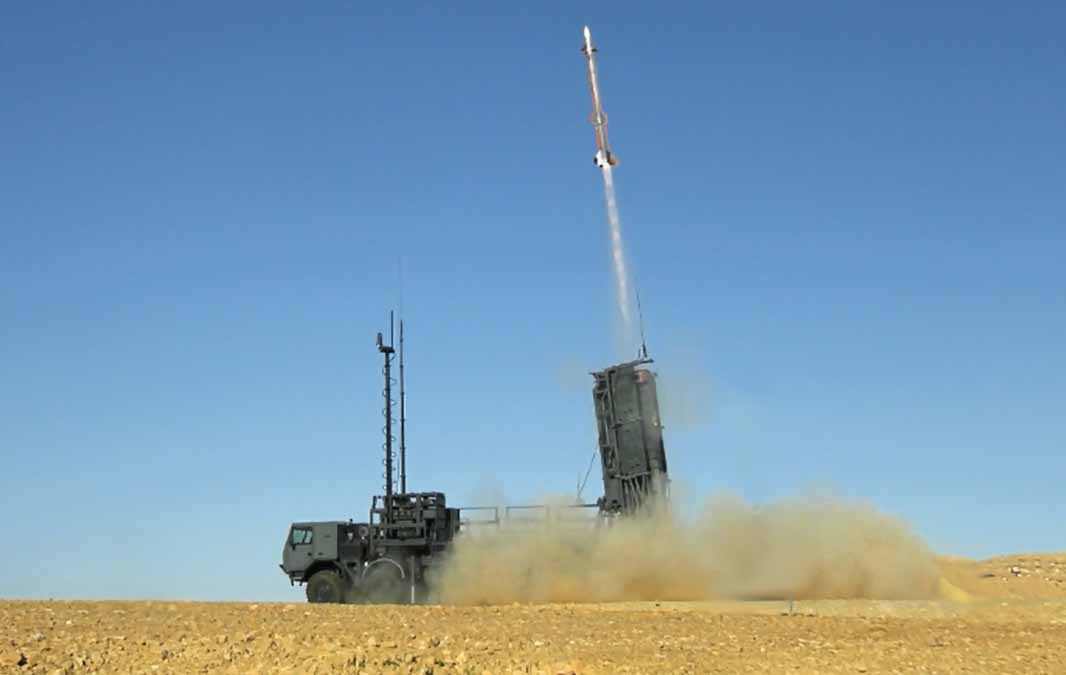
SPYDER is based on the Israeli air-to-air missiles Python-5 and Derby, or I-Derby, which have been adapted for ground launch. Depending on the configuration, the system can engage aircraft, helicopters, drones, cruise missiles, and precision-guided munitions. Defense News cites a range of up to 40 kilometers and an interception altitude of up to 12 kilometers for the variant in question; Defence Industry Europe additionally refers to a Romanian configuration with Python-5 and I-Derby, where the ranges vary depending on the missile and system design.
More important than the maximum range is the system logic. A mobile SHORAD/VSHORAD network protects airfields, bridges, command posts, ports, ammunition depots, and maneuvering units. It relieves the upper layer of air defense and forces the opponent to expend more sensors, more saturation, and more planning for a successful attack. This very density is lacking in many European armed forces. Since the end of the Cold War, short-range air defense has been treated as a lower priority because NATO operations were usually planned with air superiority. Ukraine has shattered this assumption.
The European Autonomy Claim Collides with Delivery Reality
The politically interesting point is not that Romania is buying. The interesting point is from whom Romania is buying. An EU and NATO state opts for an Israeli system, even though European suppliers exist in this segment. This is not a scandal, but a diagnosis. When Bucharest turns to Rafael after a tender, frontline experience, and time pressure, it says more about the European supply situation than about Romanian preferences.
The European Union has been talking about strategic autonomy for years, about the European Defence Fund, about joint procurement, and about expanding industrial sovereignty. At the same time, states on the eastern flank must procure systems that can be delivered in three years, fit into existing NATO architectures, and address the actual threats. In this triangle, abstract industrial policy regularly loses out to available technology. This is uncomfortable for Brussels, but it is not irrational behavior on the part of frontline states.
Romania particularly illustrates this ambivalence. Bucharest is modernizing a multi-layered air defense structure with Patriot, F-16, Gepard, Mistral, Skyranger, Chiron, and now SPYDER. This is operationally sensible but institutionally fragmented. Each additional country of origin brings its own supply chains for spare parts, training logics, software interfaces, and political dependencies. The question is not whether SPYDER is good. The question is whether Europe is building an air defense or a collection of national emergency purchases that must be painstakingly coordinated in a crisis.
NATO Benefits Immediately, Europe Learns Slowly
For NATO, the Romanian purchase is positively impactful in the short term. The Black Sea region is one of the most vulnerable flanks of the alliance. Russia can exert pressure there with drones, missiles, electronic warfare, and maritime operations without necessarily crossing the threshold of an open attack on NATO territory. More Romanian short-range air defense increases the resilience of local infrastructure and reduces the risk that a single incident will immediately escalate into a crisis for the alliance.
For Europe, the lesson is more uncomfortable. The debate over 3.5 percent or 5 percent defense spending does not automatically answer which systems will be delivered when and in what quantities. More money creates political leeway, but not immediate interoperability. Romania can close a gap because it has found a supplier. Europe can only close its structural gap when joint air defense exists not just as a summit formula but as a production, training, and maintenance regime.
The SPYDER contract is therefore less a triumph of Israeli export policy than a European mirror: The threat is integrated, procurement remains national.
A Necessary Purchase with a Strategic Aftertaste
Romania should not be criticized for this decision. A state on the Danube cannot wait for the European defense industry to resolve its governance issues. It must protect ports, cities, airfields, and units. But therein lies the paradox. The more rationally national frontline states act, the more visible the inadequacy of the European level becomes. Strategic autonomy does not fail because of a single non-European purchase. It fails when such purchases become the normal method of closing European capability gaps.
Romania's SPYDER program will strengthen NATO's eastern flank. It will likely also protect lives and critical infrastructure. But it does not answer the fundamental institutional question: Why does a European frontline state in 2026 need a non-European billion-euro contract to close an air defense gap that Europe should have prioritized since 2014?
Sources: Defense News, Defence Industry Europe, Army Recognition, Rafael information according to manufacturer communication and Romanian procurement framework.
Romania is purchasing SPYDER air defense systems to enhance its lower air defense layer against threats from Russian drones. The contract, valued at approximately 2.038 billion euros, includes two VSHORAD systems and is expected to be delivered by 2026. This decision reflects Romania's response to increased Russian drone activity near its border and highlights challenges in European defense procurement and strategic autonomy.
- Romania signed a contract for SPYDER systems worth approximately 2.038 billion euros.
- The systems are expected to be delivered within three years.
- The purchase is a response to increased Russian drone activity near Romania's border with Ukraine.
- SPYDER systems will enhance Romania's air defense capabilities against low-altitude threats.
- The procurement reflects a broader issue of European defense procurement and strategic autonomy.