
Russia's 681-Munition Strike Exposes Ukraine's Patriot Trap
 Alexandra Reeves
Russia's 681-Munition Strike Exposes Ukraine's Patriot Trap
Russia just gave the G7 a very expensive air-defence problem to look at. Everyone around the table already knew Ukraine needed more Patriots, more interceptors and more layered defences. The difference after the night of 14-15 June is that Moscow put the arithmetic on fire over Kyiv.
According to Ukraine's military, cited by the Guardian, Russia launched 70 missiles and 611 drones overnight. Ukrainian air defence said it shot down 50 missiles and 582 drones. That is an impressive defensive performance by any sane measure. It is also the wrong comfort to take from the attack.
The weapons that got through still killed civilians, damaged the Dormition Cathedral inside the UNESCO-listed Kyiv Pechersk Lavra, hit cultural sites and forced Poland, a NATO member, to scramble fighters and put ground-based air defences on heightened readiness. A 92 percent interception rate can still be a strategic failure if the remaining 8 percent lands in the right place.
The Barrage Was Designed To Break The Ledger
The strike package matters. Russia did not simply fire a few missiles at Kyiv. It mixed ballistic missiles, cruise missiles and hundreds of one-way attack drones into a single pressure event. Ukrainian reporting identified the missile mix as including Iskander-M or S-400 ballistic missiles, Kh-101 and Iskander-K cruise missiles, and several 3M22 Zircon hypersonic cruise missiles. Those categories do different things to a defender.
Shahed/Geran drones are slow, noisy and increasingly familiar to Ukrainian crews. But they are cheap enough to be thrown into the sky by the hundreds. Ballistic missiles are the opposite problem: fast, scarce, and deadly if the defender lacks a system built for terminal ballistic interception. Cruise missiles sit in the middle, forcing radar coverage, fighter patrols and ground-based interceptors to compete for attention.
This is why President Volodymyr Zelenskyy used the attack to ask G7 leaders for more support for Ukraine's air defence, especially anti-ballistic capabilities. That phrase was not decorative. Kyiv can build more mobile gun teams, electronic warfare units and interceptor drones for the Shahed layer. It cannot improvise a Patriot battery in a workshop outside Lviv.
Patriot Is A Lifesaver And A Bottleneck
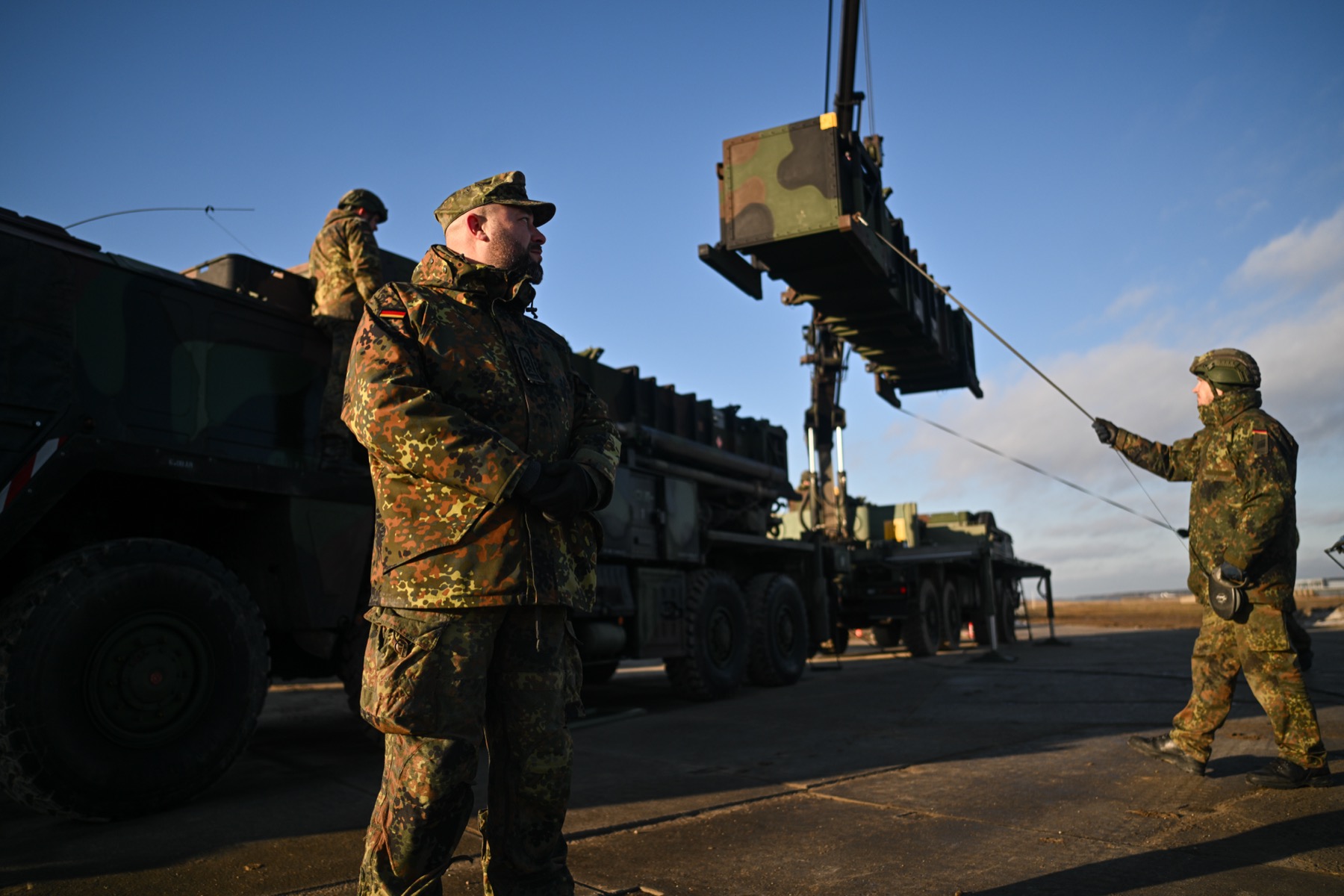
The Patriot system has earned its reputation in Ukraine. CSIS Missile Threat describes Patriot as the U.S. Army's primary air and missile defence system, with newer variants able to engage ballistic missiles, cruise missiles, loitering munitions and aircraft. In Ukraine, Patriot became famous for doing something many observers once doubted: intercepting Russian Kinzhal aeroballistic missiles over Kyiv in 2023.
But that success created a political trap. Once Patriot proved it could protect Kyiv from the hardest Russian threats, it became the standard answer to every major Russian missile raid. The system is no longer just a weapon; it is a symbol of whether NATO can keep Ukraine alive under sustained strategic bombardment.
Here is the uncomfortable part. Patriot is not a national air shield. It is high-end point defence. Batteries can protect capitals, key command nodes, airfields or energy infrastructure. They cannot cover every city, rail hub, power station and cathedral in a country the size of Ukraine. Every time Russia builds a larger mixed strike package, Kyiv must decide what deserves the best interceptors and what must rely on cheaper, thinner layers.
That is not a Ukrainian failure. It is the logic of the system. PAC-3 interceptors use hit-to-kill technology to defeat agile targets; PAC-3 MSE extends the defended area. They are exquisite because the targets are exquisite. They are also costly, slow to produce and politically competed over by the United States, Europe, the Middle East and Indo-Pacific allies. Ukraine is fighting inside a global queue.
Russia Is Betting On Saturation
Russia's drone campaign is not random cruelty, though it is certainly cruel. CSIS has described Moscow's Shahed campaign as a saturation effort using inexpensive drones to exhaust Ukrainian air defences and civilian morale. The Institute for Science and International Security reported that May 2026 set a new peak, with Russia launching 8,161 Shahed-type UAVs, including an estimated 5,181 Shahed/Geran strike drones. The same analysis argued that Russia was compensating for declining strike efficiency with larger attack packages.
That sentence is the war in miniature. If individual drones are getting less effective, launch more of them. If Ukraine jams or shoots down most of them, force Ukraine to spend time, missiles, fuel, radar hours and sleep doing it again tomorrow. If the cheap drones absorb the defensive network, use ballistic missiles to punch through the expensive layer.
The Kyiv Pechersk Lavra strike also showed how the information fight follows the weapons pattern. Russia denied targeting the cathedral and blamed a U.S.-made Patriot missile. Ukraine's Security Service said debris analysis showed a Russian Geran-2, the Russian version of the Iranian-designed Shahed, hit the site at 01:50 on 15 June, with components marked from Russia's Alabuga production zone. Moscow's claim will not convince Kyiv, but it may give hesitant Western politicians another excuse to slow decisions that were already too slow.
The NATO Question Is Not Charity
There is a lazy version of this debate that treats Patriot transfers as charity for Ukraine. That misses the bigger lesson. Russia is running a live experiment against a NATO-standard air defence problem: how to overwhelm a mixed Western-style network with cheap drones, decoys, ballistic missiles and cruise missiles. Kyiv is the test range, but Warsaw, Bucharest, Rzeszow and the Baltic capitals are taking notes because they have to.
Poland's response during the raid was telling. It did not wait for philosophical clarity. It scrambled aircraft and raised air-defence readiness because Russian mass strikes near NATO airspace have already produced debris, airspace scares and political pressure along the eastern flank. For NATO, Ukraine's air-defence shortage is a preview of what happens when Russia learns to make saturation routine.
The alliance therefore has three tasks, and none is optional. First, move more Patriot-class capacity and interceptors to Ukraine without pretending this is easy. Second, accelerate cheaper counter-drone layers: interceptor drones, electronic warfare, guns, acoustic detection and short-range missiles that do not burn million-dollar rounds on cheap targets. Third, strike the production logic behind the campaign through sanctions, component controls and support for Ukrainian long-range attacks against launch sites and factories.
The Bad Answer Is Still The Answer
The June 15 raid did not prove Ukrainian air defence is failing. It proved the opposite: Ukraine is very good at a task no country should have to perform nightly. But Russia does not need every weapon to get through. It needs enough weapons to force terrible allocation choices and enough spectacle to shake Western attention.
The immediate watch points are clear. Does the G7 produce new anti-ballistic commitments, or only another sanctions paragraph? Do European states move actual batteries and interceptors, or talk about future production? Does Ukraine get more authority and support to hit the Alabuga-style production chain feeding the drone war?
Everyone says Patriot is scarce. That is true. It is also the answer Russia wants NATO to hide behind. Scarcity is not a strategy. It is a confession that Moscow found the alliance's thinnest layer and is now firing 681 reasons through it.
Russia launched a large-scale missile and drone strike against Kyiv on 14-15 June 2023, deploying 70 missiles and 611 drones. Ukrainian air defense successfully intercepted 50 missiles and 582 drones, but the attack still resulted in civilian casualties and damage to cultural sites. The incident prompted Poland to increase its air defense readiness and highlighted Ukraine's urgent need for enhanced air defense capabilities from NATO allies.
- Russia launched 70 missiles and 611 drones in a single night strike against Ukraine.
- Ukrainian air defense intercepted 50 missiles and 582 drones, achieving a 92% interception rate.
- The strike caused civilian casualties and damage to significant cultural sites in Kyiv.
- The attack prompted Poland to scramble fighters and heighten air defense readiness.
- Ukraine's President Zelenskyy called for increased support for air defense systems from G7 leaders.