
Semtex Drone at Leipzig Airport and 250 Percent More Scrambles — Russia Tests NATO Below the Threshold of Collective Defense
 Dr. Klaus Weber
Semtex Drone at Leipzig Airport and 250 Percent More Scrambles — Russia Tests NATO Below the Alliance Threshold
On August 5, 2026, a drone loaded with Semtex was found on the runway of Leipzig/Halle Airport — near an Antonov An-124 of the Ukrainian Antonov Airlines, whose cargo consisted of military ammunition flown in from France. A day later, NATO Joint Force Command Brunssum reported an increase in fighter jet operations on the eastern flank of more than 250 percent compared to July 2025. Both reports are connected. They demonstrate how Russia is testing NATO in the summer of 2026: not with an invasion, but with actions below the threshold for which the alliance's Article 5 is designed.
The Incident in Leipzig — A New Attack Scenario
What happened in Leipzig was no coincidence. A modified FPV drone was found next to an Antonov An-124 cargo plane; a second, unknown drone collided with a landing DHL aircraft. After evaluating police reports by the Süddeutsche Zeitung, it was determined that military ammunition was still on board the Antonov when the drone was discovered. The drone itself carried Semtex, a military explosive.
German Interior Minister Alexander Dobrindt referred to a "hybrid attack scenario." The statement is more precise than it sounds: "We are familiar with drone threats, including hybrid threats, from the past. But the fact that an explosive-laden drone is on airport grounds is a new threat scenario." He did not name Russia — because the evidence allows for it not to be named. This is precisely where the institutional explosive power lies.
The Warning from Washington
On August 6, the Wall Street Journal reported, citing U.S. intelligence sources: Washington now considers it possible that Putin could provoke a NATO nation with a limited attack as early as this fall — the window extends until 2029. Until now, the assessment was that Russia was too occupied with the war in Ukraine. The new warning aligns with European voices: Lieutenant General Christian Freuding, commander of the German Army, had already warned in June that Russia could develop the capability for attacks on NATO states within three years.
The logic behind this is sobering. Lithuania's Defense Minister Robert Kaunas articulated it on August 6: "The Kremlin, Putin, needs a new escalation, some kind of new victory — and in this case, the Baltic region and Poland are the next targets."
The False-Flag Scenario — Ukrainian Drones as Russian Munitions
Kaunas' warning continued: Lithuania has data indicating that Russia is considering unconventional kinetic attacks on critical infrastructure in the Baltics — and likely intends to use drones of Ukrainian production for this purpose. This is the most insidious variant of the gray zone. For months, Ukrainian long-range drones intended to attack Russian oil refineries have been deviating from their course due to Russian GPS jamming; in March 2026, drones landed in Latvia and Estonia, and in September 2025, 21 drones without explosives entered Polish airspace. If tomorrow a "Ukrainian" drone hits Lithuanian infrastructure — who decides whether it was an accident, a Ukrainian mistake, or a Russian attack?
"We have data that Russia is considering unconventional kinetic attacks on critical infrastructure in the Baltic region. Russia will likely use drones of Ukrainian production for this." — Robert Kaunas, August 6, 2026
NATO does not answer this question. Article 5 presupposes an armed attack but does not define who decides when the attack is constructed in such a way that attribution becomes politically unfeasible. A "Ukrainian" drone over Vilnius is not a case for the North Atlantic Council — it is a case for the press department.
250 Percent More Scrambles Are a Reaction, Not Deterrence
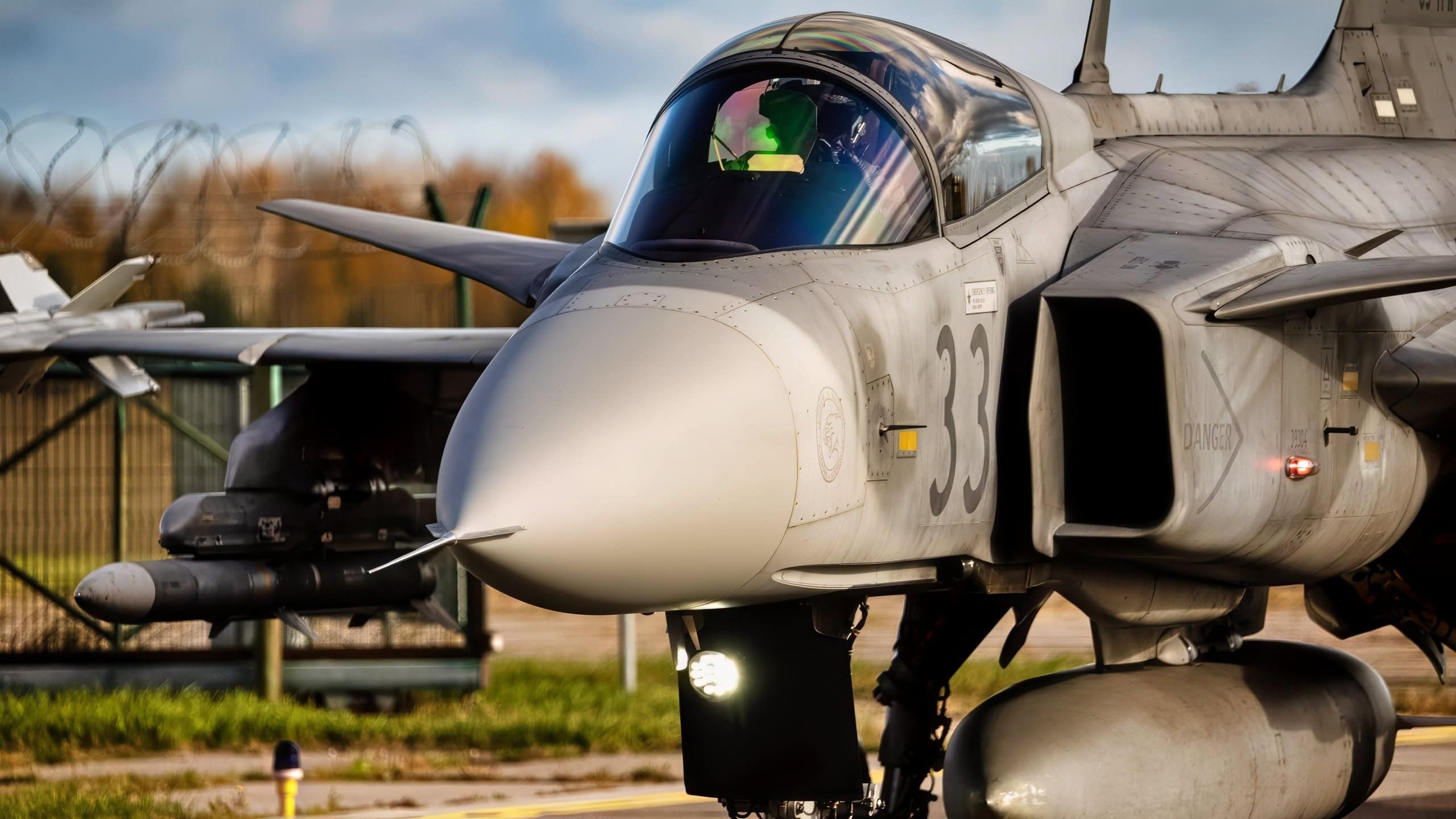
The figures from Joint Force Command Brunssum confirm the pattern: Alpha scrambles on the eastern flank increased by more than 250 percent in July 2026 compared to the previous year. Russian aircraft are flying to the border of the alliance's airspace without flight plans and without transponders; most recently, the Polish Air Force intercepted an Il-20 over the Baltic Sea on July 31. "Every scramble proves that we are vigilant," the alliance stated. This is true — and that is precisely the problem. Vigilance is the most expensive form of defense: it consumes flight hours, fuel, and political attention without eliminating the source of the test. NATO is reacting; Russia determines what is reacted to.
The Real Crisis — Munitions Stocks Instead of Deterrence Architecture
The situation is exacerbated by the material situation. The Wall Street Journal reports low stocks of critical U.S. munitions — Patriot and THAAD interceptors — following the war against Iran. President Trump responded to Zelensky's request for missiles on August 6: "We also need missiles." Deliveries of air defense missiles to Ukraine fell by two-thirds in the first half of 2026 compared to 2025. The attack on Kyiv on August 5 — 24 ballistic and four hypersonic missiles, none intercepted, at least 17 dead — shows what this concretely means.
And here the circle closes. NATO has reformed command structures, force models, and funding instruments in recent years — but has not established a common definition of what an attack below the threshold is and how to respond collectively. As long as Leipzig is negotiated as a "hybrid scenario" by the interior minister of a member state and not as an alliance issue, the gray zone remains Russia's most successful weapon system of 2026. The alliance case does not begin with the first invasion but with the first drone, about whose origin the alliance cannot agree — and this is precisely the moment Moscow is currently testing.
A Semtex-laden drone was discovered at Leipzig Airport on August 5, 2026, prompting NATO to report a 250% increase in fighter jet scrambles. This incident is part of a Russian strategy to test NATO's response capabilities without triggering Article 5. Lithuanian officials indicated that Russia may use Ukrainian drones for attacks on critical infrastructure in the Baltic region, complicating attribution of such incidents.
- A Semtex-laden drone was found at Leipzig Airport near a Ukrainian cargo plane.
- NATO reported a 250% increase in fighter jet scrambles on the eastern flank.
- The incident is part of a broader Russian strategy to test NATO below the threshold of Article 5.
- Lithuanian officials warned of potential Russian attacks using Ukrainian drones.
- The NATO response is characterized as reactive rather than preventive.