
The Japan-U.S.-Australia training of 19 aircraft including F-22 and F-35A enhances air defense posture east of Okinawa.
 Tanaka Takashi
Training of 19 Aircraft Including F-22 and F-35A Enhances Air Defense Posture East of Okinawa
On May 21, the combination of aircraft lined up over the Pacific east of Okinawa was not just a friendly flight. According to the Joint Staff Office, the Japan Air Self-Defense Force deployed four F-15s from the 9th Air Wing and one RC-2 from the Air Warning and Control Wing. The U.S. military contributed three F-22s, four F-35As, two F/A-18s, two KC-135s, one KC-130, and the Royal Australian Air Force sent one P-8A and one KC-30A. In total, there were 19 aircraft.
What the 19-Aircraft Formation Signifies
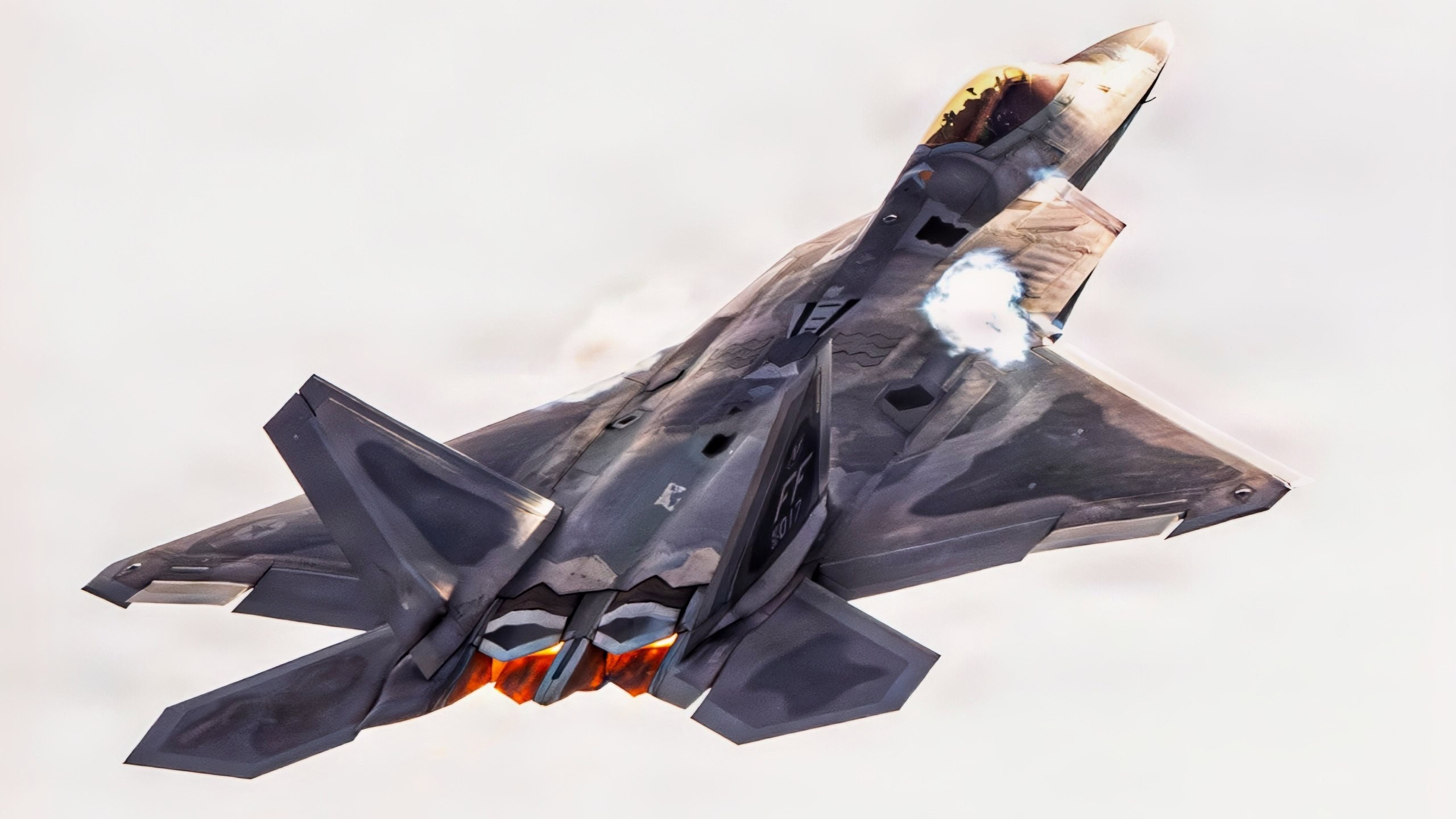
What I find noteworthy is not just the number of fighter jets, but the fact that aerial refueling, electronic intelligence gathering, and maritime patrol were all placed in the same training airspace. While the F-22 and F-35A have low detectability, that alone does not maintain an air defense line. The RC-2 reads the electromagnetic environment, the P-8A monitors movements on the sea surface, and the KC-135, KC-130, and KC-30A extend the time in the air. This combination should be viewed as training to maintain a continuous alert zone outside the first island chain, rather than just temporary air superiority east of Okinawa.
F-22 Rotation at Kadena
On May 6, U.S. Indo-Pacific Command announced that F-22s from the 90th Fighter Squadron in Alaska and the 27th Fighter Squadron in Virginia had arrived at Kadena Air Base. While it is natural to describe this as a fighter rotation to fill the gap until the deployment of the F-15EX, judging by the training on May 21, the purpose is not merely to fill a void. An experiment is underway to combine the capabilities of the 18th Wing at Kadena, the Japan Air Self-Defense Force's Naha Base, and the Royal Australian Air Force's patrol and refueling capabilities in a short cycle.
As someone from the Japan Maritime Self-Defense Force, I would say this is not only an air operation but also a matter of SLOC (Sea Lines of Communication) defense. The airspace east of Okinawa acts as a cover for maritime forces moving from the Nansei Islands to the Philippine Sea. Therefore, looking only at the F-22 does not capture the reality. Rather, the extent to which refueling and patrol aircraft can naturally integrate will determine the endurance of a prolonged conflict.
Time Lag in Confirming Chinese 054B
Two days before this training, the Japan Maritime Self-Defense Force confirmed the presence of the Chinese Navy's Jiangkai III-class frigate, specifically the 054B type, the Luhe ship 545, and the Fuyu-class supply ship 901. The Joint Staff Office stated that this was the first time the JMSDF had confirmed the class while monitoring it. Both ships moved south from about 520 kilometers northwest of Kume Island, passing between Okinawa Island and Miyako Island into the Pacific Ocean.
This suggests something significant. The 054B holds meaning not just in its individual performance but in conjunction with the 901-class supply ship. If China's capabilities to conduct anti-submarine, air defense, and escort missions in the open sea improve, Japan will need more than just short scramble responses or single training exercises. The Japan-U.S.-Australia training on May 21 coincided closely with this event, making it well-suited to the operational environment, even if coincidental.
Run-up to Valiant Shield 2026
On the same day, May 22, the Joint Staff Office announced that the JSDF would participate in Valiant Shield 2026 from June 22 to July 1. The training locations will include Self-Defense Force and U.S. military facilities within Japan, Ishinomaki City in Miyagi Prefecture, Amami City and Ryukyu Town in Kagoshima Prefecture, surrounding air and sea areas, as well as Hawaii and Guam. The arrangement connecting not only the Nansei Islands but also Tohoku, Hawaii, and Guam likely reflects an awareness of dispersed operations across the entire theater.
However, one should not be overly optimistic here. While the aircraft types of Japan, the U.S., and Australia are advanced, what becomes problematic in a crisis is not the performance of the aircraft but the coordination of airspace, the prioritization of refueling, and the scope of electronic information sharing. In particular, how quickly the information gathered by the RC-2 and P-8A can be relayed to Japan's air defense command and the strike and patrol missions of the U.S. and Australia is a practical aspect that is not visible from the published materials.
The 19 aircraft on May 21 were well organized as a show of deterrence. However, the true challenge lies not in how many stealth fighters can be lined up, but in how many days a modest formation, including refueling and information aircraft, can be sustained under political constraints.
Sources
- Japan Joint Staff, May 22 2026, Japan-U.S.-Australia Trilateral Exercise.
- Japan Joint Staff, May 22 2026, Participation in Valiant Shield 2026.
- Japan Joint Staff, May 20 2026, The activity of Chinese Navy vessels in waters surrounding Japan.
- USNI News, Western Pacific Pulse, May 22 2026.
- U.S. Indo-Pacific Command, F-22 Raptors arrive in Japan, May 6 2026.
On May 21, 2026, a joint training exercise involving 19 aircraft from Japan, the U.S., and Australia was conducted in the Pacific Ocean east of Okinawa, focusing on air defense operations. The exercise included F-22s, F-35As, and various support aircraft, enhancing regional air defense capabilities. This training followed the detection of Chinese naval vessels nearby and precedes Japan's participation in Valiant Shield 2026 in June.
- 19 aircraft participated in the training exercise including F-22s and F-35As.
- The exercise aimed to enhance air defense capabilities in the Okinawa region.
- The training involved air refueling, electronic information gathering, and maritime patrol.
- The exercise occurred shortly after the detection of Chinese naval vessels in the area.
- Japan Self-Defense Forces will participate in Valiant Shield 2026 from June 22 to July 1.